
HomeIndustryRenewable EnergyDirectional Management of Interface Defects Achieved in Perovskite Solar Cells

    Directional Management of Interface Defects Achieved in Perovskite Solar Cells

    Organic-inorganic halide perovskite materials have excellent optical capture capacity and carrier conductivity. Perovskite solar cells, with amazing power conversion efficiency, show great application prospects. However, a large number of unfavorable defects, growing up after or during the annealing process due to their ionic nature, would lead to sites of nonradiative recombination and accelerate the degradation of device efficiency and stability.

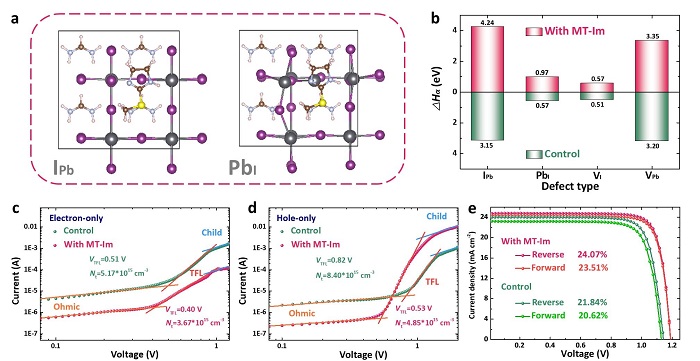
    A research team led by Pan Xu from the Hefei Institutes of Physical Science (HFIPS) of the Chinese Academy of Sciences (CAS), cooperating with Zheng Haiying from Anhui University, has achieved high-efficiency perovskite solar cells by passivating interface defects using new-type low-dimensional perovskite.


    The researchers passivated and stabilized the perovskite light-absorbing layer with amphoteric heterocyclic cation, and designed a new-type low-dimensional perovskite passivation layer.

    They found that the new perovskite, due to its amphoteric properties and strong molecular interaction, was able to deal with different surface-terminating ends and exhibited a variety of passivation effects.

    According to the theoretical calculation of defect formation energy, the formation of lead-based defects was effectively inhibited. The modified perovskite solar cells displayed reduced defect density and lowered nonradiative recombination, thereby resulting in a power conversion efficiency of over 24%. In addition, the long-term stability against humidity, high temperature, and light was improved.

    ELE Times Research Desk
    ELE Times Research Deskhttps://www.eletimes.ai
    ELE Times provides extensive global coverage of Electronics, Technology and the Market. In addition to providing in-depth articles, ELE Times attracts the industry’s largest, qualified and highly engaged audiences, who appreciate our timely, relevant content and popular formats. ELE Times helps you build experience, drive traffic, communicate your contributions to the right audience, generate leads and market your products favourably.

    Related News

    Must Read

    How Ethernet accelerates the move to software-defined vehicles

    By: Madison Ecklund, systems manager, Body Electronics & Lighting A...

    Intel Foundry Advances Chip Power Delivery with Next-Generation Capacitor Technology

    Courtesy: Intel Highlights Intel and Intel Foundry researchers demonstrated three...

    Keysight Partners with 3dB Labs to Enable Interoperable Signal Monitoring and Analysis

    Keysight Technologies announced the integration of its spectrum analysers...

    India to Boost Local Chip-making with a 1 Trillion Rupees Funding

    India is expected to unveil a funding of more...

    Qualitas Semiconductor Picks Anritsu’s Vector Network Analyzer for High-Speed Interconnect Signal Integrity Verification

    Qualitas Semiconductor Co., Ltd., a leading developer specialising in...

    The Tomorrow for AI and India’s edge advantage

    Courtesy: Qualcomm Artificial intelligence is entering its next chapter, one...

    Posifa Technologies Introduces PVC4001-C MEMS Pirani Vacuum Transducer for Wide-Range Vacuum Measurement

    Posifa Technologies has introduced its new PVC4001-C MEMS Pirani vacuum...

    STMicroelectronics to support AI infrastructure demand with high-volume production of its industry-leading silicon photonics platform

    STMicroelectronics is now entering high-volume production for its state-of-the-art...

    Impact of AI on Computing and the Criticality of Testing

    Courtesy: Teradyne Artificial intelligence (AI) is transforming industries, enhancing our...

