
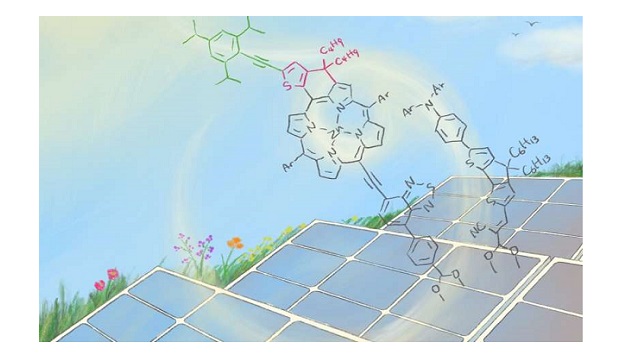
A popular type of dye-sensitized solar cell developed by research scientists at Kyoto University. The newly-made solar cell is more efficient by adjusting and updating its structure. The team report a series of adaptations with a power conversion efficiency of 10.7%, the highest yet for this kind of dye-sensitized solar cell, the most efficient solar technology available at present.
Current dye-sensitized solar cells are made up of a porous layer of titanium dioxide covered with a molecular dye. As sunlight is taken in, electrons are excited as they pass through, and are collected for power, before being ‘recycled’, reintroduced into the electrolyte and back to the dye molecule. As they are lightweight and low density, they have a high industry appeal as a replacement material for current rooftop solar panels.




There are different approaches to structuring these solar cells; with aromatic ring fusion to a porphyrin core being the most attractive, as they absorb red light well. Yet they have their downsides: the electrons are only excited for a short lifetime, have a tendency to aggregate, making conversion to power difficult.
In order to improve efficiency, Hiroshi Imahori, Tomohiro Higashino and colleagues investigated the use of a methylene bridged material, fused to the porphyrin core. They believed this would overcome the downsides, particularly by suppressing the aggregation and enhancing energy conversion.
With the new molecular dye, DfZnP-iPr, they achieved a higher efficiency than previously reported. They believe their research will reinvigorate the exploration of aromatic-fused porphyrin sensitizers for these high-performance solar cells.
“Growing concern over the use of fossil fuels and environmental issues means we need to work hard on improving sustainable energy systems. Our work improves the efficiency of a lightweight and attractive solar technology and we hope will stimulate the research community to further explore the potential of aromatic-fused porphyrin sensitizers for high performance dye-sensitized solar cells.” says Hiroshi Imahori of Kyoto University’s Institute for Integrated Cell-Material Sciences (iCeMS).

