
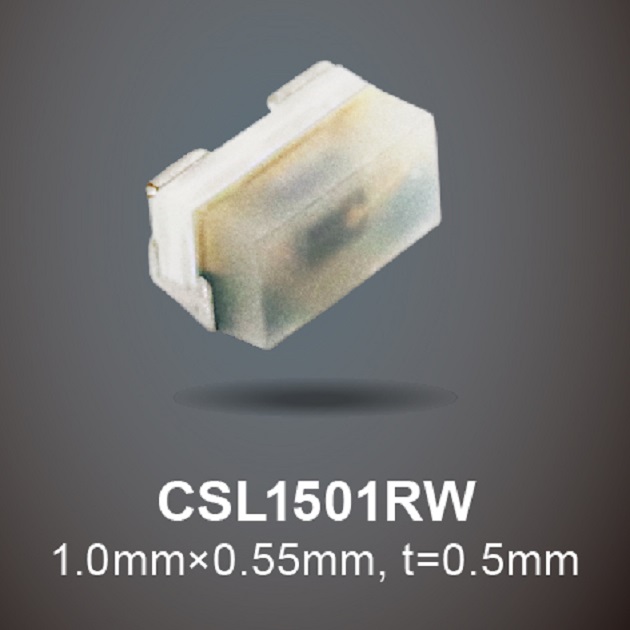
ROHM introduces a new ultra-compact side-emitting (side view) infrared LED, CSL1501RW. The device is ideal for head-mounted displays, industrial headsets, and VR/MR/AR (xR, virtual reality) gaming systems.
In recent years, VR/MR/AR technology, which has emerged following the continuing advancement of IoT, is being increasingly adopted in headsets and head-mounted displays within a variety of gaming systems. The ability to simulate 3D space and project data in the real world has expanded the market for VR/MR/AR applications in the industrial sector as well.



Parallelly, increasing application functionality has led to the use of infrared LEDs for eye-tracking together with accelerometers commonly installed for detecting body movement.
In response, ROHM now offers a new ultra-miniature side-firing infrared LED optimized for today’s needs – expanding its market-proven PICOLEDTM series of ultra-compact chip LEDs, ideal for compact mobile devices and wearables,
The CSL1501RW delivers a peak wavelength of 860nm in an industry-small (1.0×0.55mm, t=0.5mm) side-view design that emits light parallel to the mounting surface, providing exceptional design flexibility. In addition, ROHM leverages its strengths in element manufacturing to improve the luminous efficiency and reduce power consumption by over 20%. The device serves as a light source for eye tracking in VR/MR/AR applications that require greater performance.
Key Features
- Ultra-compact side-emitting form factor provides exceptional design flexibility
ROHM has expanded its venerable PICOLEDTM lineup of ultra-compact chip LEDs with the infrared CSL1501RW that delivers a peak wavelength of 860nm in a class-leading small size (1.0mm x 0.55mm, t=0.5mm), while the side-firing design offers superior versatility that makes it ideal as a light source for eye-tracking in VR/MR/AR applications.
- 20% lower power consumption over conventional products contributes to longer operating time
ROHM utilizes its strengths in LED die manufacturing to reduce power consumption by more than 20% (from 0.24W to 0.18W at 1mW/sr) by increasing both the radiant intensity and luminous efficiency vs conventional products. The result is improved energy savings that prolong application operating time.
- Achieves superior reliability in an Ultra-compact package
ROHM’s thorough quality design ensures high mounting reliability in an ultra-compact size utilizing a new package optimized for the high- intensity LED die.
This prevents issues that can occur when mounting ultra-compact products, such as lighting failures caused by the protrusion of the die bonding material.
For more information, visit www.rohm.com

