
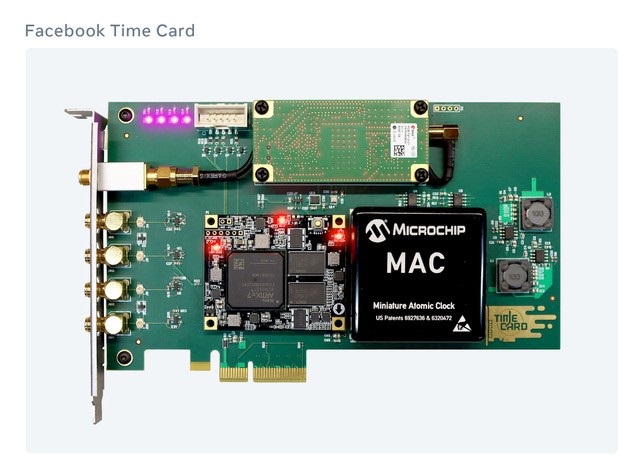
u-blox , a leading global provider of positioning and wireless communication technologies and services, has announced that Facebook has chosen the u-blox ZED-F9T global navigation satellite system (GNSS) receiver module for their timekeeping solution. By improving the synchronization of networked computers, Facebook’s Time Card can significantly speed up the performance of their data centers and distributed databases.
By open-sourcing their designs, Facebook has bolstered the adoption of highly accurate timing solutions based on u-blox technology. These solutions can easily be adopted by other industries requiring nanosecond-level timing, such as 5G cellular networks or smart power grids.




A better precise timing solution built on the ZED-F9T
Facebook set out to create a precise timing solution that reduces the computational overhead required when synchronizing the timing between different computers in a network. They used a u-blox ZED-F9T multi-band GNSS receiver to sync up their solution with the highly accurate atomic clocks onboard dozens of orbiting GNSS satellites. To bridge possible gaps in GNSS coverage and keep clock drift to a minimum, the TimeCard also contains a backup source of timing: a miniaturized atomic clock that is continuously synchronized with GNSS time.
Easy access to nanosecond-level timing accuracy
To maximize the impact of their solution, Facebook decided to open-source the design of their Time Card, which fits onto a PCIe form factor. As a result, anyone with experience working with microelectronics can turn any PC built on an x86 architecture and featuring a network interface controller into a nanosecond-level-accurate timing and synchronization solution.
Easy access to nanosecond-level timing accuracy – based on the u-blox RCB-F9T timing board, which hosts the u-blox ZED-F9T GNSS receiver – opens new avenues in industry segments that rely on highly synchronized signals, such as 5G network base stations that require tighter synchronization than those of previous generations. As power distribution networks become more complex to accommodate a growing share of decentralized renewable energy, they are becoming more reliant on reliable and accurate timing solutions. And following Facebook’s example, data centers and computer networks will be able to modernize infrastructure management to speed up performance and reduce latencies.
Facebook has shared the GitHub repository including the specs, the schematics, the mechanics, the bill of material, and the source code in partnership with the Open Compute Project (OCP) under the Time Appliance Project (TAP)

