

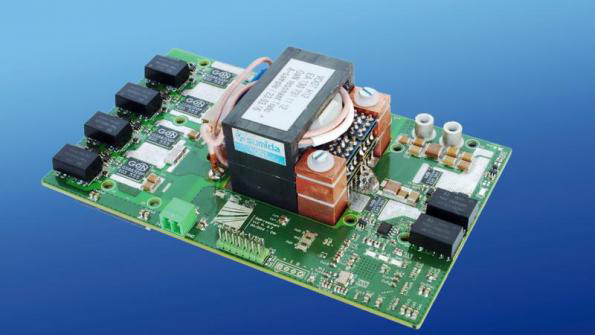
In the project “GaN-resonant – efficient, highly compact, high frequency power electronics with GaN transistors”, a group of researchers from Fraunhofer Institute for Solar Energy Systems (Fraunhofer ISE), Sumida Components & Modules and Liebherr Electronik developed a resonant DC/DC converter with GaN transistors. Since these transistors enable higher switching frequencies than other available technologies, the power density of the device can be increased, resulting in lower weight, a smaller footprint, and, as a side effect, lower component costs.
As a proof-of-concept, the group developed DC/DC converter aiming at possible deployment in aviation where low weight is a significant requirement. In order to reach the project’s target, the research partners chose the most modern power GaN transistors along with innovative inductive components. Thus, typical switching frequencies for these applications of currently up to 350 kHz for resonant converters could be increased to 2.5 MHz. “With these higher frequencies, a large part of the weight due to the passive components and the volume of the 3 kW DC/DC converters could be appreciably reduced,” says Cornelius Armbruster, developing engineer in the team at Fraunhofer ISE.



By making the passive components smaller, less material (e. g. copper or ferrite) is required for manufacturing, which saves scarce resources. GaN transistors have a beneficial dynamic behavior which allows high efficiency despite their high switching frequency. The developed converter has a power/weight ratio of 3.9 kW/kg and a total efficiency of over 90 % for a wide operating range. It reaches a comparatively high maximum efficiency of 94.5 % at half its nominal power and a switching frequency of 2 MHz. At such high frequencies, however special attention must be taken the printed circuit board design, the measurement and control technology and the electromagnetic compatibility, the team found out. In consideration of these aspects, an 8-layer printed circuit board (PCB) was produced for the demonstrator and, in particular, the control circuitry of the GaN transistors was developed and optimized. The results gained from the project can be transferred to other fields of application, the scientists say. One possible area of application is as power supply for server farms, or for communication electronics in general.
The amount of energy consumed worldwide to supply the current communications infrastructure is immense, and end to the upwards tendency is not in sight. In this case, the new design of the extremely compact, high frequency DC/DC converter which saves material and reduces power losses shows clear advantages. It boasts not only a higher efficiency but also a lower cooling demand.
The “GaN-resonant” project was launched in 2013 and ran for a period of three years. It was funded with about 1.2 million euros by the German Federal Ministry for Education and Research (BMBF).

