
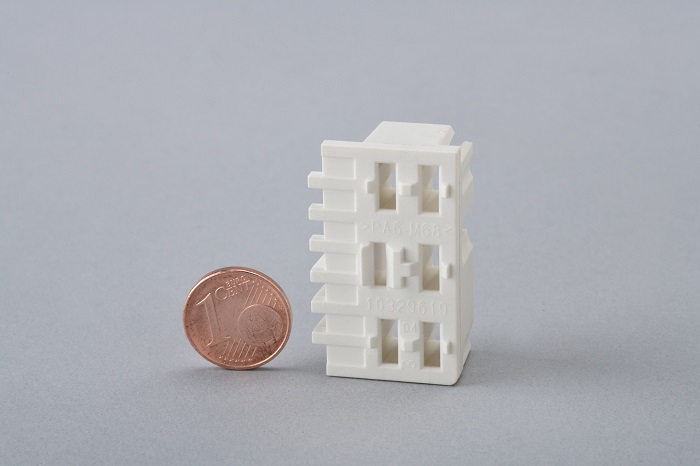
Thermally conductive plastics have great potential for use in the thermal management of charging systems for electric vehicles. One example is the charge controller in the fully electric vehicle of a sports car manufacturer based in southern Germany. The controller contains a cooling element that dissipates the heat generated in the plug contacts of the controller when charging the batteries. The cooling element is made of the thermally conductive and electrically insulating polyamide 6 Durethan BTC965FM30 from LANXESS. “As well as preventing the charge controller from overheating, our structural material meets the strict requirements for flame-retardant properties, tracking resistance and design,” explains Dr Bernhard Helbich, Technical Key Account Manager at LANXESS. The manufacturer of the entire charging system for the sports car is Leopold Kostal GmbH & Co. KG of Lüdenscheid, a global system supplier of automotive, industrial and solar electrics as well as electrical contact systems.
Efficient heat dissipation with special mineral particles




Charge controllers convert the three-phase or alternating current fed in from the charging station to direct current and control the charging process. During the process, they limit the charging voltage and current to prevent overcharging of the battery, for example. A current with an amperage of up to 48 amps flows through the plug contacts in the charge controller of the sports car, causing a significant generation of heat during charging. “Our polyamide is filled with special mineral heat-conducting particles that conduct this heat efficiently away from the source,” says Helbich. These particles give the compound a high thermal conductivity of 2.5 W/m∙K in the direction of melt flow (in-plane) and 1.3 W/m∙K perpendiculars to it (through plane).
Freedom in component design
In addition, the halogen-free flame-retardant polyamide 6 material ensures that the cooling element is highly fire-resistant. As required, it passes the UL 94 flammability test of the US testing institute Underwriters Laboratories Inc. with the best classification, V-0 (0.75 millimeters). Its high tracking resistance also contributes to greater safety. This is demonstrated by its CTI A value of 600 V (Comparative Tracking Index, IEC 60112). Helbich adds: “The tracking resistance gives designers greater freedom in engineering the component, as they can arrange electrical assemblies even more compactly without having to worry about short circuits and device defects caused by creepage currents.” Consequently, along with guides and ribs, the cooling element is equipped with six closely spaced cavities to house the plug contacts.
Good processing characteristics
Despite the high content of thermally conductive filler (68 per cent by weight), polyamide 6 has good flowability. “In terms of its processing characteristics, the material is similar to highly reinforced types of polyamide 6 that have a glass fibre content of up to 60 per cent by weight,” explains Helbich. The heat-conductive thermoplastic also has potential for use in electric vehicles battery components such as plugs, heat sinks, heat exchangers and mounting plates for power electronics.”

