
Using linear low dropout regulators (LDOs) with low quiescent current (Iq) can extend battery life in wearables and wireless Internet of Things (IoT) devices, but there are performance tradeoffs. These include transient response, noise performance, and output power range. Also, the quiescent current is sometimes confused with shutdown or disable current (Id). They are not the same, and a balance needs to be arrived at between the two. And, of course, neither Iq nor Id optimization is of much use if the overall system design is not optimized for low-power operation.
Here we’ll differentiate between Iq and Id and briefly discuss the impact each has on power dissipation. We’ll then review some of those performance tradeoffs before closing with some exemplary LDOs from Microchip and Texas Instruments, including a demo board.




The difference between quiescence and shutdown
Readiness is the difference between quiescence and shutdown. In a quiescent state, the system is in a low power, active state and ready to run. During shutdown, sometimes referred to as disabled mode, the system is asleep and not ready to run immediately. The difference is especially important in battery-powered systems, such as wireless locks that spend extended periods (often >99% of the time) in standby and have large differences between standby and active current consumption. Quiescent current can be used to calculate the power at light loads, while shutdown current can be used to determine the long-term battery life.

In devices such as LDOs, there can be a significant difference between Iq and Id. For example, one LDO has an Iq of 25 nanoamperes (nA) and an Id of 3 nA. In another case, an LDO has an Iq of 0.6 microamperes (µA) and an Id of 0.01 µA. Of course, it’s not that simple:
- The operating temperature can affect Iq and Id. This can be an important consideration for devices that will be used for extended periods at higher temperatures.
- Low Iq devices can have longer response times to dynamic load changes. This factor varies considerably between LDOs.
- Low Iq devices can generate internal noise that can be an important factor in noise-sensitive applications.
- Even LDOs can generate significant heat, making it important to follow the datasheet guidelines for layout and thermal management. Otherwise, Iq and Id performance can be compromised.
- The lowest Iq is not necessarily the best choice. If the difference between Iq and on-state current consumption is greater than two orders of magnitude, a lower-cost LDO with a higher Iq may be a good option.
150 mA low Iq LDO and demo board
Designers of systems with a single lithium-ion battery that need an LDO rated for inputs from 1.4 to 6.0 volts and delivering up to 150 milliamperes (mA) of current can consider LDOs such as the MCP1711 from Microchip Technology. This device has a typical Iq of 0.6 µA and an Id of 0.01 µA. When shutdown mode is enabled, the output capacitor is discharged through a dedicated switch in the MCP1711 to quickly reduce the output voltage to zero. The MCP1711 has an ambient operating temperature range of -40 to +85°C.
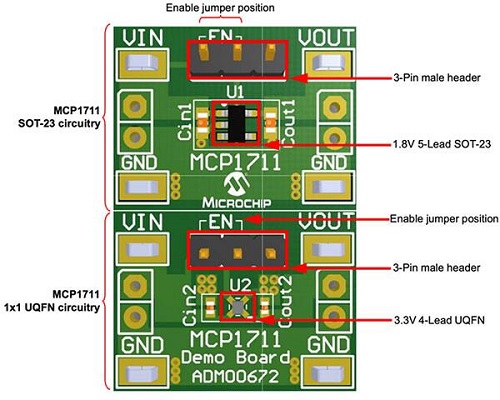
To explore the operation of the MCP1711 over a wide input voltage and load range, designers can use the ADM00672 demo board that includes two voltage options and two package options:
- 1.8 Vout with a 3.2 to 6.0 volt input range in a five lead SOT-23
- 3.3 Vout with a 4.0 to 6.0 volt input range in a four lead 1×1 UQFN
The demo board has two isolated circuits that can be independently tested.

Fast transient response and low Iq
For systems that benefit from fast transient response and low Iq, designers can turn to the TPS7A02 from Texas Instruments. It is rated for 200 mA with an Iq of 25 nA and an Id of 3 nA. It supports an output voltage range of 0.8 to 5.0 volts, programmable in 50 millivolt (mV) steps. This LDO has a typical transient response of under 10 microseconds (μs) settling time, with 100 mV undershoot for a step load change from 1 mA to 50 mA. Its response characteristics differ for load increases and decreases, as shown below. The TPS7A02 junction temperature is specified from -40 to +125°C.

Conclusion
Iq is an important characteristic to consider when designing for long battery life, but it’s only one of several factors to consider. Depending on the operating profile and power consumption patterns in a device, Id is also an important consideration. There are a variety of factors, such as the operating temperature, that impact both Iq and Id, and there is an optimal range for Iq and Id. Less is not always better.

