
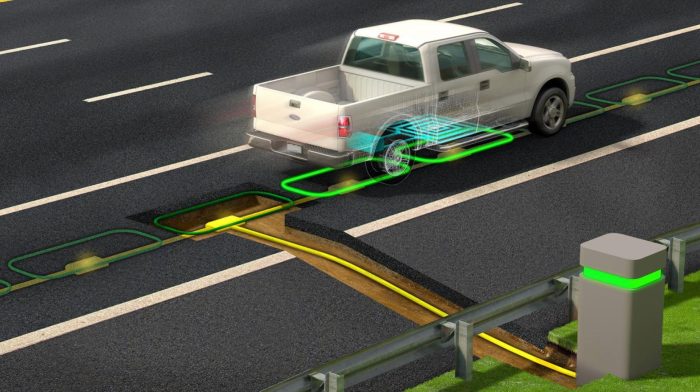
Wireless charging roads equipped with energy storage systems are promising electric vehicles sbyvirtue of their substantial advantages in time-saving and reduced pressure on the existing power infrastructure.
The electric vehicle (EV) industry has experienced remarkable expansion and technical development during the last decade. It is estimated that EVs will comprise, 48%, 42%, and 27% of light-duty vehicle sales in China, Europe, and the United States, respectively, by 2030, according to co-authors H. Oliver Gao, the Howard Simpson Professor of Engineering, and Jie Shi, a former Cornell systems postdoctoral researcher.




Integration of wireless charging roads into the existing electricity market and efficient management of the corresponding energy storage system are cruthe crucial for the successful implementation of the wireless charging road systems.
“In this work, we develop a coupled transportation–power system framework for incorporation of a wireless charging road system into the real-time electricity market,” said Gao, the director of Cornell’s Systems Engineering Program. “In addition, we propose a Lyapunov optimization-based control strategy to operate the energy storage system in a cost-efficient manner.”
The simulation study demonstrates that efficient control of the energy storage system not only reduces the energy costs of the entire wireless charging road system but also alleviates the pressure produced by the wireless charging load on the existing power grid. In two numerical examples, the energy costs are reduced by 2.61% and 15.34%, respectively.
“We designed a Lyapunov optimization-based control strategy to manage the energy flow between the wireless charging roads and the energy storage system in a cost-efficient way,” Gao said. “The proposed framework is composed of three major modules: the hybrid traffic assignment, the extended DCOPF, and the controller.”
The hybrid traffic assignment calculates the traffic flow given specific trips across a road network composed of wireless charging lanes and regular traffic lanes. The extended direct current optimal power flow (DCOPF) determines the optimal electric energy flows between the generation resources, load centers, and wireless charging roads in the given power grid. The control approach seeks to minimize the energy costs of wireless charging roads by efficiently managing the output of the energy storage system.
“Our control strategy is computationally efficient and requires no forecasts of the system states, making it appealing to practical applications,” Jie said.

