

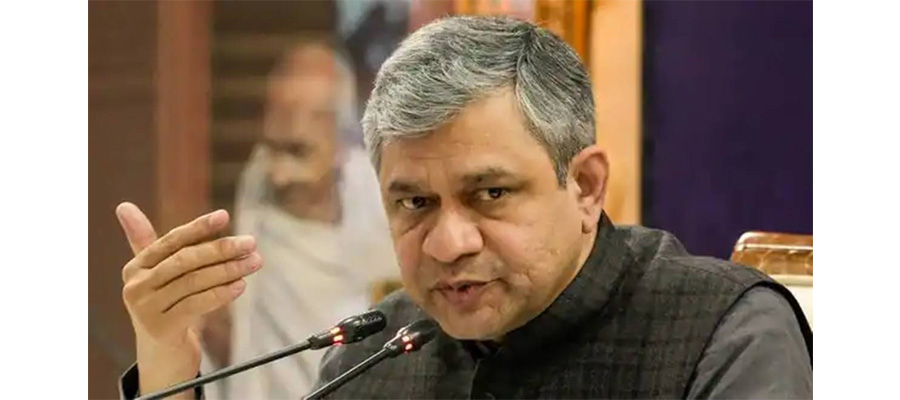
India is set to become the world’s largest semiconductor manufacturing destination within the next five years, according to Ashwini Vaishnaw, Minister of Electronics and IT. The Indian government is committed to building the right ecosystem to support semiconductor production, aiming to make it the most cost-effective globally. In December 2021, the government announced a $10 billion semiconductor manufacturing plant, and the approval for a fabrication plant is expected soon.
Vaishnaw acknowledged the complexity of semiconductor manufacturing and its related ecosystem. He highlighted the need for specialized chemicals, gases, and a reliable power supply. Even a brief voltage fluctuation can impact an entire day’s production, emphasizing the criticality of a stable power infrastructure. Additionally, the manufacturing process requires ultra-pure water. These factors underline the challenges that must be addressed to establish and sustain semiconductor manufacturing in India.



While recognizing the challenges, Vaishnaw also acknowledged the natural tendency of people to adopt a wait-and-watch approach when a new industry is being established. The government aims to address this by creating a favourable environment that encourages investment and industry participation.
Vaishnaw, who also serves as the Minister of Railways, discussed the government’s plans to expand the Vande Bharat train series. The Vande Bharat trains are indigenously manufactured semi-high speed, and self-propelled trains. By March 2024, the government plans to introduce a sleeper version of the train for distances exceeding 500 km. For distances up to 100 km, a train called Vande Metro is being developed, while for journeys between 100-500 km, the Vande Bharat chair car has been designed. The sleeper and metro variants are currently in the design phase, with the metro expected to be launched by January and the sleeper by March next year.
The government aims to connect every state in India with Vande Bharat trains and plans to produce at least two new trains every week. The production process has already commenced for 400 trains, and the frequency of rollouts is expected to increase significantly. The goal is to achieve nationwide connectivity with Vande Bharat trains by mid-June, after which the focus will shift to busy routes.
The Ministry of Railways is undertaking an ambitious track construction and upgrading program. In the previous year, approximately 5,200 km of rail tracks were built, averaging a record-breaking 14 km per day. This is a significant increase compared to the three to four km per day ten years ago. The ministry also focuses on upgrading existing tracks, with around 8,000 km renewed annually. The upgraded tracks are designed to handle higher speeds, ranging from 130 km per hour to over 160 km per hour, surpassing the earlier limit of 70-80 km per hour.
Vaishnaw acknowledged the complexity of manufacturing Vande Bharat trains, noting that it took several months to perfect the designs and establish the necessary supply chains. The ministry had to develop a new supply chain utilizing domestic companies in Coimbatore to meet the requirements of the project.
In conclusion, the Indian government is determined to establish India as a global leader in semiconductor manufacturing within the next five years. The focus is on building the right ecosystem and addressing challenges related to specialized chemicals, gases, power supply, and water purification. In addition, the government is expanding the Vande Bharat train series to connect all states in India, with plans to introduce sleeper and metro variants. The Ministry of Railways is also investing in extensive track construction and upgrades to enable faster train speeds. These initiatives showcase the government’s commitment to advancing technology and transportation infrastructure in the country.

