
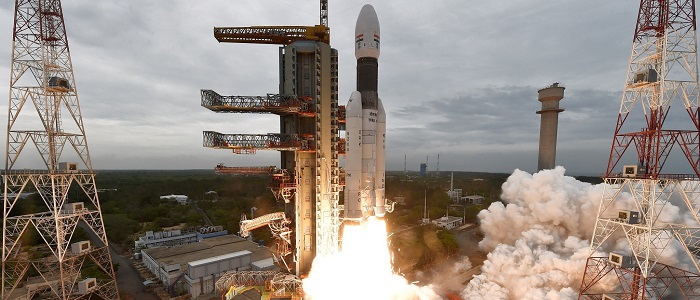
”The Indian Space Program and the research conducted by ISRO is much more advanced than the Chinese Space Agencies as we have indigenously developed the technology and have not been dependent on other countries,” said Padma Shri Prof. R.M.Vasagam, veteran Space Scientist and Project Director of APPLE. He was speaking during the 40 years celebrations of APPLE Satellite in Space organized by Chandigarh University.
APPLE Satellite happens to be India’s first communication satellite which played a foundation role for the development of the INSAT and other Communication satellites by the ISRO. Prof. Mylswamy Annadurai, Space Scientist also known as Moon Man of India, Dr. Manpreet Singh Manna, Chairman IEEE Photonics Society, Dr. L.V Muralikrishna Reddy, President BRICS FEO joined the 40 years celebrations of APPLE Satellite Project in which Aerospace, Mechatronics, Mechanical, Electronics & Communication and Computer Science Engineering students of Chandigarh University also took part. Chandigarh University honored Prof. R.M.Vasagam with Lifetime Achievement Award for his contribution to the Indian Space Program.




While replying to the question about the competition from China in the field of Space Technology, Prof. Vasagam said, ”Chinese youth are spearheading the space missions like Mars Rover, Moon Mission and if India wants to counter the competition from China then its youth have to come forward and choose Aerospace Engineering as their career.” He further added that ”Robotics is playing an important role in space technology and future the field of robotics would be contributing bigtime in the futuristic space exploration missions so pursuing a career in the emerging fields of Artificial Intelligence, Machine Learning and Mechatronics will open multiple avenues for Indian Youth.” ”To remain competitive in the business of Space Technology, India has to offer cost-effective solutions to the countries who do have resources to run a space program but have the ambition to have one to meet the future needs” added Prof. Vasagam. While recalling the memories of the APPLE Project Prof. R.M Vasagam said, ”APPLE opened a gateway of opportunities for India as it was crucial to establish the telecommunication network in the country and it also played a role for developing the futuristic communication satellites such as INSAT which placed India amongst the select league of countries having its own bunch of communication satellites.” Dr. Mylswamy Annadurai said, ”India’s space program is doing well and there are various areas such as Remote Sensing, Space Exploration where India is doing much more than China. He further added that ”In the Mars Mission also India succeeded in its first attempt itself in comparison to China. The only difference between India and China Space Programs is the budget allocation and also the number of professionals working in the respective countries. In India, only 18000 people are working in the space program as compared to more than 2 Lac in China.” Speaking on the occasion Dr. Manpreet Singh said, ”The launch of APPLE satellite was just the beginning of the success of Indian Space Program and if we look today India has successfully launched more than 300 satellites”. Prof. R.M Vasegam applauded the efforts of Chandigarh University in the field of Science & Technology, especially in Aerospace Engineering as the University is already working on the development of Student Communication Satellite which will be launched into space by 2022. Recently Chandigarh University has also become the first university in North India to launch a course on Satellite System Design and Building.

