
Manufacturers of cutting-edge audio equipment constantly seek to enhance sound quality while also meeting the growing demand for compact, lightweight, more integrated, and energy-efficient designs. At the same time, they must ensure seamless connectivity, cost-effectiveness, and user-friendly functionality, making audio product development more complex than ever. To overcome these challenges, SounDigital has integrated CoolGaN transistors from Infineon Technologies AG into its new 1500 W Class D amplifier, featuring an 800 kHz switching frequency and five channels. Infineon’s advanced GaN technology has improved the energy efficiency of the amplifier by five percent and reduced energy loss by 60 percent.
“We are excited to enhance the performance of our audio amplifiers using Infineon’s GaN power semiconductors, enabling us to inspire people and provide entertainment by amplifying music around the world,” said Juliano Anflor, CEO of SounDigital. “GaN transistors significantly enhances our overall system performance with minimized system cost and increased ease of use.”




“GaN technology is transforming the audio amplifier industry, providing unparalleled efficiency and performance,” said Johannes Schoiswohl, Head of the GaN Business Line at Infineon. “Infineon’s leading GaN solutions deliver superior sound quality, higher power density, and reduced energy consumption, enabling SounDigital’s audio systems to reach new levels of fidelity and performance.”
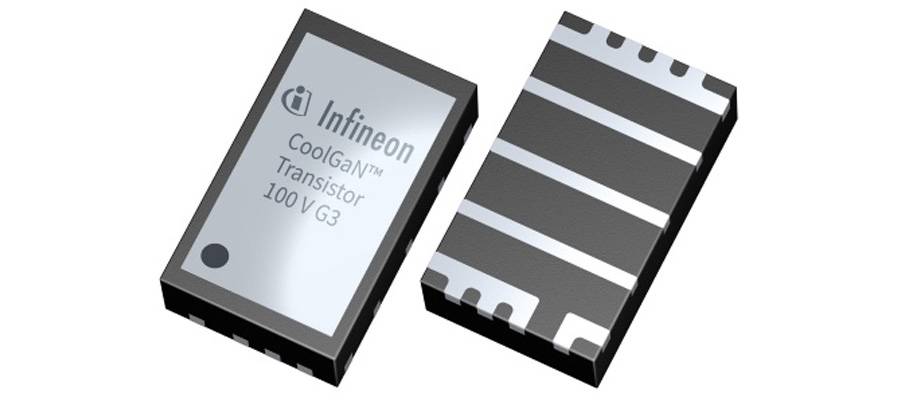
For its 1500 W Class D amplifier, SounDigital selected Infineon’s 100 V normally-off E- mode transistors: IGC033S101 in a PQFN-3×5 package and IGB110S101 in a PQFN-3×3 package. With their low on-resistance, the transistors are ideal for demanding high-current applications, enabling significant improvements in both sound quality and efficiency of SounDigital’s amplifier. The GaN-based amplifier also delivers high performance while reducing power dissipation by 75 W, allowing for a 50 percent smaller heat sink.
Additionally, the overall system size has been reduced by 40 percent without compromising performance. The audio quality has been further improved by the CoolGaN transistors, with total harmonic distortion (THD) reduced by 70 percent, enabling a more precise and detailed sound experience. At the same time, the idle current has been reduced by 40 percent, significantly improving energy efficiency.

