Courtesy: NXP Semiconductors
The foundation of Industrial IoT (IIoT) is based on communication between different devices for data gathering, processing, and sharing over the cloud. In this week’s Wireless Wednesday blog, we will look at how a purpose-built, Tri-Radio solution (Wi-Fi, Bluetooth, 802.15.4) aids in seamless communication between the diverse protocols used in IIoT.




Industrial infrastructure encompasses different interconnected components—such as sensors, end-nodes, controllers, and processors—that are connected over Wi-Fi, Bluetooth, or 802.15.4 (Thread, Zigbee, Matter). IIoT solutions require interoperability among these devices along with robust performance across these wireless protocols. NXP’s Wireless Connectivity Solutions provide a range of devices that enable the co-existence of three leading radios—Wi-Fi, Bluetooth, and 802.15.4—making sensor-to-cloud communication seamless and unlocking the full potential of Industrial IoT.
Let’s clarify some of the use cases in the IIoT space and some possible solutions for upgrading systems with wireless connectivity.
Smart Factory Management System
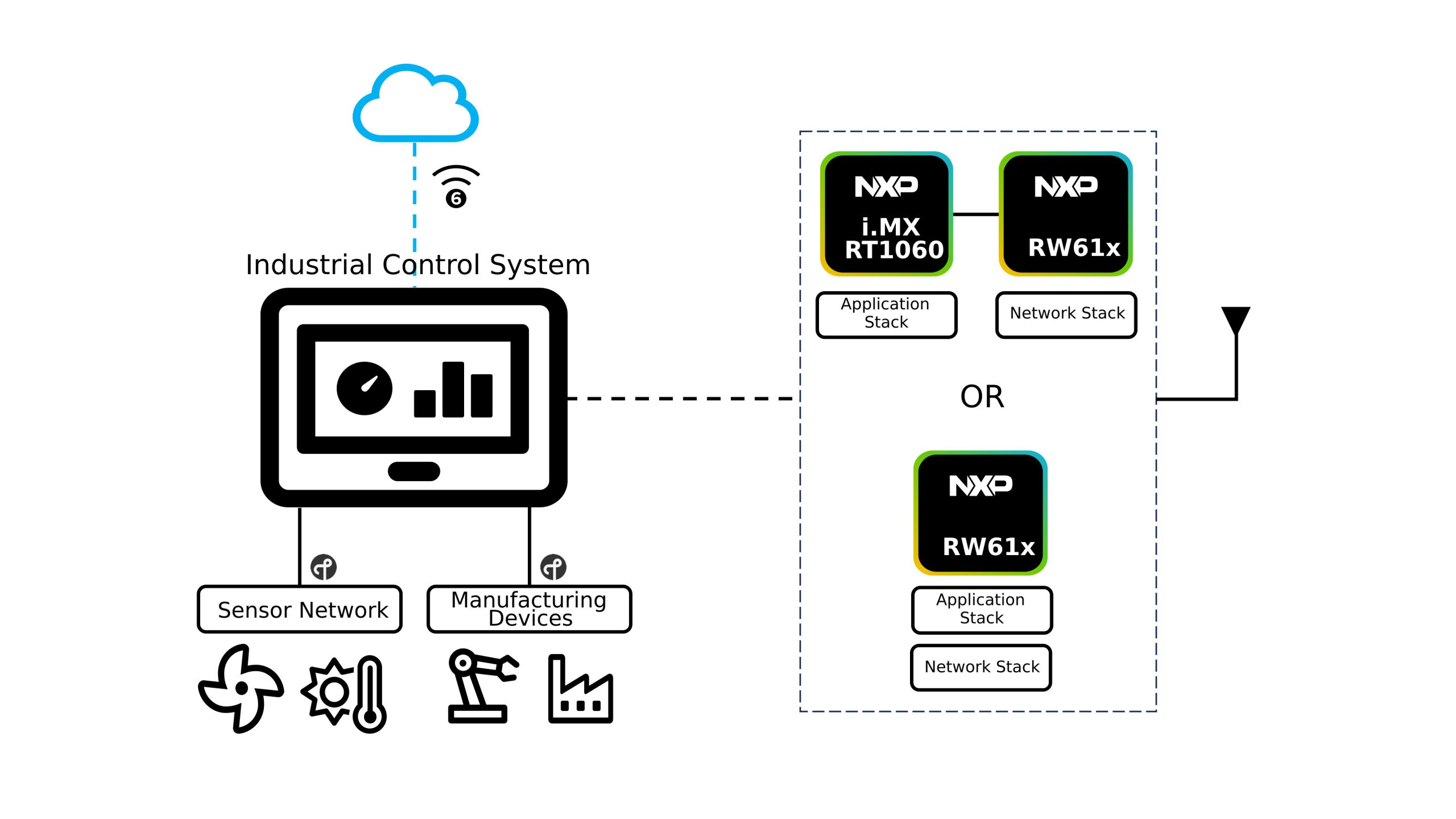
To improve the safety, quality, and efficiency of manufacturing devices like machines and robots, these devices must be connected to collect, process, and share data as well as suggest efficiency improvements. HMI screens in an industrial control system serve as a user interface between operators and machines on the factory floor. These devices must be connected to the cloud for remote access and sharing key metrics or data.
NXP’s RW61x solution addresses this application by providing an application-dedicated 260 MHz Arm Cortex-M33 with Tri-Radio capability supporting Wi-Fi, Bluetooth LE, and 802.15.4. This single-chip solution offers cost savings while providing flexibility to support multi-protocol use cases, such as communicating with end nodes on a Thread network or sharing data over Wi-Fi. The RW61x can either work as an independent wireless MCU in Standalone mode or in Network Co-Processor mode (NCP), pairing with a host processor or microcontroller.
Smart Energy Management System
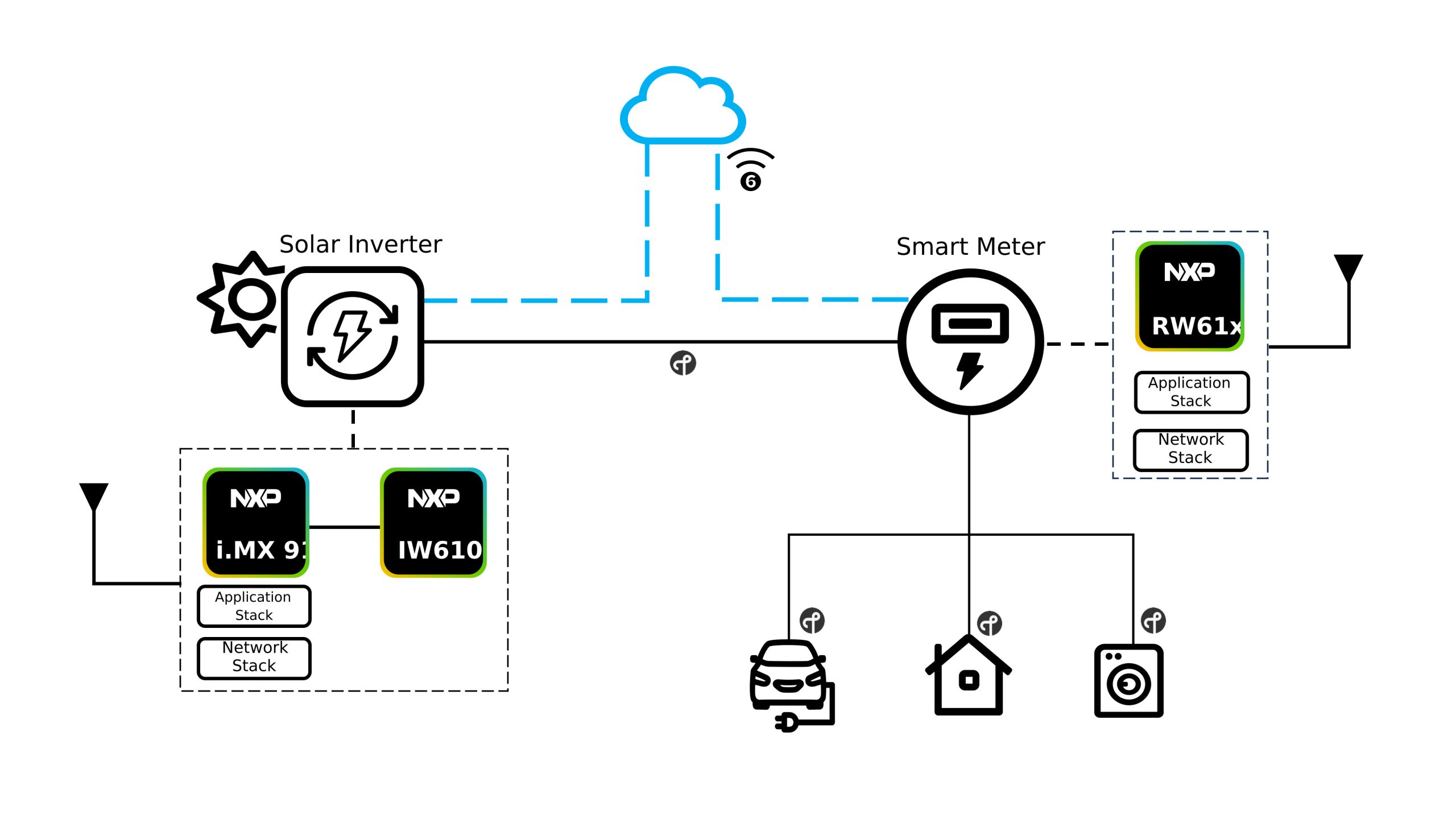
With the market moving to build energy-efficient devices and systems, such as smart meters and solar inverters, the efforts to collect and track energy consumption have increased. A smart meter can collect, monitor, process, and send power and voltage data to the customers and billing centers to analyze trends and optimize energy consumption. A solar inverter converts DC power produced from panels to AC power and supplies that energy to different loads.
The smart meter and solar inverter can communicate over narrowband radios like Zigbee, Thread, or Bluetooth. They can use Zigbee or Thread to collect information like energy consumption, anomalies, or maintenance cycles. Bluetooth technology can be used for commissioning smart devices on the network, making it easy to expand or scale the network of connected devices. When these energy devices utilize Wi-Fi connectivity, they can send the data to the cloud or to an In-Home Energy Display or Home Control Panel to show information on energy production, usage by different systems or appliances, cost savings on power, etc.
NXP provides a solution for smart energy management systems. The IoT-optimized IW610 Wi-Fi 6 Tri-radio solution can be paired with the i.MX 91 Processor in Radio-Co-Processor (RCP) mode to implement wireless connectivity in smart meter, solar inverter, or other smart energy applications. With diverse host interface support for SDIO, USB, UAR,T and SPI, the IW610 can be paired with a wide range of NXP processors or third-party, non-NXP processors. Additionally, the connectivity solution is scalable by pairing the i.MX 91 with the IW612 Wi-Fi 6 Tri-Radio solution or IW416 Wi-Fi 4 + Bluetooth solution for applications that require higher or lower wireless performance, respectively. For applications that require less processing performance, the RW61x can be used as a single-chip solution for MCU and connectivity.