
As technological advancements continue to pursue personalisation & customisation at every level, illumination has also transformed from a need to a customisation. Consequently, the LED industry is moving towards a similar yet prominent stride, making customised and occasion-specific solutions, keeping in consideration the human behaviour and lighting changes across the day. Long seen as the constant and uniform thing, illumination is now being reimagined as something dynamic and customisable.
In the same pursuit, the industry has moved towards enabling Human-Centric Lighting(HCL), where lighting is designed and engineered to emulate natural daylight, ranging from dimming them as the Sun goes down, while brightening up as the day begins. Gradually, illumination is now being designed around human biology, visual comfort, and cognitive performance rather than simple brightness or energy efficiency.




But what lies behind this marvel is hardcore engineering. Technically, the result is made possible by the marvels of spectral engineering & control architectures, wherein the former adjusts the light spectrum while the latter enables the intelligence directing the timing changes of the lighting system. Simultaneously, the dual play brings forth today’s human-centric lighting into real-life examples and is also making them more customised and personalised. This ultimately helps in supporting human circadian rhythms, enhancing well-being, mood, and performance.
To enable these engineered outcomes, embedded sensors, digital drivers, and networked control platforms are integrated into the modern-day LED lights, transforming illumination into a responsive, data-driven infrastructure layer. In combination, spectral engineering and intelligent control systems are reshaping the capabilities of LED lighting, transforming it from a passive utility into a dynamic, precision-engineered tool for enhancing human wellbeing, productivity, and performance.
How is Spectral Power Distribution engineered?
When we talk about LED lights, white light is the first thing that comes to our minds. Although the same is not true scientifically. Surprisingly, LEDs inherently emit blue light and not white. To turn the blue light into white, a Phosphor coating is applied over it. Consequently, the blue light mixes with the phosphor to turn some of the light into green, red & yellow simultaneously. These lights eventually mix to turn white.
Spectral Power Distribution (SPD) is simply the profile of the white colour which is not visible to our naked eyes, and how much of each colour is present in the visible white light. The final light can be controlled by various means, such as the type of phosphor, how thick the phosphor layer is, or by adding extra coloured LEDs (like red or cyan).
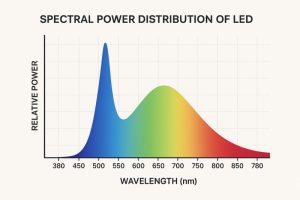
Spectral Power Distribution is engineered by carefully mixing different colours of light inside an LED, even though it looks white, so that the light feels right for the human body and mind.
Engineering the Spectral Power Distribution of White LEDs
Often, it is seen that the very same white light is sometimes harsh while sometimes soft- all this is because of various variables. Today, from being a static character, SPD has turned into a tunable design parameter,++ becoming a Controllable Design Variable. To this effect, SPD is largely controlled by Phosphor composition (which colours it emits), Particle size and density, and finally Layer thickness and distribution.
That’s why the same 400K LEDs from different manufacturers can feel completely different — their SPDs are different, even if the Correlated Color Temperature (CCT) is the same. But as long as the final color is decided by some application made during manufacturing, the effect remains static. While spectral Power distribution is essential, it is equally important to dictate the given behaviour as per the time of the day.
Multi-Channel LED Configurations for Spectral Tunability
To enable a real-time nature to this Spectral tunability, engineers today use multiple LED channels, including:
- White + Red
- White + Cyan
- RGBW / RGBA
- Tunable white (warm white + cool white)
By precisely varying the current supplied to each LED channel, the spectral power distribution can be reshaped in real time, allowing the system to shift between blue-enriched and blue-reduced lighting modes as required. This level of control allows you to adjust the perceived colour temperature independently of the light’s biological impact, rather than having them locked together. As a result, SPD is no longer a fixed characteristic of the light source but becomes a dynamic, real-time controllable design parameter.
Melanopic Response, Circadian Metrics, and Spectral Weighting
When we talk about light, visibility & brightness make up the primary issue, but that has changed drastically with the emergence of Human Centric Lighting (HCL). With HCL coming into play, photopic lux, the quantification of brightness, is no longer a go-to metric to decide upon the quality of lighting. It is because it explained only one part of the coin, which is visibility, and not how this light or visibility affects human biology.
At the same time, Human Centered Lighting focuses on how light affects the circadian system, alertness, sleep–wake cycles, mood, and hormonal regulation. This phenomenon has brought up new metrics that tell us not only about the brightness or visibility, but also how it biologically acts. One such metric is Melanopic Lux, which weights the spectrum based on melanopsin sensitivity. Melanopsin is a photopigment in our eyes, usually sensitive to Blue-Cyan light.
Interestingly, more melanopic stimulation → increased alertness and circadian activation, while less melanopic stimulation → relaxation and readiness for sleep. That’s where we come to the core of our subject – Light induced behaviuour. The emergence of Melanopic Lux allows engineers to decouple visual brightness from biological effect, giving the right direction to Human Centric Lighting.
While melanopic metrics define what kind of biological response light should produce, control architectures determine when and how that response is delivered. Translating circadian intent into real-world lighting behaviour requires intelligent control systems capable of dynamically adjusting spectrum, intensity, and timing throughout the day. This is where embedded sensors, digital LED drivers, and networked control platforms come into play, enabling lighting systems to modulate melanopic content in real time—boosting circadian stimulation during the day and reducing it in the evening—without compromising visual comfort or energy efficiency.
Other metrics, such as Melanopic Equivalent Daylight Illuminance (EDI) and Circadian Stimulus (CS) are used to quantify how effectively a light source supports circadian activation or melatonin suppression, beyond what photopic lux can describe.
LED Drivers and Power Electronics for Dynamic Spectral Control
In human-centric lighting systems, LED drivers are no longer simple power supplies but precision control elements that translate circadian intent into real-world illumination. Because LEDs are current-driven devices, accurate current regulation is essential to maintain stable brightness and spectral output, especially as temperature and operating conditions change.

Dynamic spectral tuning typically relies on multi-channel LED architectures, making channel balancing a critical requirement. Each LED colour behaves differently electrically and thermally, and without independent, well-balanced current control, the intended spectral profile can drift over time, affecting both visual quality and biological impact.
Equally important is dimming accuracy. Human-centric lighting demands smooth, flicker-free dimming that preserves spectral integrity at all brightness levels, particularly during low-light, evening scenarios. Advanced driver designs enable fine-grained dimming and seamless transitions, allowing lighting systems to dynamically adjust spectrum and intensity throughout the day while maintaining visual comfort and circadian alignment.
System Integration Challenges and Design Trade-Offs
While human-centric lighting promises precise control over both visual and biological responses, delivering this in real-world systems involves significant integration challenges and design trade-offs. Spectral accuracy, electrical efficiency, thermal management, and system cost must all be balanced within tight form-factor and reliability constraints. Multi-channel LED engines increase optical and control complexity, while higher channel counts demand more sophisticated drivers, sensing, and calibration strategies.
Thermal effects further complicate integration, as LED junction temperature directly influences efficiency, colour stability, and lifetime. Without careful thermal design and feedback control, even well-engineered spectral profiles can drift over time. At the same time, adding sensors, networking, and intelligence introduces latency, interoperability, and cybersecurity considerations that must be addressed at the system level.
Ultimately, successful human-centric lighting solutions are defined not by any single component, but by holistic co-design—where optics, power electronics, controls, and circadian metrics are engineered together. The trade-offs made at each layer determine whether a system merely adjusts colour temperature or truly delivers biologically meaningful, reliable, and scalable lighting performance.

