
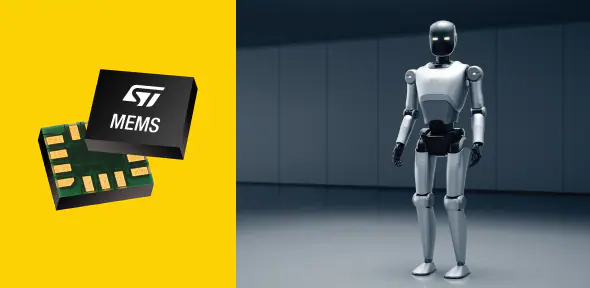
STMicroelectronics announced the acceleration of global development and adoption of physical AI systems, including humanoid, industrial, service and healthcare robots. ST is integrating its comprehensive portfolio for advanced robotics into the reference set of components compatible with the NVIDIA Holoscan Sensor Bridge (HSB). In parallel, high-fidelity NVIDIA Isaac Sim models of ST components are being integrated into both companies’ robotics ecosystems to support faster, more accurate sim-to-real research and development. The first deliverables available to developers today include the integration of Leopard’s depth camera enabled by ST with the NVIDIA HSB and the high-fidelity model of an ST IMU into NVIDIA’s Isaac Sim ecosystem.
“ST is well engaged within the robotics community, providing robust support and a well-established ecosystem,” said Rino Peruzzi, Executive Vice President, Sales & Marketing, Americas & Global Key Account Organization at STMicroelectronics. “Our collaboration with NVIDIA aims to unleash the next wave of cutting-edge robotics innovation with developer and customer experience streamlined at every step, from the inception of AI algorithms to the seamless integration of sensors and actuators. This will accelerate the evolution of sophisticated AI-driven physical platforms.”




“Accelerating the development of next-generation autonomous systems requires high-fidelity simulation and seamless hardware integration to bridge the gap between virtual training and real-world deployment,” said Deepu Talla, Vice President of Robotics and Edge AI at NVIDIA. “The integration of STMicroelectronics’ sensor and actuator technologies with NVIDIA Isaac Sim, Holoscan Sensor Bridge and Jetson platforms provides developers with a unified foundation to build, simulate and deploy physical AI at scale.”
Simplifying sensor and actuator integration with the Holoscan Sensor Bridge
With the NVIDIA HSB, developers can unify, standardise, synchronise, and streamline data acquisition and logging from multiple ST sensors and actuators, a critical foundation for building high-fidelity NVIDIA Isaac models, accelerating learning, and minimising the sim-to-real gap.
The goal is to simplify the process of connecting ST sensors and actuators to NVIDIA Jetson platforms through pre-integrated solutions for the combination of STM32 MCUs, advanced sensors (including IMUs, imagers, and ToF devices) and motor‑control solutions, particularly for humanoid robot designs. Leopard Imaging’s stereo depth camera for robots is the perfect example. Using ST imaging, depth and motion-sensing technologies, it is expected to support a broad wave of designs across Physical AI OEMs, academic research groups and the industrial robotics community.
Reducing cost, complexity, and challenges with high-fidelity modelling for Omniverse Isaac
Advanced robotics developers face high development costs, in addition to modelling challenges. High‑fidelity simulations with extensive randomisation demand substantial GPU and CPU resources and large datasets. Selecting which parameters to randomise, and over what ranges, requires deep domain expertise. Poor choices can result in unrealistic scenarios or inefficient training. Finally, excessive variability can confuse models, slow convergence, and degrade real‑world performance when randomisation no longer reflects plausible conditions.
ST and NVIDIA’s objective is to provide accurate, hardware-calibrated models for the comprehensive portfolio of ST components, matching the requirements of advanced robotics. Following the availability of the first model of an IMU, ST is working to bring developers models of ToF sensors, actuators and other ICs derived from benchmark data collected on real ST hardware, using ST tools to capture accurate parameters and realistic behaviour, resulting in models optimised to NVIDIA’s Isaac Sim ecosystem. NVIDIA HSB is being integrated into ST’s toolchain collaboratively.
As a result, ST and NVIDIA envision that more accurate models will significantly improve robot learning. With models that closely mirror real-world device behaviour, robots can learn from simulations that better reflect actual conditions, shortening training cycles and lowering the cost of building and refining humanoid robotics applications.

