
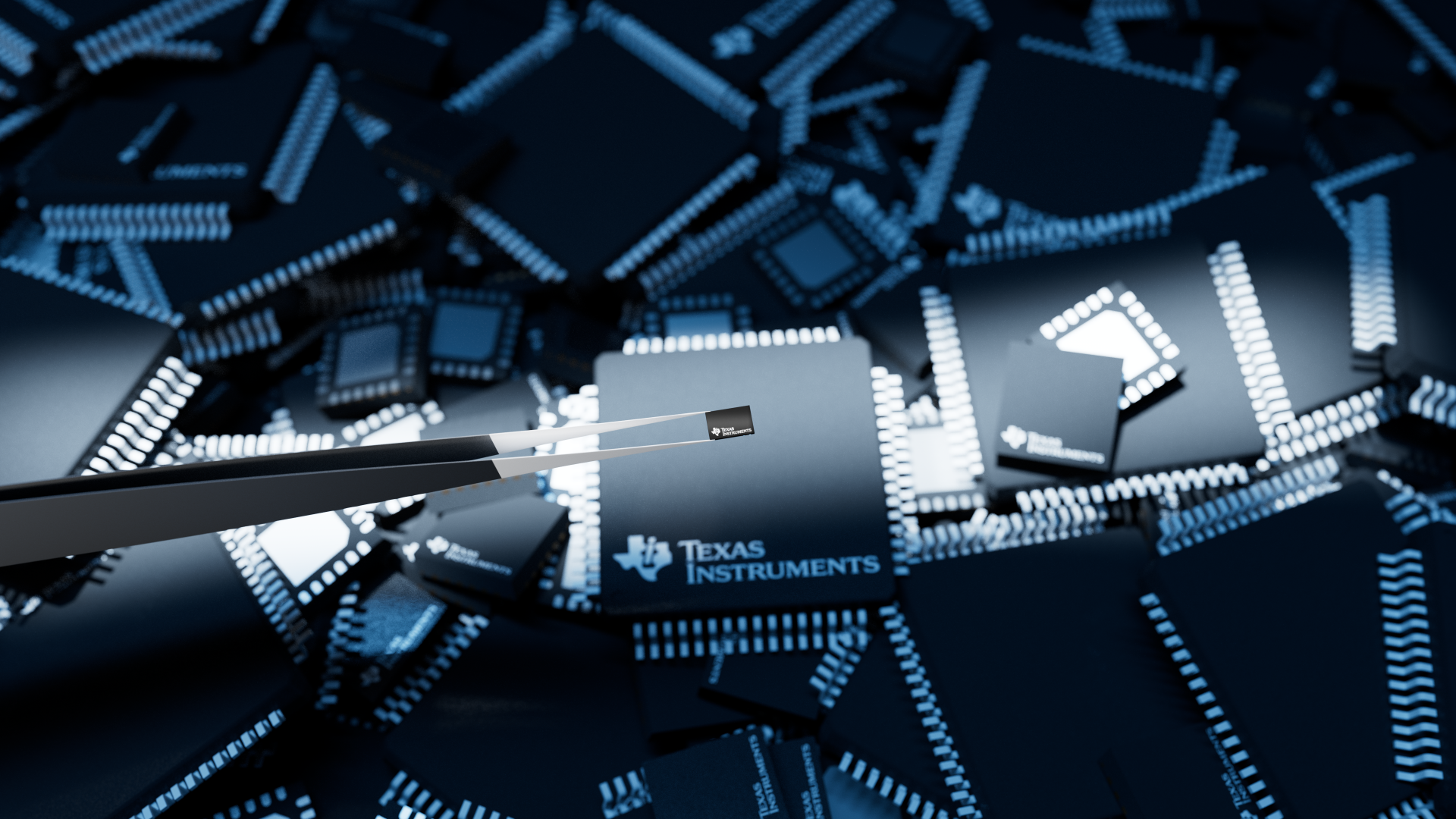
Texas Instruments (TI) introduced two new microcontroller (MCU) families with edge artificial intelligence (AI) capabilities, supporting the company’s commitment to enabling edge AI across its entire embedded processing portfolio. The MSPM0G5187 and AM13Ex MCUs integrate TI’s TinyEngine neural processing unit (NPU), a dedicated hardware accelerator for MCUs that optimises deep learning inference operations to reduce latency and improve energy efficiency when processing at the edge.
TI’s embedded processing portfolio is supported by a comprehensive development ecosystem, including the CCStudio integrated development environment (IDE). Its generative AI features allow engineers to use simple language to accelerate code development, system configuration and debugging through industry-standard agents and models paired with TI data. Altogether, TI is accelerating the adoption of edge AI across electronic devices, from real-time monitoring in wearable health monitors and home circuit breakers to physical AI in humanoid robots. These end-to-end innovations are featured in TI’s booth at embedded world 2026, March 10-12, in Nuremberg, Germany.



“TI invented the digital signal processor almost 50 years ago, laying the groundwork for today’s edge AI processing,” said Amichai Ron, senior vice president, Embedded Processing and DLP® Products at TI. “Now TI is leading the next phase of innovation by integrating the TinyEngine NPU across our entire microcontroller portfolio, including general-purpose and high-performance, real-time MCUs. By enabling AI across our software, tools, devices and ecosystem, we are making edge AI accessible and easy to use for every customer and every application.”
“While much of the world has been focused on AI acceleration and NPUs in bigger SoCs, it turns out some of the more interesting and far-reaching applications of AI can be enabled inside smaller chips like microcontrollers,” said Bob O’Donnell, President and Chief Analyst at TECHnalysis Research. “Edge-based applications of AI acceleration can make consumer devices more intelligent and industrial devices more efficient. Plus, if you can combine these chips with software development tools that themselves leverage AI to help build AI features, you bring the power of AI acceleration to a significantly wider audience of engineers and device designers.”
Advanced intelligence at your fingertips
Consumers are always looking for everyday technology to be more intelligent, from fitness wearables to home appliances and electrical systems. However, many engineers believe that AI capabilities are limited to higher-end applications due to high costs, power demands, and coding requirements. TI’s new MSPM0G5187 Arm Cortex-M0+ MSPM0 MCU represents a fundamental shift for embedded designers, who can now bring edge AI to a wide range of simpler, smaller and more cost-effective applications.
With local computation, the TinyEngine NPU executes computations required by neural networks in parallel to the primary CPU running application code. Compared to similar MCUs without an accelerator, this hardware acceleration:
- Minimises the flash memory footprint.
- Lowers latency by up to 90 times per AI inference.
- Reduces energy utilisation by more than 120 times per AI inference.
Such levels of efficiency allow resource-constrained devices – including portable, battery-powered products – to process AI workloads. At under US$1 in 1,000-unit quantities, the MSPM0G5187 MCU reduces system and operating costs by offering an affordable alternative to other MCU or processor architectures.
Real-time control plus AI acceleration for multimotor systems
Motor control applications in appliances, robotics and industrial systems increasingly call for intelligent features such as adaptive control and predictive maintenance, but implementing these capabilities has historically required complex, multi-chip designs. Building on over two decades of motor control leadership through the C2000™ real-time MCU portfolio, TI’s new AM13Ex MCUs are the industry’s first to integrate a high-performance Arm Cortex-M33 core, TinyEngine NPU and advanced real-time control architecture into a single chip.
This degree of integration enables designers to implement sophisticated motor control and AI features simultaneously without external components, lowering bill-of-materials costs by up to 30%. Key enhancements include:
- The ability to maintain precise real-time control loops for up to four motors while the TinyEngine NPU runs adaptive control algorithms for load sensing and energy optimisation.
- An integrated trigonometric math accelerator that performs calculations 10 times faster than coordinate rotation digital computer (CORDIC) implementations, delivering more precise, responsive motor-control performance.
Easily train, optimise and deploy AI models
Both MCU families are supported by TI’s CCStudio Edge AI Studio, a free development environment that simplifies model selection, training and deployment across TI’s embedded processing portfolio. This edge AI toolchain gives engineers full flexibility to run AI models on TI MCUs through either hardware or software implementations. Today, there are more than 60 models and application examples available in the tool to help developers start deploying edge AI in any device, with additional tasks and models planned in the future.

