

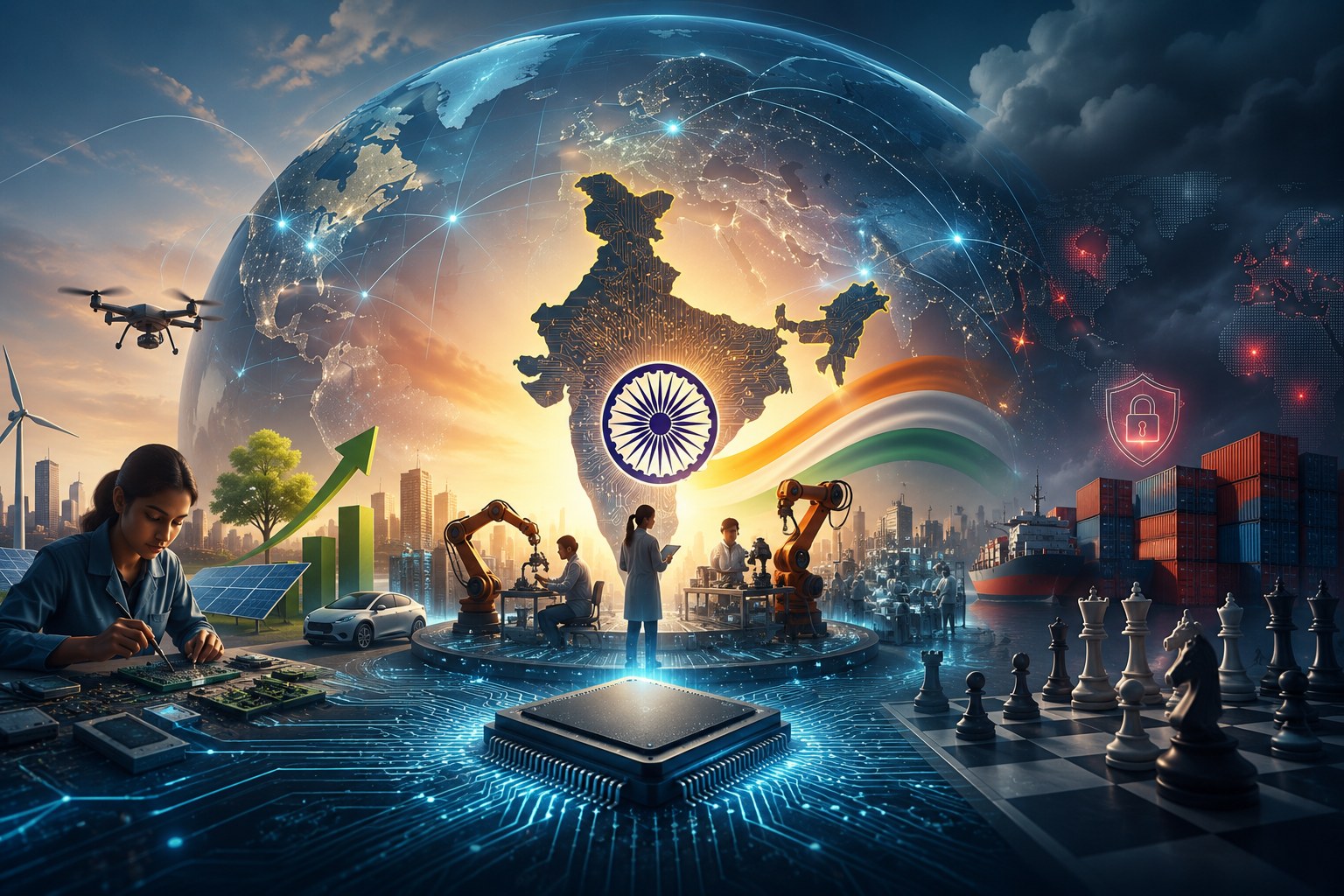
The global electronics industry is witnessing its most significant restructuring since the rise of Asia as the world’s manufacturing hub three decades ago. What was once driven primarily by cost efficiencies and globalization is now being reshaped by geopolitics, strategic autonomy, supply chain security, and technological sovereignty. Electronics has ceased to be merely an industrial sector; it has become a geopolitical instrument.
The emergence of the “China Plus One” strategy symbolizes this transformation. Nations and corporations across the world are seeking to diversify manufacturing footprints beyond China, not necessarily to replace China, but to reduce excessive dependence on a single geography. The disruptions caused by the COVID-19 pandemic, semiconductor shortages, trade tensions, and evolving geopolitical rivalries exposed vulnerabilities in global supply chains that had long been ignored in pursuit of efficiency.



China’s dominance in electronics manufacturing remains unparalleled. From consumer electronics and telecom equipment to batteries, solar cells, and semiconductor packaging, China has built an industrial ecosystem that is difficult to replicate overnight. More importantly, it controls a substantial portion of the global rare earth value chain, including mining, refining, and processing. Rare earth elements are indispensable for electric vehicles, renewable energy systems, advanced electronics, defence platforms, and semiconductor manufacturing.
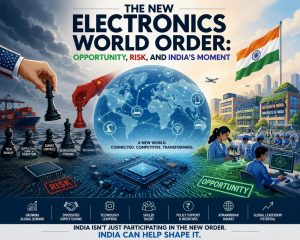
This concentration of strategic resources has become a major concern for governments worldwide. As geopolitical competition intensifies, access to critical minerals is increasingly viewed through the lens of national security. The world has learned that dependence on a single source for critical inputs can become a strategic vulnerability.
Consequently, efforts are accelerating to identify alternatives. Countries including the United States, Australia, Canada, Japan, and members of the European Union are investing heavily in alternative rare earth supply chains. Research institutions and technology companies are exploring substitute materials, recycling technologies, and rare-earth-free magnet designs. Innovations in ferrite magnets, advanced composites, nanomaterials, and material science are gradually reducing dependence on traditional rare earths in selected applications.
However, the reality remains that there is no immediate substitute for many critical rare earth elements. The challenge is not merely discovering alternatives but achieving commercial viability at scale. The future is therefore likely to be defined by a combination of diversification, recycling, strategic stockpiling, and technological innovation.
At the same time, the United States faces a different challenge. Despite being the world’s leader in semiconductor design, software, and innovation, it has struggled to maintain large-scale manufacturing competitiveness. Decades of offshoring have hollowed out portions of the manufacturing ecosystem. While initiatives such as the CHIPS Act represent a major commitment toward rebuilding domestic semiconductor capacity, establishing fabrication facilities is only one piece of the puzzle. Manufacturing excellence requires an entire ecosystem of suppliers, materials, a skilled workforce, logistics, packaging, testing, and supporting industries.
This reality underscores a fundamental lesson: manufacturing ecosystems cannot be created overnight. They evolve through sustained investments, policy consistency, talent development, and industrial clustering over decades.
Against this backdrop, India finds itself at a historic inflection point.
India’s Electronics System Design and Manufacturing (ESDM) journey has evolved remarkably over the past decade. From being largely an importer of electronic products, the country has steadily built capabilities in mobile phone manufacturing, electronics assembly, semiconductor packaging, design services, and component production. Policy initiatives such as Production Linked Incentive (PLI) schemes, semiconductor missions, design-linked incentives, and infrastructure development have begun to attract global investments.
India’s strengths extend beyond cost competitiveness. The country possesses one of the world’s largest engineering talent pools, a rapidly growing domestic market, a vibrant startup ecosystem, and increasing geopolitical trust among major global powers. As companies seek resilient and diversified supply chains, India is emerging as a credible long-term partner.
Yet, India must recognize that the opportunity presented by China Plus One is not automatic. Competing nations such as Vietnam, Thailand, Malaysia, Indonesia, and Mexico are equally determined to attract global investments. The race is not merely for assembly operations but for ownership of high-value segments including semiconductor fabrication, advanced packaging, component manufacturing, industrial electronics, defence electronics, and next-generation technologies.
The next phase of India’s ESDM evolution must therefore focus on deep manufacturing capabilities. Component ecosystems, semiconductor materials, specialty chemicals, electronic-grade gases, passive components, sensors, power electronics, and advanced manufacturing equipment need equal attention. Without these foundational layers, value addition remains limited.
The electronics industry today sits at the intersection of economics, technology, and geopolitics. Semiconductors have become strategic assets. Rare earth minerals have become instruments of influence. Supply chains have become matters of national security. Manufacturing capacity has become a measure of strategic resilience.
A new world order is emerging where technological capability will increasingly determine economic power and geopolitical influence. Nations that control critical technologies, advanced manufacturing, intellectual property, and strategic resources will shape the contours of the twenty-first century.
For India, this moment represents more than an industrial opportunity. It is an opportunity to redefine its position in the global technology landscape. The objective should not merely be to become an alternative manufacturing destination but to emerge as a technology creator, innovation hub, and trusted global electronics powerhouse.
The global electronics industry is entering an era where resilience may become as important as efficiency, strategic autonomy as important as globalization, and innovation as important as scale. In this evolving landscape, India has the potential to become one of the defining success stories of the next industrial age.
The question is no longer whether the global electronics supply chain will diversify. The question is who will lead the next chapter of that transformation.
India has a rare opportunity to ensure that it is among the leaders writing that story.

