
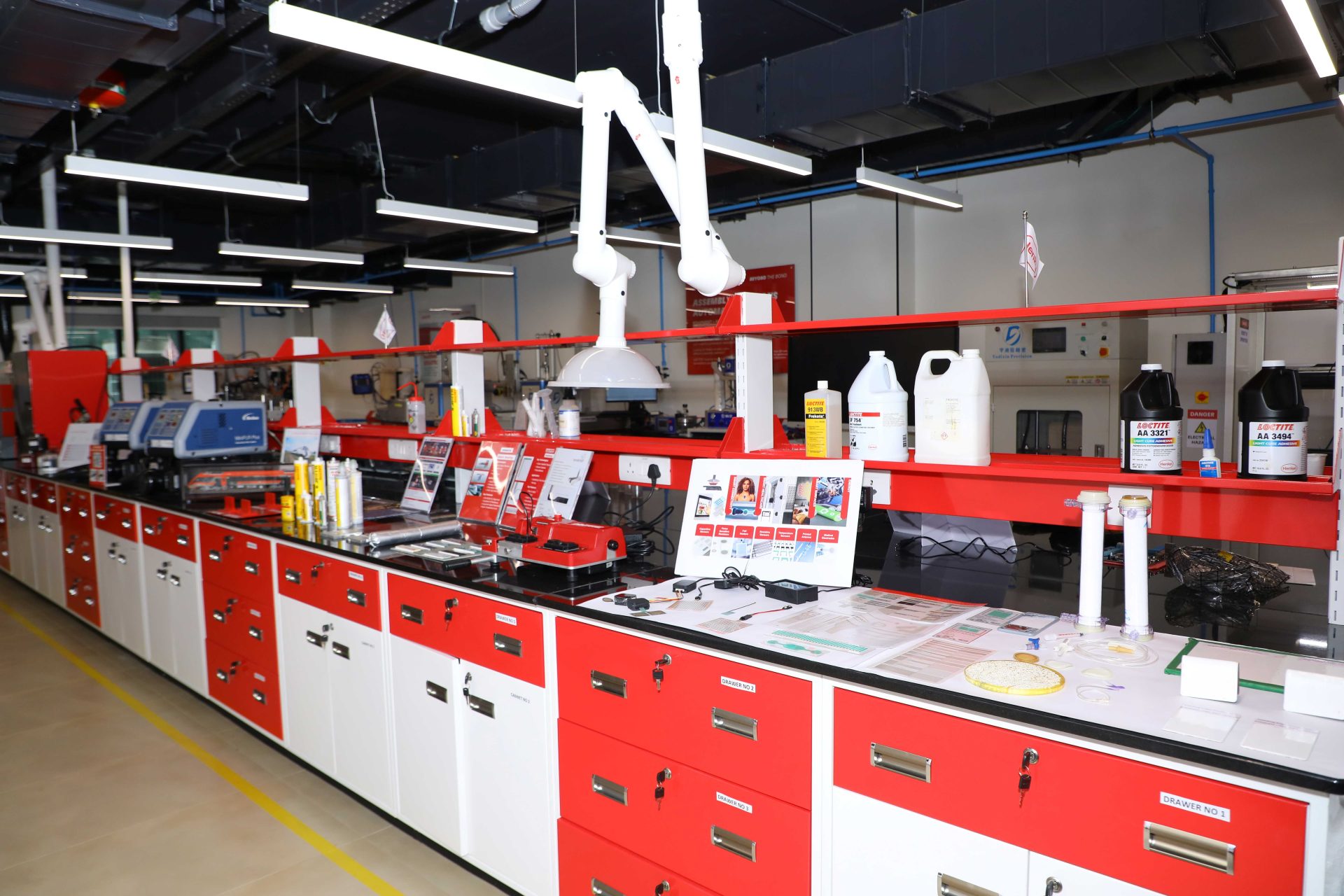
Henkel has announced the launch of its Customer Application Centre in Bengaluru, reinforcing its commitment to India’s rapidly expanding electronics manufacturing sector. The new facility will serve as a collaborative innovation hub where Henkel experts and customers can co-develop, test, and validate advanced adhesive and thermal management solutions for next-generation electronics manufacturing.
The new facility represents one of Henkel’s most significant application engineering commitments in the India Middle East and Africa (IMEA) region, and is designed to address a critical gap in India’s electronics value chain: the absence of localized, world-class application testing and validation infrastructure that allows manufacturers to develop, qualify, and scale advanced materials solutions without the time and cost of sending work overseas.




India’s electronics manufacturing sector has grown nearly sixfold over the past decade. The momentum is accelerating, driven by the rapid build-out of data centre and AI computing infrastructure, 5G and fibre network expansion, electric vehicle charging systems, industrial automation, and advanced medical devices. Each of these sectors depends critically on high-performance adhesives, thermal management materials, and protective coatings, and each demands faster, more localised application engineering support than India’s ecosystem has traditionally been able to provide.
Bengaluru was a natural choice. The city’s concentration of semiconductor design talent, electronics R&D centres, and global OEM engineering teams makes it the single most important node in India’s electronics innovation ecosystem. Locating the centre here puts Henkel’s application expertise directly alongside the engineers and manufacturers who need it most.
“India’s electronics manufacturing ecosystem is at an inflexion point, and Bengaluru is at the centre of it,” said S. Sunil Kumar, Country President – India, Henkel. “What manufacturers across our focus sectors increasingly need is not just world-class materials, but a local partner who can co-develop, test, and validate those materials under real production conditions, and help them move from concept to market faster. That is precisely what this centre is designed to do. It is our most tangible expression yet of Henkel’s long-term commitment to India’s electronics future.”
The 5,000 sq. ft. facility, of which approximately 2,400 sq. ft. is dedicated laboratory and testing space, is built to replicate actual electronics manufacturing conditions, allowing customers to evaluate and optimise materials and processes before committing to production scale. Around 60-65% of the investment has gone into advanced lab and testing equipment, with 20-25% directed at customer co-development infrastructure.
The facility serves five high-growth sectors: telecom and 5G infrastructure, data centres and AI computing, power electronics and EV systems, industrial automation, and medical electronics. Its key capabilities span advanced thermal management testing, precision dispensing systems, electrical characterisation tools, and rapid-cure chambers, supporting the full journey from prototyping and material validation through to production readiness.
The centre directly supports India’s Make-in-India and Production-Linked-Incentive objectives by bringing application engineering, process optimisation, and reliability validation onshore. A substantial share of activities that Indian electronics manufacturers previously had to route through overseas facilities, or simply defer, can now be conducted locally, compressing development cycles and accelerating time to market.
Henkel application experts will work side-by-side with customer engineering teams at the facility, co-developing solutions tailored to specific device architectures and manufacturing requirements. This collaboration model is central to the centre’s design and is what distinguishes it from a conventional testing laboratory.

