
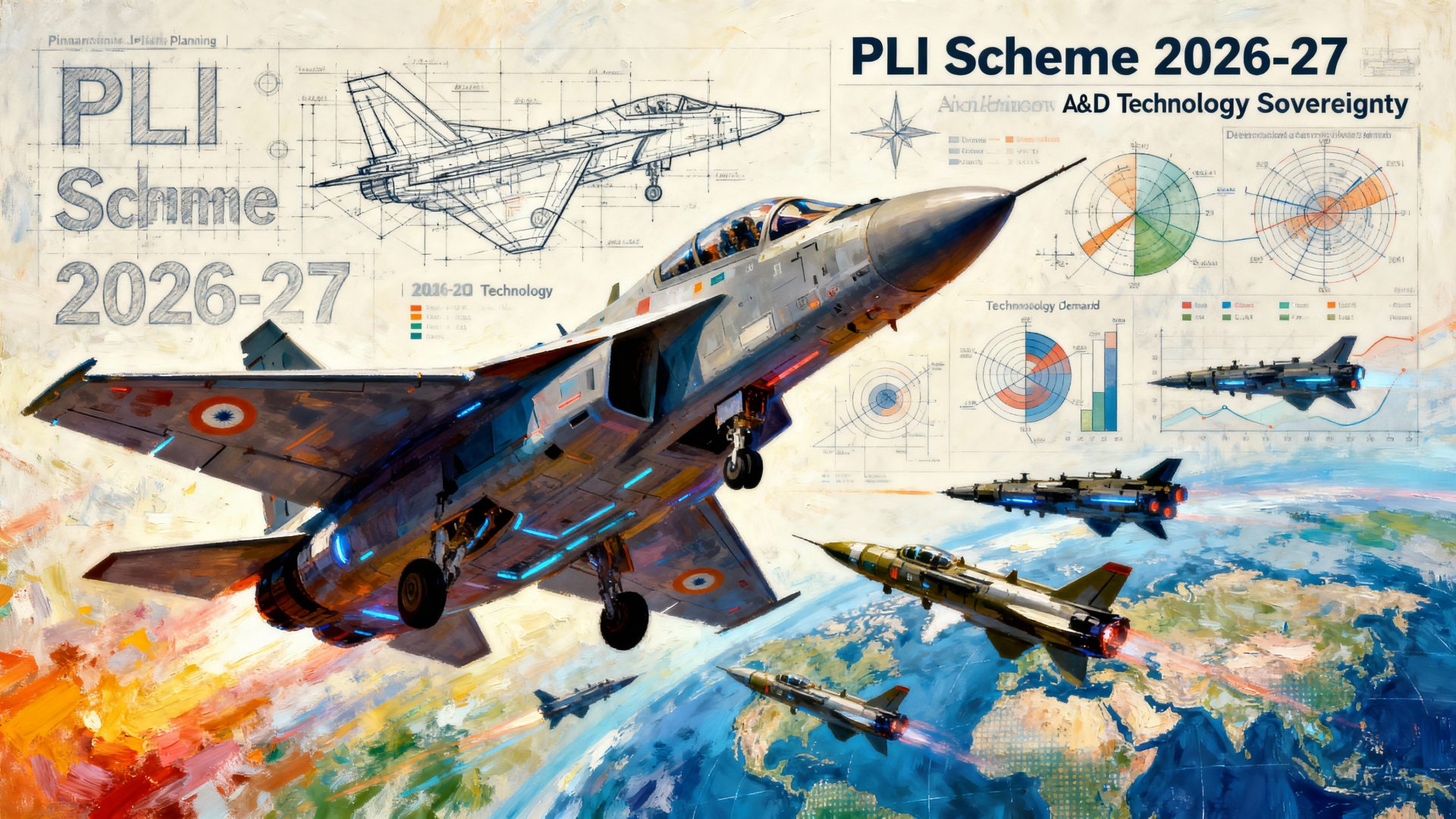
As the Union Budget approaches, the spotlight intensifies on India’s aerospace and defence technology sector, a vertical that has transitioned from a heavy importer to a nascent global manufacturing hub. The numbers tell a story of aggressive scaling: under the aegis of “Atmanirbhar Bharat,” domestic defence production surged to a historic ₹1.27 lakh crore in FY 2023-24.
However, for an industry eyeing a $5 trillion economy, this record high is viewed not as a finish line, but as a baseline. The shift toward indigenous manufacturing has fundamentally rewired the nation’s military-industrial complex, replacing foreign dependency with homegrown R&D and high-tech sovereignty. As the government prepares to lay out its fiscal roadmap, the industry is looking for more than just procurement orders; it is looking for deep-tech incentives, streamlined export pathways, and sustained capital outlay.




This budget will be a litmus test for India’s self-reliance commitment. Stakeholders are bracing for announcements that could further catalyse the aerospace ecosystem, ensuring that “Made in India” weaponry and avionics don’t just meet internal security needs but become a cornerstone of India’s global economic footprint.
The Tech-Sovereignty Mandate
As the lines between commercial innovation and battlefield superiority blur, technology has emerged as the definitive fulcrum for India’s tri-service modernisation. Industry experts argue that the upcoming Budget presents a pivotal window to institutionalise this convergence through aggressive structural reforms.
Central to this discourse is the evolution of the Production Linked Incentive (PLI) Scheme. While the current framework has provided a vital tailwind for the drone industry, there is a growing consensus that a “narrow-lens” approach is no longer sufficient. To truly insulate India’s supply chain from global volatility, the PLI umbrella must expand to cover the high-stakes world of dual-use technologies.
In terms of using technology in aerospace and defence technology development, the use of AI and related features will play a significant role.
“Investing in digital twins and simulation technology for testing and research in aviation and defence can boost precision and efficiency in the electronic manufacturing industry. Tecknotrove urges the government to prioritize use of digital twin technology in this financial budget. It’s a strategic move that will amplify innovation, save research and development and manufacturing costs, and drive India’s self-reliance in manufacturing. Digital twins aren’t just a trend—they’re a game-changer. With decades of expertise in digital twins for aviation and defence, we have seen this technology helping in at least 30% reduction in costs,” says Payal Gupta, Co-Founder, Director-Business Development, Tecknotrove Systems India Pvt. Ltd.
The strategic roadmap for the FY 2026-27 fiscal cycle should ideally prioritise:
- The Full Drone Spectrum: Moving beyond basic assembly to incentivise the manufacturing of high-endurance propulsion systems and autonomous flight controllers.
- Electronic Warfare & Surveillance: Bringing Airborne Early Warning (AEW) systems, jamming devices, and advanced radar arrays under the incentive net to neutralise import dependencies.
- The Robotics Frontier: Providing fiscal stimulus for indigenous sensors and robotic systems that will define the future of unmanned combat and deep-space communication.
By widening these incentive corridors, the government can transform the “Make in India” initiative from a manufacturing slogan into a high-tech powerhouse, ensuring that the next generation of aerospace sensors and AI-driven robotics are conceived, designed, and built on Indian soil.
By: Shreya Bansal, Sub-Editor

