
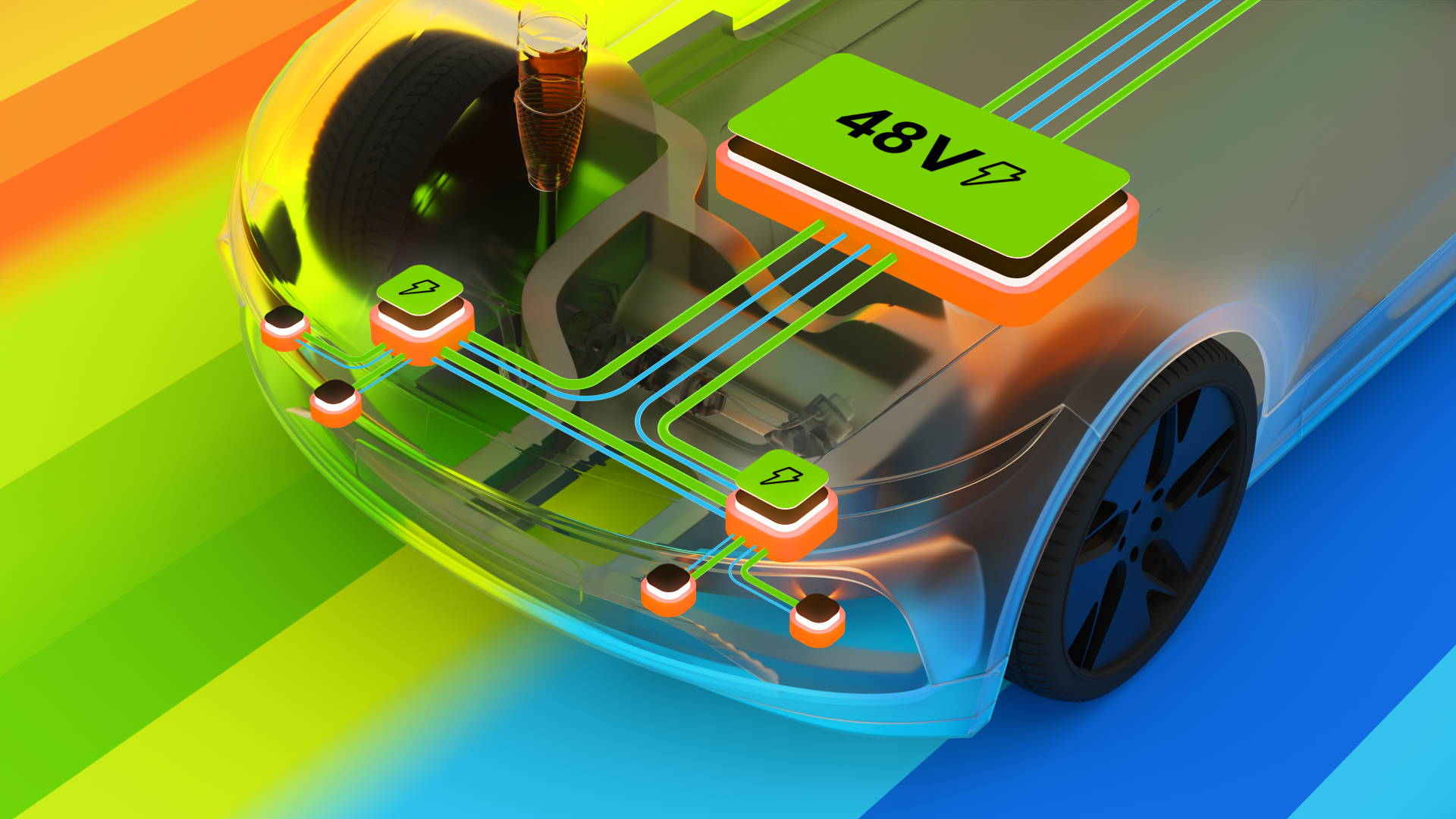
NXP Semiconductors introduced its NXP CoreRide Z248 zonal reference system – the semiconductor industry’s first pre-validated, design-ready zonal foundation that combines advanced 48 V energy distribution, deterministic data handling, functional safety, and real-time responsiveness. The hardware-software foundation is designed to optimise system performance, reduce system integration effort, shorten development cycles, and allow OEMs and Tier 1s to focus investment where it matters most. It sets a new benchmark for accelerating the journey from zonal architecture concepts to production‑ready implementations.
Built on NXP’s S32K5 microcontroller series, its integrated advanced MRAM technology unlocks ultra-fast, ultra-frequent over-the-air updates throughout the entire vehicle lifecycle. At the software level, the Z248 integrates a comprehensive pre-validated software stack that streamlines complex development of smart data energy network (SDEN) functionalities such as impedance, power and protection monitoring, intelligent data routing, AI‑enabled virtual sensing, diagnostics, and audio.



With its built-in, validated remote protocol stack (RCP), it supports the up-integration of end node functions and ECU consolidation to enable new cost-optimised vehicle architectures. It also addresses key challenges of 48 V zonal systems by managing energy conversion, distribution, and protection within a single, integrated architecture.
The Z248 is rigorously validated through thousands of system-level tests demonstrating outstanding low-power modes, fast boot and fast wake-up response. It is supported by a modern, collaborative continuous integration, continuous testing and continuous delivery (CI/CT/CD) development environment that allows significantly faster test loops with OEMs and tier 1s, shortening validation cycles.
Why it matters: Automakers are being asked to move faster, scale broader, and spend smarter – even as safe zonal consolidation, hybrid power systems, and AI-enabled features dramatically increase architecture complexity. NXP’s new CoreRide zonal reference system brings scalability to this rising architectural complexity. It reduces risk by helping OEMs and tier 1s accelerate development into production, and it eases the switch from legacy platforms and lower total cost of ownership – freeing them from complex integration to put them on a path to production.
“As new E/E architectures redefine vehicle design, our focus is simple: give the automotive ecosystem the foundation to move faster and differentiate with confidence,” said Sébastien Clamagirand, SVP and General Manager, Automotive Systems & Platforms at NXP Semiconductors. “The NXP CoreRide zonal reference system Z248 delivers a performance-optimised, scalable 48 V foundation that intelligently fuses power, data and software, while dramatically simplifying system integration, reducing time to market, and enabling OEMs to focus on vehicle differentiation and long‑term value creation.”
More details: The Z248 zonal reference system is delivered with a complete Board Support Package (BSP) with pre-integrated software from the NXP CoreRide partner ecosystem, including GLIWA’s performance monitoring suite, Green Hills’ software compiler and Vector’s embedded software and tools. The full package undergoes extensive validation to help ensure optimised performance, while continuously improving processing efficiency and power consumption based on the primary use cases of a zonal ECU.
It’s a scalable, safe and secure hardware-software stack that adapts easily to different variants of SDV E/E architectures and integrates naturally with NXP’s broader system offering. It leverages technologies across computing, networking, power management and 48 V energy distribution, including NXP’s S32K566 zonal microcontroller featuring on-chip MRAM that significantly accelerates ECU programming times, both in factory settings and during over-the-air (OTA) updates.
The reference system also integrates 48‑volt‑capable power components such as eFuse, PMIC and DC‑DC converters, robust in‑vehicle networking through Ethernet PHY and CAN transceivers, and built-in audio support. In addition, it introduces a new concept for zonal I/O extension. Designed for broad applicability with housing and a wiring loom, the new NXP CoreRide Z248 zonal reference system can be deployed across ICE, hybrid and BEV platforms, supporting the industry’s move toward zonal processing and ECU consolidation.
Ecosystem Voices
Peter Gliwa, CEO and Founder of GLIWA
“NXP understood that the eco-system, the tooling around a new platform, is essential for its success. With our Analysis Suite T1 built into the NXP CoreRide Z248 zonal reference system, high efficiency, proper timing analysis and timing verification are very well addressed.”
Dan Mender, Vice President of Business Development at Green Hills Software
“Green Hills is proud to play a central role in NXP’s transformative reference solution strategy, which simplifies and accelerates production-focused automotive ECU development through pre-integrated hardware and software optimised for zonal automotive architectures. By leveraging Green Hills’ integrated software solutions, customers can develop high-quality, safety-critical applications with a minimal footprint and optimal performance, while significantly reducing time to deployment.”
Sam Yeh, Chairman of Inventec
“In response to the automotive E/E architecture trend toward zonal and centralised designs, Inventec is collaborating with NXP Semiconductors to support the advancement of next-generation zonal architectures. Through this collaboration, Inventec can provide hardware design and JDM support to OEMs as part of NXP’s zonal E/E architecture initiatives.”
Jochen Rein, Senior Vice President, Business Unit Software Platform at Vector
“The combination of the NXP CoreRide platform and Vector’s software foundation provides a robust basis for next‑generation zonal architectures. We enable our joint customers to reduce their time- to-market due to a pre-integrated and highly optimised software stack.” Vector contributes as an NXP CoreRide partner, providing pre‑integrated software and tools that help streamline development and ensure smooth integration within the zonal ECU architecture.”

