
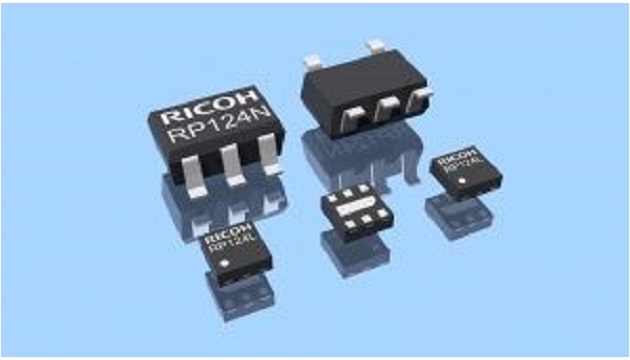
Ricoh has launched a low quiescent current LDO regulator with an integrated battery voltage monitor and an output enable pin.
The regulator, designated RP124, has a current consumption of 0.3µA (at no-load), extending the lifetime of battery powered devices, which is important for those applications that are mainly in sleep mode and resume for a periodical brief moment to perform a task.




A conventional way to measure the remaining battery charge is using an external resistor divider + MOSFET connected to an A/D Converter, however, the input impedance of this solution is typically low resulting in a considerable current flow to ground, draining the battery and limiting the lifetime of the application.
The RP124 provides a solution to this with a built-in high-value resistor divider, plus a voltage follower as a buffer. This gives the chip a lower current flow to ground, while providing a strong output that is compatible with the input impedance of the A/D converter.
Not all version have the output-shorting fet, and in some versions ‘CE’ disables the monitor circuit rather than the main regulator
In addition, all essential components for this circuit are integrated into the chip, reducing valuable circuit board space and cost – it needs only three external capacitors (input, output and one on the voltage monitor output). In this way, it is possible to make a simple voltage-based fuel gauge for primary batteries, for example.
Intended applications live mainly in a sleep mode and only wake up briefly to perform a measurement, transmits some data and go back to the sleep mode again. Input range is 1.7 to 5.5V (6.5V abs max), and output options are: 1.2, 1.5, 1.8, 2.4, 2.5, 2.7, 2.8, 3.0, 3.1, 3.3 and 3.6V – all ±0.8% and at up to 100mA.

