
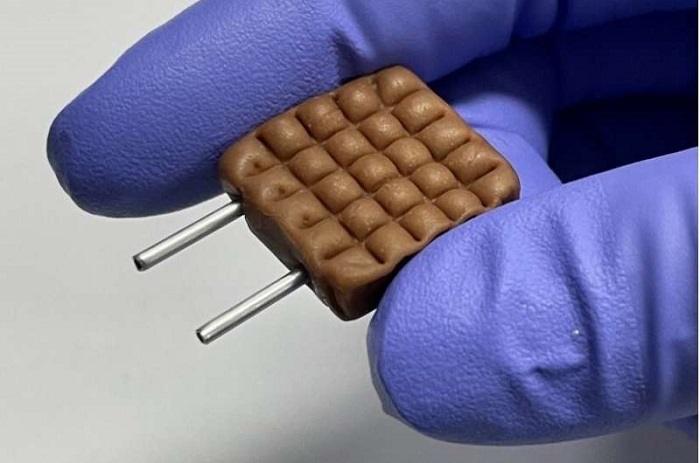
Single-use diagnostic tests often aren’t practical for health professionals or patients in resource-limited areas, where cost and waste disposal are big concerns. So, researchers have turned to a surprising material, Tootsie Roll candy, to develop an inexpensive and low-waste device. The candy was used as an electrode, the part of the sensor that detects salt and electrolyte levels in saliva, to monitor ovulation status or kidney health.
Disposable test strips have advanced the speed and accuracy of at-home health monitoring. For example, ovulation predictor kits measure luteinizing hormone levels, and there are test strips that measure creatinine levels for patients with chronic kidney disease. However, their costs add up quickly and, between the packaging and the strips themselves, there’s a lot of waste that needs to be disposed of. Previous researchers have indicated that simple measurements of a person’s salivary salt and electrolyte content could be appropriate for managing some conditions. So, Beelee Chua and Donghyun Lee wanted to repurpose unconventional and widely available materials, including electrically conductive soft candies, into an easily accessible, low-waste sensor that could simply be licked by patients to analyze their saliva.




To make the prototype sensor, the researchers first flattened a Tootsie Roll and pressed crevices into its surface in a crosshatched pattern to hold the saliva sample. Then, they inserted two thin, reusable aluminum tubes, which acted as electrical contacts, connecting the candy electrode into a circuit with a current source and an output voltage detector. In preliminary tests, the device could measure salt levels that were physiologically relevant for health monitoring in a salt-water solution and artificial saliva. For example, when covered in diluted artificial saliva, the sensor could reliably measure a change in voltage low enough to detect the 10 to 30 percent drop in salts that occurs when a person ovulates. While the maximum salt content in the artificial saliva samples was similar to that of a healthy adult, the researchers used calculations to estimate that conductivities three times higher, which signal a problem with the kidneys, would be within the measurable range of the device. Although testing with real human samples is still needed, the researchers say that using soft candy as electrodes opens up the possibility for low-waste, inexpensive electrochemical sensors and circuits in the future.

