
Southern Green Gas Ltd (SGG) and Swiss Re, one of the world’s leading providers of reinsurance, insurance and other forms of risk-based transfer, have agreed to collaborate on Carbon Removals initiatives in Australia involving Direct Air Capture of CO2 (DAC).
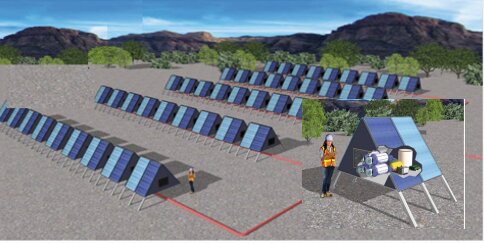
The collaboration comes as SGG advances the development of its world leading technology for solar powered DAC modules.




The modules utilize metal organic framework nano-materials to preferentially adsorb CO2 from the air, as well as incorporating design-for-manufacture that facilitates low cost high volume manufacture in Australia.
Because the DAC technology is fully solar powered and removes CO2 from the air, it is delivering negative emissions, essential to achieving Net Zero emissions.
SGG has set a medium-term cost target of $100 per ton of CO2, at which point the modules should underpin development of major carbon removal projects within Australia.
SGG and Swiss Re will collaborate on Carbon Removals in the following areas:
- Building awareness amongst key stakeholders in Australia of the opportunity for Carbon Removals
- Educating international stakeholders on Australia’s world leading potential for Carbon Removals
- Facilitating access to funding for demonstration projects
- Creating consortia of project investors and off-take customers to make projects bankable
Head of Swiss Re Australia & New Zealand, Sharon Ooi, said the organization’s collaboration with SGG aligns with its global commitment on sustainability and net-zero.
“The carbon removal market creates a new ecosystem of stakeholders and needs—and with that comes opportunities to build expertise and commercialize this new risk pool,” said Ooi.
Swiss Re advocates for emissions reduction first, then removal.
“There will always be emissions from bushfires, hard-to-abate sectors and historic residual emissions, so carbon removal needs to be part of our planning to reduce present day emissions and the carbon built up in the atmosphere,” said Mark Senkevics, Head of Property & Casualty Underwriting, Asia, Australia & New Zealand at Swiss Re.
“Nature-based solutions are accessible and ready to use but will not do the job alone, so we must drive a balanced mix of natural and tech solutions to achieve and sustain the 1.5°C target.”
A recent Swiss Re Institute report highlights that achieving net-zero emissions involves building a carbon removal industry capable of delivering negative emissions at the speed (within three decades) and scale (10–20 billion tons per year) that climate science says will be required to enable sustainable living for future generations.
SGG Managing Director Mr Rohan Gillespie said “Australia is well placed to make a significant contribution to this major Carbon Removal task. Numerous studies have identified both onshore and offshore basins with the potential capacity to permanently store hundreds of billions of tons of CO2. We are excited by this collaboration with Swiss Re, one of the world’s foremost leaders in advocating for and assisting in the emergence of Carbon Removal as a new industry to tackle climate change.”

