
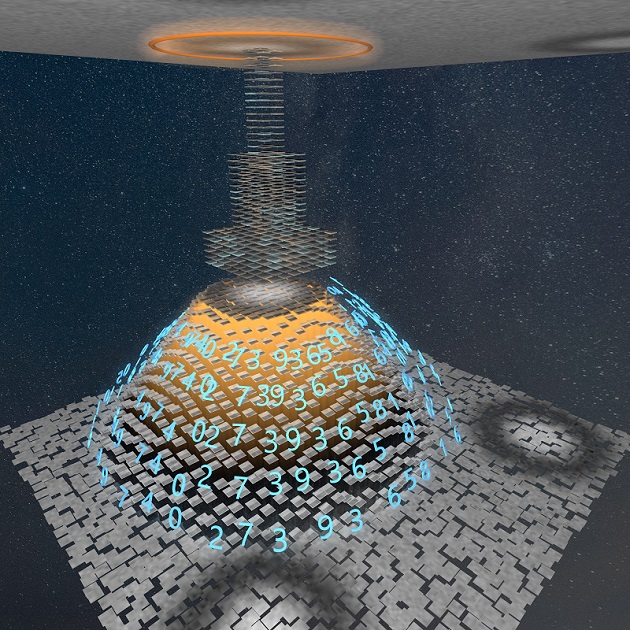
An AI tool developed offers new opportunities for analyzing images taken with microscopes. A study shows that the tool, which has already received international recognition, can fundamentally change microscopy and pave the way for new discoveries and areas of use within both research and industry.
The focus of the study is deep learning, a type of artificial intelligence (AI) and machine learning that we all interact with daily, often without thinking about it. For example, when a new song on Spotify pops up that is similar to songs we have previously listened to or when our mobile phone camera automatically finds the best settings and corrects colors in a photo.




Deep learning has taken the world by storm and has had a huge impact on many industries, sectors, and scientific fields. A tool has been developed that makes it possible to utilize the incredible potential of deep learning, with a focus on images taken with microscopes.
Deep learning can be described as a mathematical model used to solve problems that are difficult to tackle using traditional algorithmic methods. In microscopy, the great challenge is to retrieve as much information as possible from the data-packed images, and this is where deep learning has proven to be very effective.
The tool that has been developed involves neural networks learning to retrieve exactly the information that a researcher wants from an image by looking through a huge number of images, known as training data. The tool simplifies the process of producing training data compared with having to do so manually so that tens of thousands of images can be generated in an hour instead of a hundred in a month. This makes it possible to quickly extract more details from microscope images without needing to create a complicated analysis with traditional methods. In addition, the results are reproducible and customized, specific information can be retrieved for a specific purpose.
For example, the tool allows the user to decide the size and material characteristics for very small particles and to easily count and classify cells. The researchers have already demonstrated that the tool can be used by industries that need to purify their emissions since they can see in real-time whether all unwanted particles have been filtered out.
The researchers are hopeful that in the future the tool can be used to follow infections in a cell and map cellular defense mechanisms, which would open up huge possibilities for new medicines and treatments.

