
HomeTechnologyArtificial IntelligenceNew AI Tool Tracks Evolution of COVID-19 Conspiracy Theories on Social Media

    New AI Tool Tracks Evolution of COVID-19 Conspiracy Theories on Social Media

    A new machine-learning program accurately identifies COVID-19-related conspiracy theories on social media and models how they evolved over time—a tool that could someday help public health officials combat misinformation online.

    A lot of machine-learning studies related to misinformation on social media focus on identifying different kinds of conspiracy theories. Instead, we wanted to create a more cohesive understanding of how misinformation changes as it spreads. Because people tend to believe the first message they encounter, public health officials could someday monitor which conspiracy theories are gaining traction on social media and craft factual public information campaigns to preempt widespread acceptance of falsehoods.


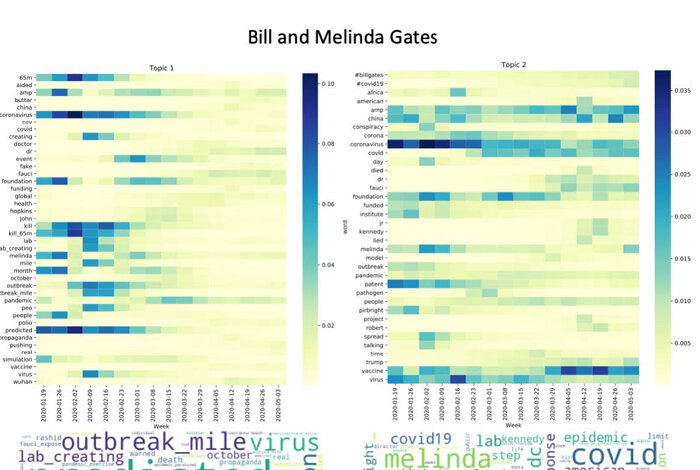
    The study, anonymized Twitter data to characterize four COVID-19 conspiracy theory themes and provide context for each through the first five months of the pandemic. The four themes the study examined were that 5G cell towers spread the virus; that the Bill and Melinda Gates Foundation engineered or has otherwise malicious intent related to COVID-19; that the virus was bioengineered or was developed in a laboratory; and that the COVID-19 vaccines, which were then all still in development, would be dangerous.

    “We began with a dataset of approximately 1.8 million tweets that contained COVID-19 keywords or were from health-related Twitter accounts,” said Dax Gerts, a computer scientist also in Los Alamos’ Information Systems and Modeling Group, and the study’s co-author. “From this body of data, we identified subsets that matched the four conspiracy theories using pattern filtering, and hand-labeled several hundred tweets in each conspiracy theory category to construct training sets.”

    Using the data collected for each of the four theories, the team built random forest machine-learning, or artificial intelligence (AI), models that categorized tweets as COVID-19 misinformation or not.

    ELE Times Research Desk
    ELE Times Research Deskhttps://www.eletimes.ai
    ELE Times provides extensive global coverage of Electronics, Technology and the Market. In addition to providing in-depth articles, ELE Times attracts the industry’s largest, qualified and highly engaged audiences, who appreciate our timely, relevant content and popular formats. ELE Times helps you build experience, drive traffic, communicate your contributions to the right audience, generate leads and market your products favourably.

    Related News

    Must Read

    AI Glasses: Ushering in the Next Generation of Advanced Wearable Technology

    Courtesy: NXP Semiconductors   AI integration into wearable technology is...

    The semiconductor technology shaping the autonomous driving experience

    Courtesy: Texas Instruments Last summer in Italy, I held...

    The electronics Industry in 2026 and Beyond: A Strategic Crossroads

    As we stand on the threshold of 2026, the...

    Keysight & Samsung: Industry-First NR-NTN S-Band & Satellite Mobility Success

    Keysight Technologies announced a groundbreaking end-to-end live new radio non-terrestrial...

    Quantum Technology 2.0: Road to Transformation

    Courtesy: Rhode & Schwarz After more than 100 years of...

    Develop Highly Efficient X-in-1 Integrated Systems for EVs

    Courtesy: Renesas The recent tightening of CO2 emission regulations has...

    Cadence to deliver pre-validated chiplet solutions to Accelerate Chiplet Time to Market

    Cadence announced a Chiplet Spec-to-Packaged Parts ecosystem to reduce...

    Microchip Releases Custom Firmware For NVIDIA DGX Spark For Its MEC1723 Embedded Controllers

    Microchip Technology announced the release of custom-designed firmware for...

    Infineon and HL Klemove collaborate to advance innovation for SDVs

    Infineon Technologies AG and HL Klemove aim to strengthen...

