
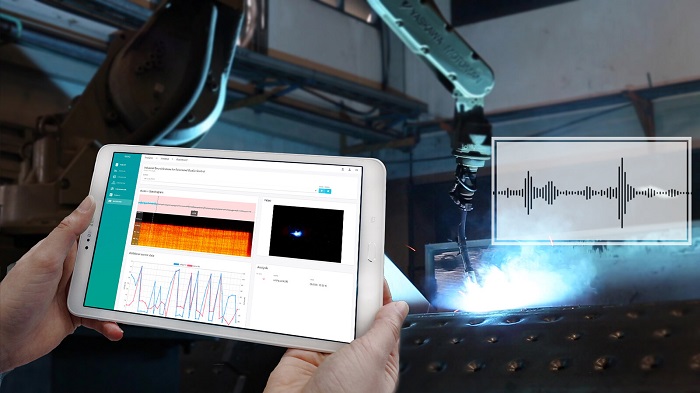
Many companies do not have the confidence to try out artificial intelligence (AI) models. These models can, after all, quickly become confusing. As a result, they have a wealth of untapped potential for quality control. The new IDMT-ISAAC software now makes it possible for users without any expert knowledge of AI to also benefit from artificial intelligence applications.
Artificial intelligence holds great potential, for instance for quality control in manufacturing companies. Yet the procedure for training AI models is complex and calls for mathematic knowledge. Ultimately, such analyses may involve countless parameters. The barriers to entry, then, are high—small and medium-sized enterprises (SMEs) that do not have their own development department often shy away from AI applications. The ongoing operation also calls for expertise: If a component’s product design or geometry is altered slightly after an AI algorithm has been programmed, the algorithm will initially see this as an error. The AI then needs to be retrained.




SMEs are taking note: Artificial intelligence can also be handled without expert knowledge
The “IDMT-ISAAC” software from the Fraunhofer Institute for Digital Media Technology IDMT in Ilmenau helps users without any expert knowledge of AI to overcome these hurdles. IDMT-ISAAC stands for Industrial Sound Analysis for Automated Quality Control. They aim to qualify SMEs to modify and adapt the AI algorithms themselves. They can apply IDMT-ISAAC to their own audio data and retrain the software to obtain fast and reliable results and decision-making aids for their quality assurance procedures.
As experienced machine operators will know, the sound of the process betrays many a defect. IDMT-ISAAC too relies on sound: The researchers trained the system with recorded acoustic data from welding processes. The AI software analyzes the typical process noises and draws conclusions about the quality of the weld seam in question from the audio data. At the core of IDMT-ISAAC is a framework that allows users to change various parameters with just a few clicks, teaching the AI about a product geometry change, for example, in the process. The plan is to adapt the software to live operations in summer 2021. The system should then be able to promptly analyze real-time data from production and optimize the quality assurance processes. And the aim is to have the software actively intervening in production within the next three to four years.
The framework offers new analysis potentials for more than just welding processes. They have integrated various methods into the module to allow other processes like milling to be mapped relatively quickly. Looking forward, companies will also be able to use their own software and access the Institute’s AI on the server at Fraunhofer IDMT via an interface. No matter whether the companies integrate the AI into their own systems through the framework or access it over an interface: the data are processed anonymously, and so data protection and data security requirements are fulfilled at all times.
Understanding AI decisions
Various user profiles can be applied to adapt the software for a number of user groups: for both novices and accomplished AI users. AI algorithm developers like to get a sense, for example, of how AI takes its decisions and which sounds it uses as a basis for those decisions. therefore taking the framework a step closer to Explainable AI, in order to make AI more comprehensible.

