
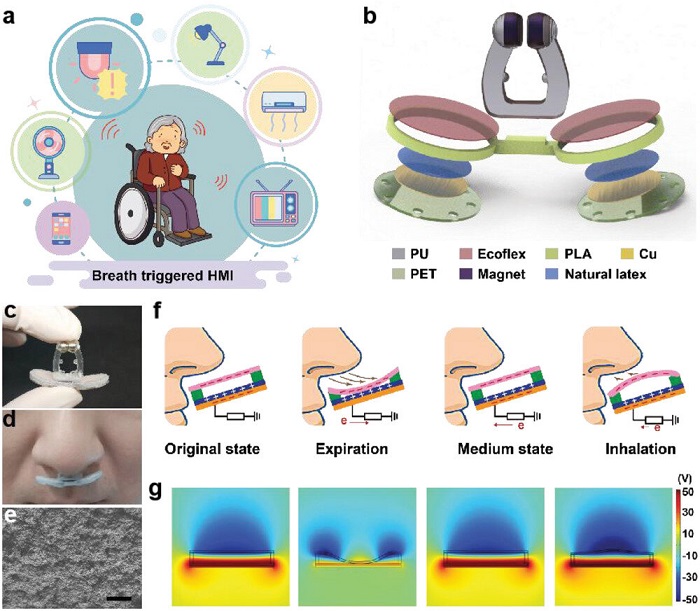
Researchers at Case Western Reserve University have created a simple prototype device that enables users to control “smart home” technology by changing their breathing patterns.
The self-powered unit fits into the nostrils and has the potential to enhance the quality of life for people with limited mobility or inability to speak clearly. It also can be programmed to provide automatic alerts to medical personnel if an individual has trouble breathing.




“We believe that having both of these capabilities–smart technology control and medical alert–in a small device makes this special,” said Changyong “Chase” Cao, an assistant professor of mechanical and aerospace engineering who is leading the research and development of the device.
Cao and his collaborators recently published their research in the journal Advanced Materials Interfaces. The team included recent Postdoc Yaokun Pang (now a professor at Qingdao University, China) and Ph.D. student Shoue Chen. Cao said he has also applied for a patent on their prototype device, Cao said.
The ‘smart technology’ revolution
Together, smart-appliance and smart-home technology make up a rapidly growing industry as hundreds of consumer-ready appliances and devices are Bluetooth-enabled or folded into the “Internet of Things” (IoT).
Smart-home appliances include lighting and energy control systems, air conditioners, and security systems. They can be controlled remotely or programmed to perform autonomously.
But for users who can’t speak or use their limbs to program a device, smart technology’s benefits are nearly impossible to access.
“Smart technology is great–but only if you can actually use it,” Cao said. “Our new design would allow for anyone who is breathing to be able to turn devices on and off, or change the settings of a thermostat, for example.”
How the device works
Cao and his collaborators used a technology known as triboelectric nanogenerators (TENGs), or triboelectrification, to make the device work.
TENGs can convert mechanical energy harvested from the environment to electricity for powering small devices such as sensors or recharging consumer electronics.
The technology, developed in earnest over the last decade, allows scientists to convert daily mechanical energy into useful electric power. That energy present in the natural environment includes rain, wind, or even everyday body motions, such as touching hands together, walking, or, in this case, breathing.
Cao said the device–dubbed a “breathing-driven Human-Machine Interface (HMI) system”—could be available to the public within three to five years because of its simple design and function. He said the team will keep working on the prototype in the coming months and years to ready it for practical use.

