
Fiber interconnection strategies for photonic integrated circuits (PICs) are usually developed using adhesives. However, this connection technique can lead to optical degradation in the long term and thus to optical transmission losses, which are fatal in applications such as medical technology and the life sciences. As part of the “PICWeld” Eurostars project, Fraunhofer IZM researchers and partners have developed an adhesive-free, space-saving and robust laser welding process for fixing optical fibers to PICs. Integrating the process into an automated alignment system has proven its industrial maturity, making the glass-glass joining technique extremely attractive for commercial use.
It has long been known that biochemical processes, ranging from organ function to temperature regulation and hormone production, are influenced significantly by light. Research around light and the body has now advanced considerably and newer disciplines such as life sciences and biophotonics are addressing issues at the intersection between the natural sciences and medicine. High-precision, complex measurements can thus be used to obtain information about how light interacts with matter, by studying the structure of cells and tissues relevant to cancer for example.




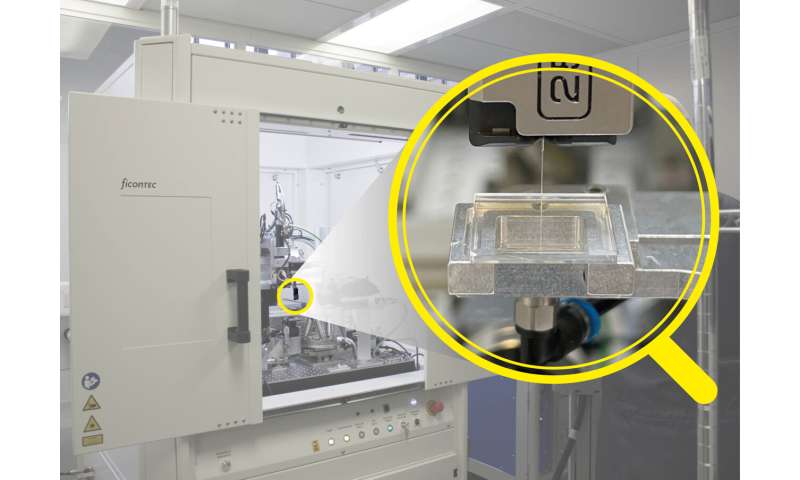
But gaining insight into these innermost biological secrets is no easy undertaking: Recently, miniaturized systems based on PICs with highly stable fiber connections have been proposed as a way of understanding the role of visible light in biological processes. This is precisely where the Fraunhofer Institute for Reliability and Microintegration IZM came in with the research project “PICWeld” by developing a completely new laser welding process that can be used to attach optical fiber directly to PICs based on fused silica glass substrates. With the help of its partner ficonTEC Service GmbH, this process was implemented in an automated system that offers high reproducibility and scalability.
The research team led by Dr. Alethea Vanessa Zamora Gómez set itself the task of developing glass-glass joints that are simpler, more robust, and more durable. Such connections are already used in the world of specialist optics, but conventional solutions have a significant drawback: In most cases, the discrete optical components are connected by an adhesive. The softness of the adhesive can cause the position of the component to change over time, and it also creates an interference point between the two layers of glass, which can lead to signal attenuation and become brittle as the adhesive ages. Long-term stability is therefore often critical. To circumvent these disadvantages of the joining technique, the researchers have developed a process of CO2 laser welding, creating a direct, thermally robust, and transparent glass-glass joint for the first time.

