
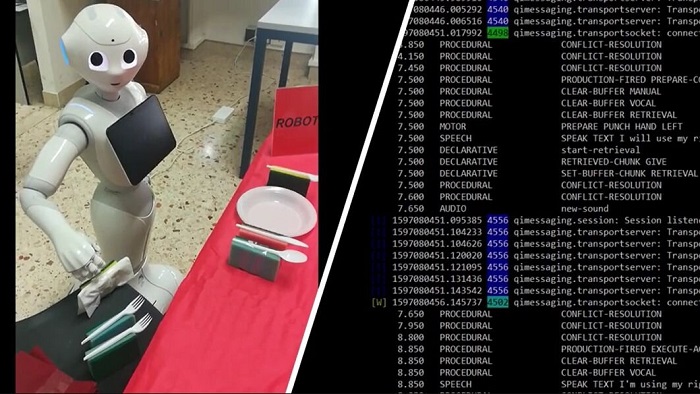
Ever wondered why your virtual home assistant doesn’t understand your questions? Or why your navigation app took you on the side street instead of the highway? In a study researchers designed a robot that “thinks out loud” so that users can hear its thought process and better understand the robot’s motivations and decisions.
If you were able to hear what the robots are thinking, then the robot might be more trustworthy. The robots will be easier to understand for laypeople, and you don’t need to be a technician or engineer. In a sense, we can communicate and collaborate with the robot better.




Inner speech is common in people and can be used to gain clarity, seek moral guidance, and evaluate situations in order to make better decisions. To explore how inner speech might impact a robot’s actions, the researchers built a robot called Pepper that speaks to itself. They then asked people to set the dinner table with Pepper according to etiquette rules to study how Pepper’s self-dialog skills influence human-robot interactions.
The scientists found that, with the help of inner speech, Pepper is better at solving dilemmas. In one experiment, the user asked Pepper to place the napkin at the wrong spot, contradicting the etiquette rule. Pepper started asking itself a series of self-directed questions and concluded that the user might be confused. To be sure, Pepper confirmed the user’s request, which led to further inner speech
Comparing Pepper’s performance with and without inner speech, the researchers discovered that the robot had a higher task-completion rate when engaging in self-dialog. Thanks to inner speech, Pepper outperformed the international standard functional and moral requirements for collaborative robots—guidelines that machines, from humanoid AI to mechanic arms at the manufacturing line, follow.
People were very surprised by the robot’s ability. The approach makes the robot different from typical machines because it has the ability to reason, to think. Inner speech enables alternative solutions for the robots and humans to collaborate and get out of stalemate situations.
Although hearing the inner voice of robots enriches the human-robot interaction, some people might find it inefficient because the robot spends more time completing tasks when it talks to itself. The robot’s inner speech is also limited to the knowledge that researchers gave it.
In some sense, they are creating a generational robot that likes to chat. The authors say that, from navigation apps and the camera on your phone to medical robots in the operation rooms, machines and computers alike can benefit from this chatty feature. Inner speech could be useful in all the cases where we trust the computer or a robot for the evaluation of a situation.

