
A team of computer science researchers at the University of Alabama at Birmingham have created and tested a new, Bluetooth-based system for disseminating emergency messages in an urban environment.
The team wanted to fix inefficiencies in how emergency or hazard messages are disseminated. The messages are usually sent to the public through broadcast media or physical signs.



According to the study, 96 percent of adults in the United States own smartphones; but as of Aug. 8, 2016, only 387 wireless emergency alerts were sent by state or local governments —compared to 2 million alerts sent by the National Weather Service.
During natural disasters, many of our communication infrastructures break down due to power or phone network outages. Disseminating emergency management information to people and informing them of dangers or evacuation routes is difficult. Their system, InSight, can work during disasters—even in the absence of power, GPS and phone networks—to disseminate alerts and save lives.”
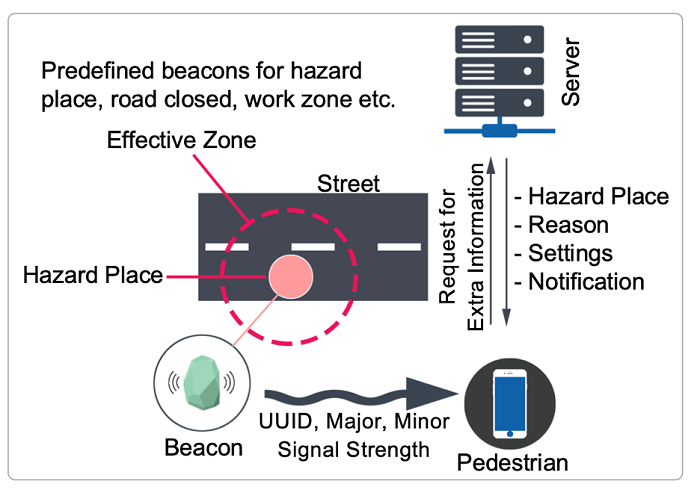
InSight was designed to be a beacon easily deployable by first responders with minimal cost that will accurately detect users approaching a hazard sight. The product is composed of a mobile app, beacons, and a backend server to compute and disseminate the signals that can be received without a connection to the internet. The beacons are inexpensive and easy to deploy during disasters—a first responder can simply throw them into specific locations from a car to quickly mark hazards or evacuation routes.
The beacons were tested in three different emergency situations: a construction site, a traffic intersection, and an evacuation route. They were deployed on foot and thrown from a car, both methods being completed in under seven minutes. Results indicated that, when users were on foot or a bike, they received alerts while less than 200 feet away from the beacon.
The experiments show the feasibility of deploying the beacons in real-life emergency scenarios. The long range of the signal ensures that users can get notified of the hazard from a safe distance. It also works during storms, rain, or darkness, when visibility is limited. The current warning methods require either a visible sign or a working phone or communication network—neither of which may be useful in such disaster scenarios.
InSight was presented by Hasan and his team at the Institute of Electrical and Electronics Engineers’ 2021 Consumer Communications and Networking Conference, the world’s largest tradeshow for consumer technology. The project was funded in part by a grant from the National Science Foundation.
The team believes that InSight is both timely and vital in saving human lives during disasters—recent snowstorms and tornado events show how the traditional infrastructure can easily break down, costing precious lives.

