
Recent technological advancements have enabled the development of new tools to assist people with different types of disabilities, allowing them to move more freely in their surroundings and complete a number of everyday tasks. These include a broad range of smart technologies and devices, ranging from home assistants to mobile robots and bionic limbs. This led to the discovery of a Semi-Autonomous and Gaze-Guided Wheelchair.
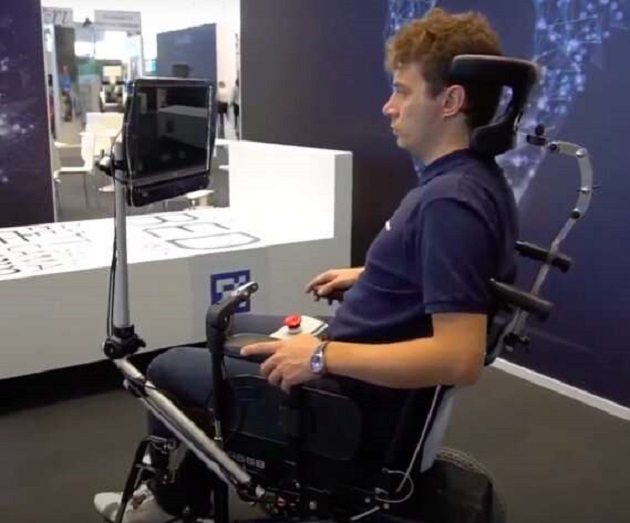
Researchers at the University of Trento and the University of Padua have recently created a safe and efficient Semi-Autonomous wheelchair that moves according to users’ eye-movements. This unique system could allow people with severe motor disabilities to control the wheelchair’s movements, even if they are incapable of moving their limbs.



“Our aim was to design an innovative, cost-effective and user-friendly control system based on gaze detection for a power wheelchair to allow users with any severe motor disability to move easily and autonomously within their homes,” Alessandro Luchetti and Luca Maule, two of the researchers who carried out the study, told TechXplore via email.
RoboEYE was designed by Maule in collaboration with the MIRo lab, a research team within the University of Trento’s Industrial Engineering Department, led by Prof. De Cecco. The eye-movement-controlled wheelchair integrates the functionalities of mobile robotic systems into a standard power wheelchair.
When navigating their surrounding environment, users sitting on the wheelchair can choose between two different driving strategies, one based on eye movements and the other based on pointing to the desired destination.
“The most intuitive and direct modality foresees the continuous control of frontal and angular wheelchair velocities by gazing at different areas of a monitor,” Luchetti and Maule said.
“The Semi-Autonomous modality, on the other hand, allows navigation toward a selected point in the environment by just pointing and activating the wished destination while the system autonomously plans and follows the trajectory that brings the wheelchair to that point.”
Luchetti, Maule and their colleagues evaluated the effectiveness of the wheelchair in numerical simulations and real-world experiments in which volunteers tested RoboEYE and provided feedback about their experiences. The findings they collected were highly promising and highlighted the safety, reliability and efficiency of their unique wheelchair design.
“Compared to other solutions, RoboEYE is minimally invasive to its users, it integrates functionalities derived from the field of mobile robotics, it takes into account the role of uncertainty in human-machine interactions, and it is based on low-cost hardware solutions,” Luchetti and Maule said. “The result is an efficient and cost-effective system that ensures a user’s safety.”
Interestingly, the dual navigation system they designed could also be applied to other wheelchairs or structures of different shapes and sizes. In the future, the study could pave the way toward the realization of innovative and highly efficient tools to assist people with severe motor disabilities.

