
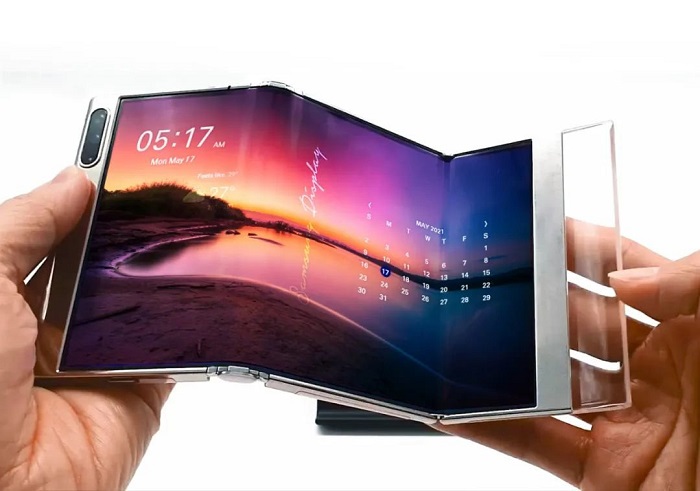
With the established success of flexible computer screen displays, many users are wondering how display technology will advance next. So far, free-form displays have grown popular as a next-generation product that offers both portability and high-resolution visuals.
While this technology is still quite new, a wealth of research already exists into the stretchable displays that make up free form displays, products that can stretch into any direction like rubber.




The research at Samsung appeared in the well-known journal Science Advances discussing a technology that bypasses the limitations of stretchable devices. The associated experiment showed stable performance even when the display was significantly elongated. As these products can already be used in existing semiconductor processes, Samsung researchers have high hopes about what this could mean for the commercialization and salability of stretchable devices.
In fact, the research team at Samsung managed to implement a stretchable organic LED (OLED) display and a photoplethysmography (PPG) sensor into just one device to measure and display the user’s heart rate in real time. This process allowed for an electronic stretchable device capable of assessing bodily metrics via the skin.
Indeed, this skin display can stretch up to 30 percent. The material that makes this possible comes from what is known as an elastomer structure, a polymer compound with outstanding elasticity and resilience that utilizes existing semiconductor fabrication processes for adaptation to the substrates of stretchable OLED displays and optical blood flow sensors. This development in elastic endurance comes as the first in the semiconductor industry.
By and large, the research team explains that the overall goal here is to enable wearers of these stretchable devices to check their heart rate and other biometric data throughout the day without worrying about performance degradation due to excessive movement. Research even showed that this sensor could detect a heartbeat signal 2.4 times more strongly than would have been identified by a fixed silicon sensor. Moreover, because the monitor automatically displays the data, the user need not take time to transfer the stretchable product to an external device to read results.
Fortunately, researchers confirm that this product can be safely worn by adults, children, infants and patients with certain diseases. The team attributes the high-scale durability of these devices to the elasticity of elastomer, whose material exists across all product components, including the electrode, emission material layer and sensor, substrate and thin film transistor.
Thus, instead of a more fragile plastic material, elastomer equips these stretchable devices with the capabilities of large-area processing and micro-patterning. Coupled with close adherence to the wearer’s skin, these devices prove the most efficient yet for displaying biometric data on a day-to-day basis.

