
Anyone with children knows that while controlling one child can be hard, controlling many at once can be nearly impossible. Getting swarms of robots to work collectively can be equally challenging unless researchers carefully choreograph their interactions—like plane information—using increasingly sophisticated components and algorithms. But what can be reliably accomplished when the robots on hand are simple, inconsistent, and lack sophisticated programming for coordinated behavior?
A team of researchers sought to show that even the simplest of robots can still accomplish tasks well beyond the capabilities of one, or even a few, of them. The goal of accomplishing these tasks with what the team dubbed “dumb robots” (essentially mobile granular particles) exceeded their expectations, and the researchers report being able to remove all sensors, communication, memory, and computation—and instead of accomplishing a set of tasks through leveraging the robots’ physical characteristics, a trait that the team terms “task embodiment.”



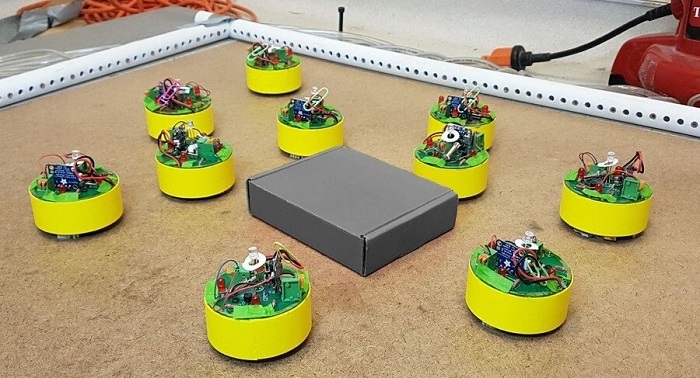
The team’s BOBbots, or “behaving, organizing, buzzing bots” that were named for granular physics pioneer Bob Behringer, are “about as dumb as they get,” explains Randall. “Their cylindrical chassis have vibrating brushes underneath and lose magnets on their periphery, causing them to spend more time at locations with more neighbors.” The experimental platform was supplemented by precise computer simulations led by Georgia Tech physics student Shengkai Li, as a way to study aspects of the system inconvenient to study in the lab.
Despite the simplicity of the BOBbots, the researchers discovered that, as the robots move and bump into each other, “compact aggregates form that are capable of collectively clearing debris that is too heavy for one alone to move,” according to Goldman. “While most people build increasingly complex and expensive robots to guarantee coordination, we wanted to see what complex tasks could be accomplished with very simple robots.”
A theoretical abstraction known as a self-organizing particle system was developed to rigorously study a mathematical model of the BOBbots. Using ideas from probability theory, statistical physics, and stochastic algorithms, the researchers were able to prove that the theoretical model undergoes a phase change as the magnetic interactions increase—abruptly changing from dispersed to aggregating in large, compact clusters, similar to phase changes we see in common everyday systems, like water and ice.
The rigorous analysis not only showed us how to build the BOBbots, but also revealed the inherent robustness of our algorithm that allowed some of the robots to be faulty or unpredictable.

