
HomeElectronicsSemiconductors and ChipsTechnology for Downscaling Transistors could Advance Semiconductor Design

    Technology for Downscaling Transistors could Advance Semiconductor Design

    An innovation by Purdue University researchers could help the semiconductor industry design transistors that are smaller, use less power and switch from on to off at smaller applied voltages. As a result, the innovation could lead to better and more powerful central processing unit generations, which can compute more operations with less energy.

    Tillmann Kubis is the Katherine Ngai Pesic & Silvaco Research Assistant Professor of Electrical and Computer Engineering in Purdue’s Elmore Family School of Electrical and Computer Engineering. He said it has become more difficult to meet the performance requirements of nanotransistors.


    “They need a high enough ON-current and low enough OFF-current, with a small enough difference to switch between both,” Kubis said. “These challenges have significantly slowed the downscaling of transistors around the last eight years, making it increasingly difficult to introduce more powerful CPU generations.”

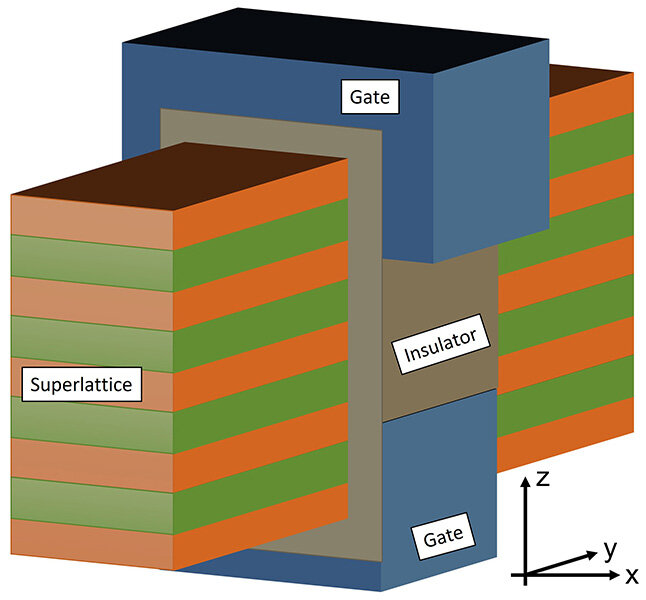
    Kubis and James Charles, a senior research associate in the Elmore Family School of Electrical and Computer Engineering, have created CasFET, or cascade field effect transistor, technology. It introduces a new switching method to transistors, one that is like the effects observed in quantum cascade lasers.

    “CasFET is a more general approach than transistor technology we had developed several years ago. It offers more flexibility in the choice of materials and voltage settings,” Kubis said. “In technical terms, CasFET does not require band-to-band tunneling. Because of this, semiconductor designers could be able to develop faster-switching and more energy-efficient transistors.”

    Kubis and Charles continue to develop the first CasFET prototype.

    “Once that is showing the performance goals, we will continue with defining a concrete CasFET prototype design,” Kubis said.

    ELE Times Bureau
    ELE Times Bureauhttps://www.eletimes.ai/
    ELE Times provides a comprehensive global coverage of Electronics, Technology and the Market. In addition to providing in depth articles, ELE Times attracts the industry’s largest, qualified and highly engaged audiences, who appreciate our timely, relevant content and popular formats. ELE Times helps you build awareness, drive traffic, communicate your offerings to right audience, generate leads and sell your products better.

    Related News

    Must Read

    Kyocera and Rohde & Schwarz’s multipurpose phased array antenna module (PAAM) at CES 2026

    Kyocera and Rohde & Schwarz will demonstrate the characterization...

    AI PCs: What Tata Electronics and Intel Aim to Scale in India

    Tata Electronics, a global enterprise headquartered in India, and...

    UP’s Semiconductor Push: State to Build Three New Electronics Hubs Beyond NCR

    With an aim to boost development and employment beyond...

    One Nation, One Compute Grid: India’s Leap into the AI and Supercomputing Era

    Courtesy: Dr. Harilal Bhaskar, Chief Operating Officer (COO) and...

    New, Imaginative AI-enabled satellite applications through Spacechips

    As the demand for smaller satellites with sophisticated computational...

    Beyond the Bill: How AI-Enabled Smart Meters Are Driving Lead Time Optimization and Supply Chain Resilience in the Energy Grid

    Introduction Smart meters have significantly evolved since their initial implementation...

    Inside the Digital Twin: How AI is Building Virtual Fabs to Prevent Trillion-Dollar Mistakes

    Introduction Semiconductor manufacturing often feels like modern alchemy: billions of...

