

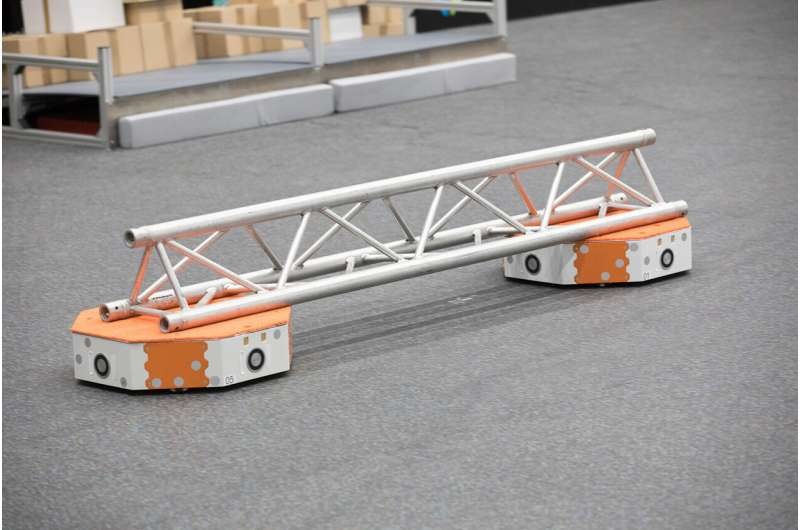
A new generation of automated guided vehicles uses artificial intelligence and communicates via 5G to organize themselves as swarm and execute jobs independently. Able to sort large quantities of packages, this high-speed transporter can serve to boom online and mail-order businesses well.
The coronavirus crisis has given e-commerce a big boost. More and more consumers are shopping online to avoid the crowds in stores and minimize the risk of infection. A study conducted found that people are ordering everyday consumer goods such as food and drugstore products online far more frequently than they did before the pandemic.



The unmanned automated vehicle can sort objects and transport them from A to B at speeds up to ten meters per second. These vehicles can accelerate like a sports car and are pioneers for a whole new performance class.
The system is based on a swarm of drones developed earlier. Its 20 drones emulate the behavior of a flock of birds. Each drone takes its cues from its neighbors’ behavior, continuously adapting flight direction and speed to match other drones’ trajectory. This rules out collisions and enables drones to form groups. The reciprocal action of the drones’ individual decisions results in a swarm intelligence that does not require central coordination. The swarm system incorporates simulation-based artificial intelligence.
It is equipped with an omnidirectional chassis; the direction of travel and direction of rotation are completely independent of one another. This means the new vehicle can turn in any direction without having to pause to maneuver. The robots have a ground camera on board to help with orientation. This camera generates 400 images per second of the floor surface. This way, the vehicle is able to determine its location very accurately even when traveling at high speeds in tight formations.
As a stand-alone automated vehicle, it is able to transport and sort parcels weighing up to 30 kilograms. This makes it the perfect luggage carrier for airports. These AI-driven go-carts can also work in concert as larger collectives to carry large, heavy, and bulky objects. Powered by four electric motors, It sharply brakes at just the right moment right in front of its destination, and the payload slides from the robot onto the delivery platform.
About 60 vehicles can process 13,000 parcels per hour which is equivalent to the performance of conventional sorting systems. But this novel breed of a vehicle has two great advantages over conventional sorting systems: it requires much less fixed infrastructure and can be put into operation far more quickly.

