
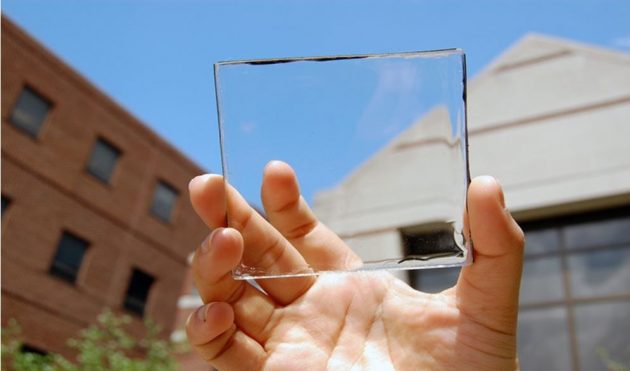
See-through solar materials that can be applied to windows represent a massive source of untapped energy and could harvest as much power as bigger, bulkier rooftop solar units, scientists from Michigan State University report in Nature Energy.
Led by engineering researchers at Michigan State University, the authors argue that widespread use of such highly transparent solar applications, together with the rooftop units, could nearly meet U.S. electricity demand and drastically reduce the use of fossil fuels.




“Highly transparent solar cells represent the wave of the future for new solar applications,” said Richard Lunt, the Johansen Crosby Endowed Associate Professor of Chemical Engineering and Materials Science at MSU. “We analyzed their potential and show that by harvesting only invisible light, these devices can provide a similar electricity-generation potential as rooftop solar while providing additional functionality to enhance the efficiency of buildings, automobiles, and mobile electronics.”
Lunt and colleagues at MSU pioneered the development of a transparent luminescent solar concentrator that when placed over a window creates solar energy without disrupting the view. The thin, plastic-like material can be used on buildings, car windows, cell phones or other devices with a clear surface.
The solar harvesting system uses organic molecules developed by Lunt and his team to absorb invisible wavelengths of sunlight. The researchers can “tune” these materials to pick up just the ultraviolet and the near-infrared wavelengths that then convert this energy into electricity.
Moving global energy consumption away from fossil fuels will require such innovative and cost-effective renewable energy technologies. Only about 1.5 percent of electricity demand in the United States and globally is produced by solar power.
But in terms of overall electricity potential, the authors note that there are an estimated 5 billion to 7 billion square meters of the glass surface in the United States. And with that much glass to cover, transparent solar technologies have the potential of supplying some 40 percent of energy demand in the U.S. – about the same potential as rooftop solar units. “The complimentary deployment of both technologies,” Lunt said, “could get us close to 100 percent of our demand if we also improve energy storage.”
Lunt said highly transparent solar applications are recording efficiencies above 5 percent, while traditional solar panels typically are about 15 percent to 18 percent efficient. Although transparent solar technologies will never be more efficient at converting solar energy to electricity than their opaque counterparts, they can get close and offer the potential to be applied to a lot more additional surface area, he said.
Right now, transparent solar technologies are only at about a third of their realistic overall potential, Lunt added. “That is what we are working towards,” he said. “Traditional solar applications have been actively researched for over five decades, yet we have only been working on these highly transparent solar cells for about five years. Ultimately, this technology offers a promising route to inexpensive, widespread solar adoption on small and large surfaces that were previously inaccessible.”
The work is funded by the National Science Foundation and the U.S. Department of Education.
Lunt’s coauthors are Christopher Traverse, a doctoral student in engineering at MSU, and Richa Pandey and Miles Barr with Ubiquitous Energy Inc., a company Lunt cofounded with Barr to commercialize transparent solar technologies.

