
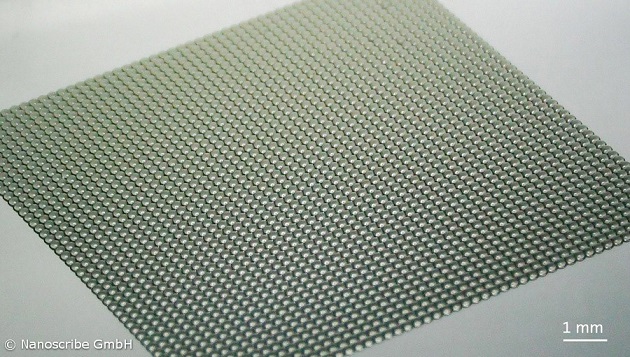
Nanoscribe’s new Photonic Professional GT2 3D printers change the way to produce micro-optical components. This additive manufacturing technology enables the fabrication of ultra-precise micro-optics as polymer masters for serial production, which are needed, for instance, in mobile or augmented reality devices, for sophisticated sensors or advanced solutions in healthcare and automotive industry.
At SPIE Photonics West, the leading trade fair in optics and photonics, Nanoscribe presents the entire process chain for series production of micro-optics based on 3D printed polymer masters as starting point (booth 366, South Hall). Up to now, the production of innovative micro-optical designs has been challenging due to very high demands with respect to shape accuracy and low surface roughness required for optimum optical performance. Furthermore, product development processes have to cope with the ever-increasing importance of rapid innovation cycles and low costs for serial production.




Serial Production by Injection Molding
The 3D printed polymer masters fit well into common industrial processes for series production such as injection molding, hot embossing and nanoimprint lithography. For example, a nickel shim is generated by electroforming the 3D printed polymer master of a microlens array. The shim is then used as an insert for injection molding of a thermoplastic polymer, such as PMMA (polymethyl methacrylate) or PC (polycarbonate). Within seconds the molten thermoplastic is injected into the insert cavity, cooled and solidified, duplicating the polymer master shape. This standard process cuts the production time and costs per piece to affordable consumer market products.
Additive Manufacturing of Micro-Optics
Based on the powerful technology of two-photon polymerization (2PP) Nanoscribe’s 3D printers transform digital models directly into physical objects with submicron resolution. In comparison to conventional methods, such as gray-scale lithography, reflow techniques or diamond milling, Nanoscribe’s 3D printers provide enormous freedom of design and at the same time a very robust chemical process to produce almost any concave or convex surface shape.
The high precision 3D printer uses a femtosecond laser beam that exposes and solidifies photosensitive material only in the tight focal point. The printer scans the laser focus within a photoresin in a layer-by-layer fashion with layer distances down to the nanometer scale, creating 3D objects with optical surface quality in a single printing step. The additive process enables the fabrication of micro-optics with designs that are otherwise impossible to produce. Hemispherical and aspherical microlens arrays, for instance, can be fabricated with arbitrarily small distances between the lenses allowing even to overlap the lenses.

