
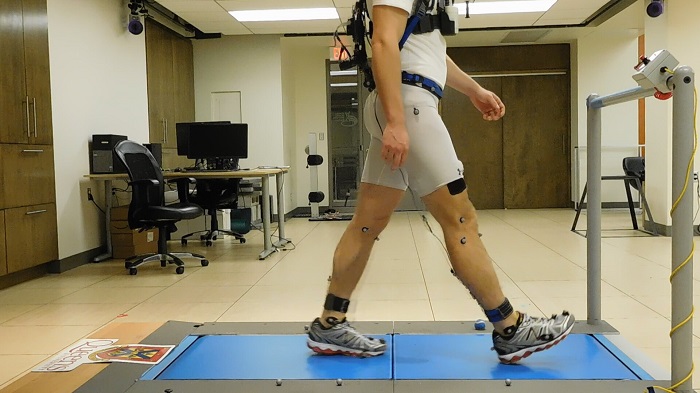
An exoskeleton designed by Queen’s Engineering researchers that improves walking efficiency is the subject of a new study featured in the leading academic journal Science.
The science of walking is taking its next big step with the aid of a unique exoskeleton that allows users to walk further while using less energy. Developed by a multidisciplinary team from the Queen’s Faculty of Engineering and Applied Science, the backpack-mounted prototype removes energy during a specific phase of the gait cycle, lessening the metabolic cost of walking. Details of the device’s development and evaluation were published today in Science—one of the world’s foremost academic journals.




Unlike existing exoskeleton technologies that either add energy or transfer it from one phase of the gait cycle to another, this new device assists users by removing energy which helps the knee muscles during a critical moment—called the terminal swing phase.
“Removing energy from a person’s legs during walking may sound counterintuitive, like applying the brake in a moving car,” says Michael Shepertycky, a recent Ph.D. graduate and lead author of the study, “but our muscles naturally remove energy while we walk, and our device helps them to do so.”
The team envisages the technology—which weighs just over half a kilogram—enabling hikers to walk longer distances or helping nurses be less tired after a long shift on their feet.
“Improving walking and running economy has been an important topic of research for the past two decades, due to its scientific and practical implications,” says Qingguo Li, Associate Professor of Mechanical and Materials Engineering and co-author of the study. “Walking is a delicate and highly optimized process, which makes it difficult to use exoskeletons to improve walking efficiency.”
In addition to assisting the user, the device converts the removed energy into electricity that can be used to power the device’s control system and other portable devices. This energy harvesting capability could be particularly useful for individuals traveling on foot in remote locations, allowing them to charge cellular phones or GPS devices. Yan-Fei Liu, Professor of Electrical and Computer Engineering and co-author of the study, led the development of the device’s power electronics.
The team’s interdisciplinary approach included elements of walking biomechanics, physiology, human-machine interactions, and design innovation. Much of this research was conducted in the Human Mobility Research Centre, a Queen’s/Kingston Health Sciences Centre facility equipped with world-class gait analysis technology.

