
How to predict the sound produced by a tonewood block once carved into the shape of a violin plate? What is the best shape for the best sound? Artificial intelligence offers answers to these questions.
In the article “A Data-Driven Approach to Violinmaking,” the Chilean physicist and luthier Sebastian Gonzalez (post-doc researcher) and the professional mandolin player Davide Salvi (Ph.D. student) show how a simple and effective neural network is able to predict the vibrational behavior of violin plates. This prediction is obtained from a limited set of geometric and mechanical parameters of the plate.




The ability to predict the sound of a violin design can truly be a game-changer for violin makers, as not only will it help them do better than the ‘grandmasters,’ but it will also help them explore the potential of new designs and materials. This research allowed us to take the first steps in this direction, showing how artificial intelligence, physical simulation, and craftsmanship can all join forces to shed light on the art of violin making.
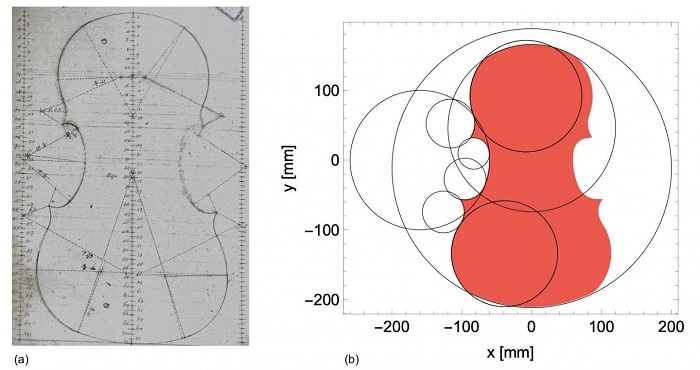
Violins are extremely complex objects, and their geometry is defined by their outline, arching on the horizontal and vertical sections. The inspiration for this study came from a historical drawing on display at the Museo del Violino in Cremona. Politecnico di Milano researchers developed a model that describes the violin’s outline as the conjunction of arcs of nine circles. Thanks to this representation and an efficient model of the curvature of the plate, based on the renowned ‘Messiah’ violin by Stradivarius, researchers were able to draw a violin plate as a function of 35 parameters.
By randomly changing such parameters, such as radii and center position of the circles, arching, thickness, mechanical characteristics of the wood, etc., they built a dataset of violins, which includes shapes that are very similar to those used in violin making, but also designs that had never been seen before. Such shapes constituted the input for the neural network.
Advanced tools for the modeling of vibrations were used for characterizing the acoustic behavior of each violin in the dataset.
The next step was to understand if a simple neural network would be able to predict the acoustic behavior of a violin plate, starting from its parameters. The answer turned out to be positive, with an accuracy that came close to 98%, exceeding any expectations.
This work offers an innovative and promising tool in the hands of Cremona violin makers and, in perspective, of the international community. By using a neural network, it will enable luthiers to predict how a tone-wood block will sound once carved into a plate. But it can also be used to design two violins with matching acoustic behavior even if built with different wood. In the future, this research will allow us to select the best wood to be used for a particular violin, something that today is still based on purely aesthetic considerations.

