
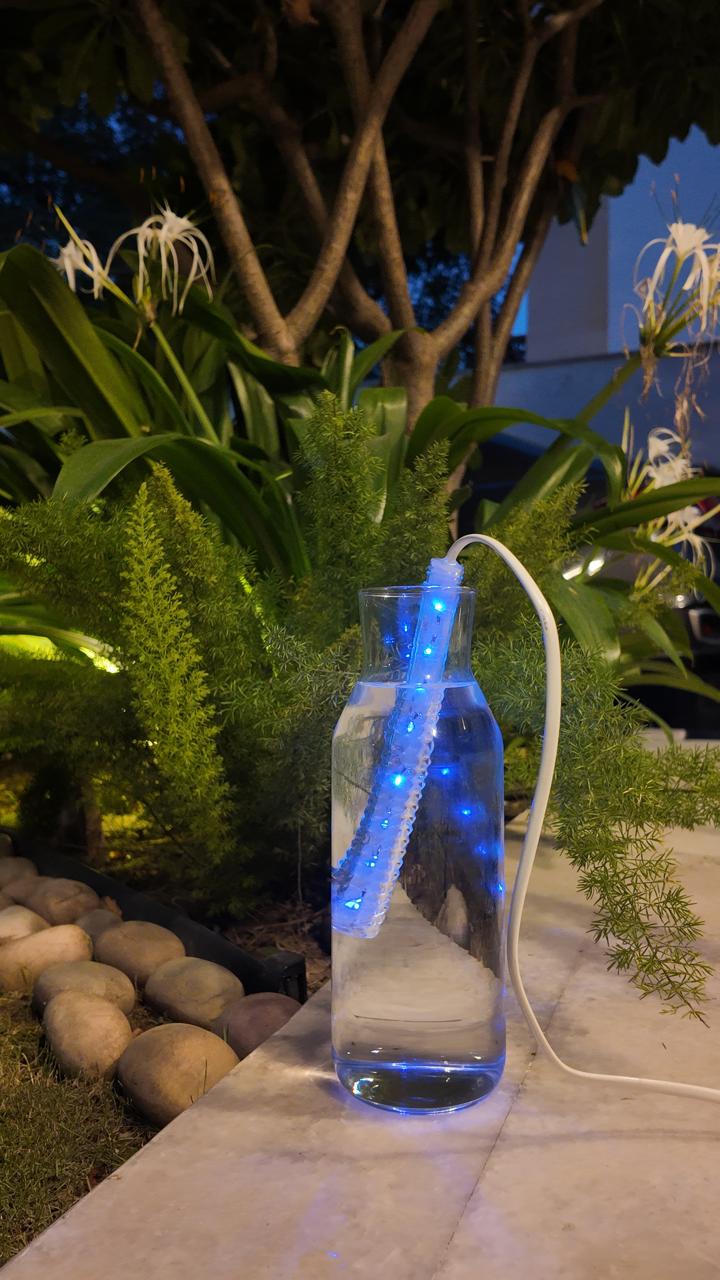
In a bid to provide safer drinking water to thousands across Delhi’s largest informal settlements, 16-year-old Devika Raj Batra, has developed a community water-safety initiative built around a patent-pending submersible UV-C LED sterilisation device. The unit disinfects stored household drinking water in about fifteen minutes. Running on a standard USB cable, this purification solution is designed to be placed directly into the buckets, matkas, and drums families already use.
The device works with a single button and emits an audible cue when the sterilisation cycle is complete. The users do not need to follow any user’s manual or read any instruction guide before using this device. What’s more, they can carry on with the household’s existing water-storage habits while making the most of this technology.



Validating The Process
As part of the developmental process, Devika and her team has conducted microbiological testing, adhering to IS and WHO standards on household water samples before and after treatment. The device was claimed to be tested for total coliforms, E. coli, faecal coliforms, Staphylococcus aureus, Salmonella, and Shigella. Every tested indicator pathogen was successfully inactivated. With this initiative, Devika intends to target India’s urban informal settlements, where the act of collecting, storing, boiling, filtering, and protecting household water is a strenuous task.

A class 12 student from New Delhi, Devika has designed this unit from scratch. This portable sterilisation device is part of Project Amrit, which already reaches more than 10,000 residents across nearly 2,000 households in the Kusumpur Pahari region of South Delhi. A sensor can tell when a waste container is full. A digital system can help plan collection routes. A simple monitoring device can identify waterlogging or overflowing drains. A local dashboard can show which sanitation complaints remain unresolved.
This initiative has showcased documented health improvements across 300 households till date. The design choices behind Project Amrit, says Devika, are not specific to Delhi, but across all applicable informal settlements, which feature a submersible form factor, chemical-free operation, low maintenance, compatibility with existing storage vessels, and usability for households with limited literacy or time. This makes the model scalable across urban settlements in South Asia, Sub-Saharan Africa, and Southeast Asia, where stored drinking water remains a major site of contamination.
Role of Semiconductors in the Process
In July 2026, the Union Cabinet approved Semicon 2.0, with a total budget outlay of Rs 1,27,500 crore. The new phase aims to take India beyond individual projects and develop a wider semiconductor ecosystem covering design, manufacturing and related capabilities. This is important not only for India’s technology industry. It matters because semiconductors will increasingly sit inside the systems that manage water, energy, transport, agriculture, healthcare and communications.
India’s semiconductor mission carries important benefits a village. A semicon production factory may appear far removed from a village handpump or agricultural field. But the connection becomes clear when we follow the technology one step further. Imagine a water tank fitted with a small electronic sensor. The sensor can measure the level of water. It can send information to a control system. The system can identify unusual changes in consumption.
A sudden fall in water level may indicate a leak. A pump can be switched on or off according to actual requirements rather than guesswork. The chip is only one small part of the system. But without the electronics inside it, the system would not be able to sense and communicate what is happening. This is the real promise of the semiconductor revolution: making physical systems measurable and easier to manage.

