
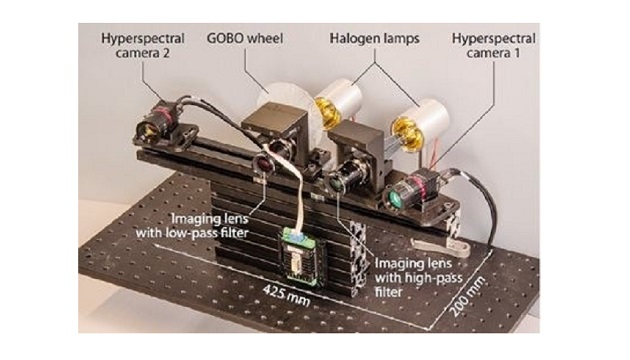
A 5D hyperspectral imaging system (HSI), so-called because it captures multiple wavelengths of light plus spatial coordinates as a function of time, has been developed by a team at Friedrich Schiller University Jena and the Fraunhofer Institute for Applied Optics and Precision Engineering, in collaboration with a group from Ilmenau University of Technology.
The compact system operates in the visible-to-NIR spectral range and provides high degrees of spatial and spectral resolution, depth accuracy, and high frame rates. It could be used for a variety of applications, including optical-based sorting of products and identity authentication.




The researchers have created a prototype system with a footprint of 200 × 425 mm (about the size of a laptop). The prototype uses two hyperspectral snapshot cameras to form 3D images and obtain depth information. By identifying specific points on the object’s surface that are present in both camera views, the system can create a complete set of data points in space for the object. However, this approach only works if the object has enough texture or structure to unambiguously identify points.
“Our earlier development of a system projecting aperiodic patterns by a rotating wheel made it possible to project pattern sequences at potentially very high frame rates and outside the visible spectral range,” said research team leader Stefan Heist. “New hyperspectral snapshot cameras were also an important component because they allow spatially and spectrally resolved information to be captured in a single image, without any scanning.”
The researchers characterized the prototype by analyzing the spectral behavior of the cameras and the 3D performance of the entire system. They showed that the system could capture visible-to-NIR 5D images as fast as 17 frames per second.
The team also created NIR 5D models of a person’s hand, showing that the system could be used as a simple way to detect veins. The imager could also be used for agricultural applications, which the researchers showed by using it to capture the 5D change in reflection spectrum of citrus plant leaves as they were absorbing water.

