
Vehicle electrification is increasing – and correspondingly the extent of a touch panel used for the operation of automotive cockpit applications. Screen sizes have grown excessively – either as pillar to pillar architecture or as seamlessly designed massive center console displays.
That, however, means that displays are getting ever larger – and thus more complicated to be operated only via touch input. This can be significantly improved by incorporating “hybrid” input devices allowing an intelligent capacitive and mechanical operation.




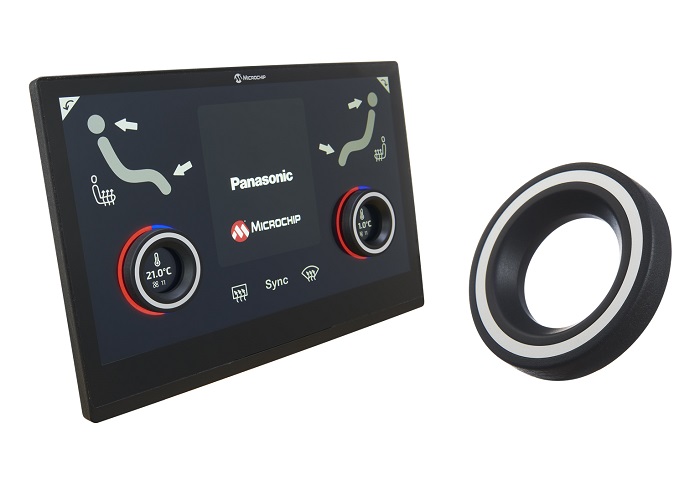
The Magic Knob as a capacitive rotary encoder containing mechanical rotation & push functionality that can be placed everywhere on the touch area in order to bridge the gap between touch and mechanical haptics.
Looking back at Panasonic’s former “Magic Knob”, it required a dedicated unique pattern on the touch sensor which is no longer necessary. This has been a constructive prerequisite that caused some design and touch handling limitations.
The newly developed MPMK (Microchip Panasonic Magic Knob) – developed in cooperation with Microchip Technology Inc. – is ready to be driven with standard touch sensors by using Microchip’s exclusive MK variant of the maXTouch touchscreen controllers enabling placement of the knob anywhere on the touch panel. In addition to the rotating operation, it also comes with a vertical ring push function. Both functions can be customized for offering the customers an ideal click feeling sensation.
This haptic fine-tuning can be successfully engineered due to a profound mechanical design know-how, based on the long-term development of mechanical encoders.
Being mounted directly on the touch panel, the MPMK enables an easy integration of touch panel and HVAC operating devices – which has conventionally been placed separately from the CID.
This results in the profile being slimmer – and an overall reduction of components which is good news in terms of user-friendliness, production efficiency and eco-friendliness. This, by the way, also applies for any kind of non-display application – as long as there is a capacitive sensor behind the respective flat or glass panel, the MPMK can be operated the same way.
And, outstandingly, under special circumstances: the unit can be reliably operated with gloves!

