
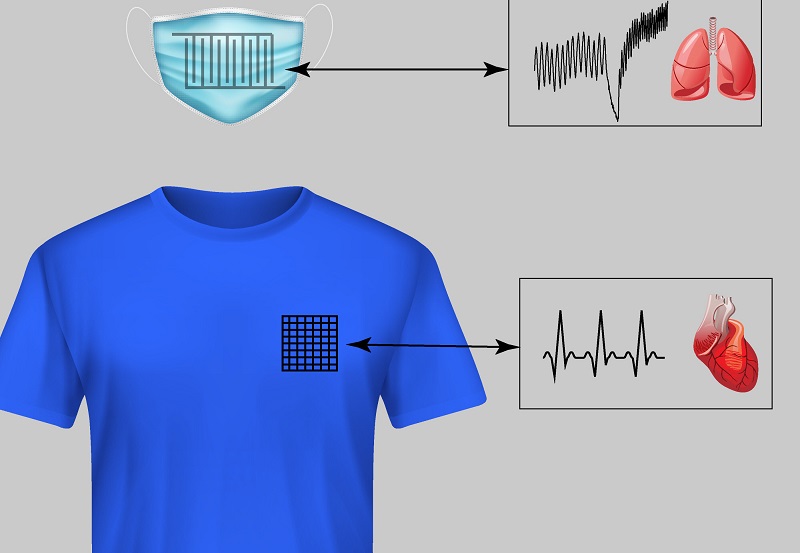
Imperial researchers have embedded new low-cost sensors that monitor breathing, heart rate, and ammonia into t-shirts and face masks.
Potential applications range from monitoring exercise, sleep, and stress to diagnosing and monitoring disease through breath and vital signs.




Spun from a new Imperial-developed cotton-based conductive thread called PECOTEX, the sensors cost little to manufacture. Just $0.15 produces a meter of thread to seamlessly integrate more than ten sensors into clothing, and PECOTEX is compatible with industry-standard computerized embroidery machines.
The first author of the research said “The flexible medium of clothing means our sensors have a wide range of applications. They’re also relatively easy to produce which means we could scale up manufacturing and usher in a new generation of wearables in clothing.”
The researchers embroidered the sensors into a face mask to monitor breathing, a t-shirt to monitor heart activity, and textiles to monitor gases like ammonia, a component of the breath that can be used to detect liver and kidney function. The ammonia sensors were developed to test whether gas sensors could also be manufactured using embroidery.
One of the researchers added: “We demonstrated applications in monitoring cardiac activity and breathing, and sensing gases. Future potential applications include diagnosing and monitoring disease and treatment, monitoring the body during exercise, sleep, and stress, and use in batteries, heaters, and anti-static clothing.”
Seamless sensors
Wearable sensors, like those on smartwatches, let us continuously monitor our health and well-being non-invasively. Until now, however, there has been a lack of suitable conductive threads, which explains why wearable sensors seamlessly integrated into clothing aren’t yet widely available.
Enter PECOTEX. Developed and spun into sensors by Imperial researchers, the material is machine washable, and is less breakable and more electrically conductive than commercially available silver-based conductive threads, meaning more layers can be added to create complex types of sensors.
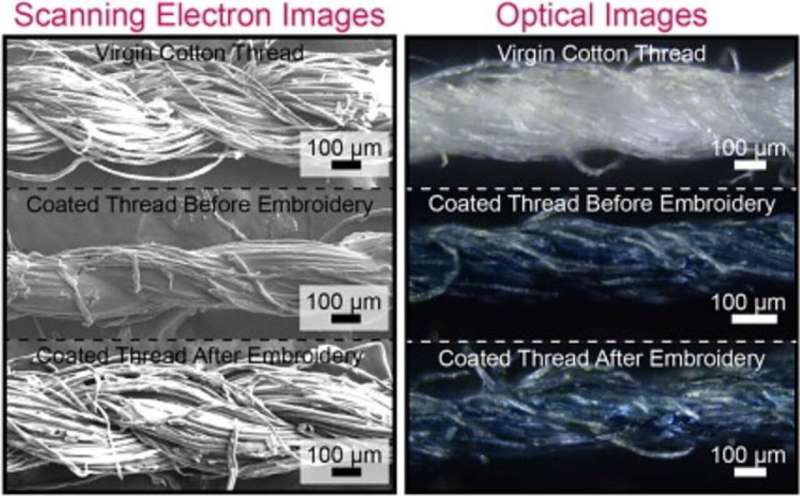
The researchers tested the sensors against commercially available silver-based conductive threads during and after they were embroidered into clothing.
During embroidery, PECOTEX was more reliable and less likely to break, allowing for more layers to be embroidered on top of each other.
After embroidery, PECOTEX demonstrated lower electrical resistance than the silver-based threads, meaning they performed better at conducting electricity.
PECOTEX is high-performing, strong, and adaptable to different needs. It’s readily scalable, meaning we can produce large volumes inexpensively using both domestic and industrial computerized embroidery machines.
The research opens up exciting possibilities for wearable sensors in everyday clothing. Monitoring breathing, heart rate, and gases can already be seamlessly integrated, and might even be able to help diagnose and monitor treatments of disease in the future.
The embroidered sensors retained the intrinsic properties of the fabric such as wearability, breathability and feel-on-the-skin. They are also machine washable at up to 30°C.
Next, the researchers will explore new application areas like energy storage, energy harvesting and biochemical sensing for personalized medicine, as well as finding partners for commercialization.

