
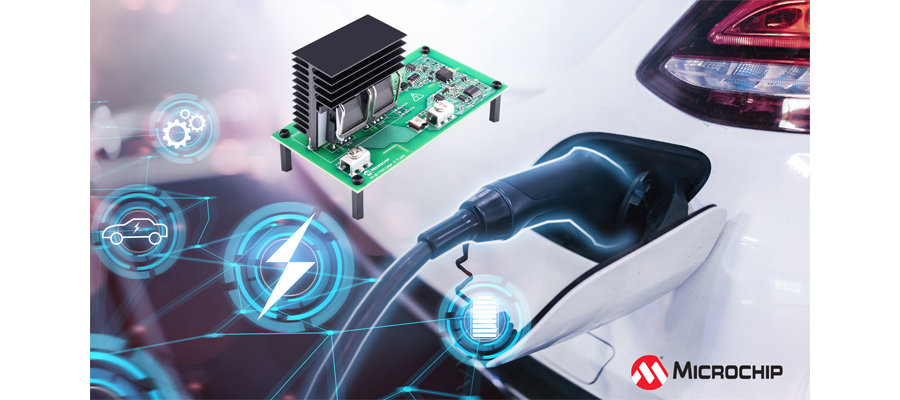
Microchip’s E-Fuse demonstrator is available in six variants for 400–800V battery systems
High-voltage electrical subsystems throughout Battery Electric Vehicles (BEVs) and Hybrid Electric Vehicles (HEVs) require a mechanism to protect the high-voltage distribution and loads in the event of an overload condition. To provide BEV and HEV designers with a faster and more reliable high-voltage circuit protection solution, Microchip Technology Inc. announces the E-Fuse Demonstrator Board, enabled by silicon carbide (SiC) technology, available in six variants for 400–800V battery systems and with a current rating up to 30 amps.




The E-Fuse demonstrator can detect and interrupt fault currents in microseconds, 100–500 times faster than traditional mechanical approaches because of its high-voltage solid-state design. The fast response time substantially reduces peak short-circuit currents from tens of kilo-amps to hundreds of amps, which can prevent a fault event from resulting in a hard failure.
“The E-Fuse demonstrator provides BEV/HEV OEM designers with a SiC-based technology solution to jumpstart their development process with a faster, more reliable method for protecting power electronics,” said Clayton Pillion, vice president of Microchip’s silicon carbide business unit. “The E-Fuse solid-state design also alleviates long-term reliability concerns about electromechanical devices because there is no degradation from mechanical shock, arcing or contact bounce.”
With the E-Fuse demonstrator’s resettable feature, designers can easily package an E-Fuse in the vehicle without the burden of design-for-serviceability constraints. This reduces design complexities and enables flexible vehicle packaging to improve BEV/HEV power system distribution.
OEMs can accelerate development of SiC-based auxiliary applications with the E-Fuse demonstrator because of the built in Local Interconnect Network (LIN) communication interface. The LIN interface enables the configuration of the over-current trip characteristics without the need to modify hardware components, and it also reports diagnostic status.
The E-Fuse demonstrator leverages the unrivaled ruggedness and performance of Microchip’s SiC MOSFET technology and PIC microcontrollers’ Core Independent Peripherals (CIPs) with a LIN-based interface. The companion components are automotive-qualified and yield a lower part count and higher reliability over a discrete design.
Microchip’s SiC power solutions provide the industry’s broadest and most flexible portfolio of MOSFETs, diodes and gate drivers in bare die, discretes, modules and customizable power modules.
Development Tools
The E-Fuse Demonstrator Board is supported by MPLAB X Integrated Development Environment (IDE) to enable customers to quickly develop or debug software. The LIN Serial Analyzer development tool allows customers to easily send and receive serial messages from a PC to the E-Fuse Demonstrator Board.

