
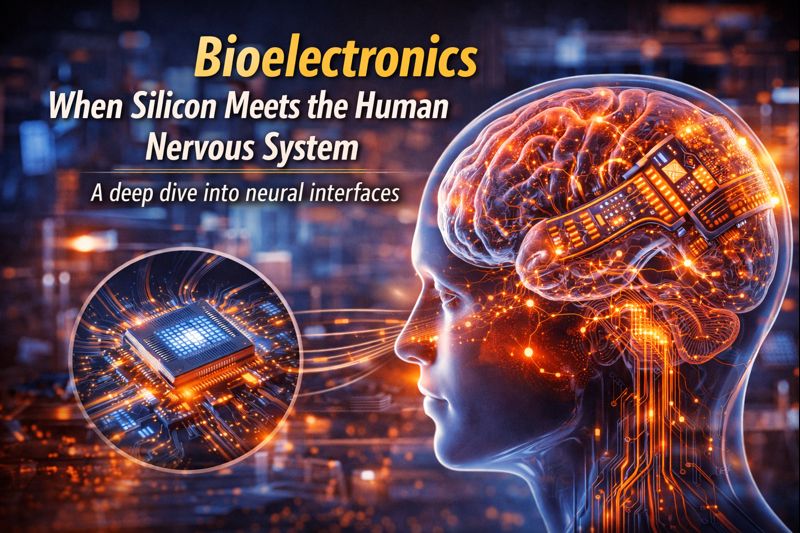
Before examining the challenges and opportunities in bioelectronics, it is essential to understand how electronics and the human body converge. The human body—intrinsically organic and biological—can now interact with silicon-based systems through chips, interfaces, and digital extensions that do more than observe; they actively influence physiological function and enable measurable outcomes.
At its core, the human nervous system is among the most sophisticated electrical networks known. Every sensation, movement, and cognitive process originates as an electrical impulse transmitted across billions of neurons. Bioelectronics builds on this foundation by developing electronic systems capable of reading, interpreting, and modulating these neural signals with high precision.




At the centre of this convergence lies neural interface technology—where electronics, materials science, neuroscience, and computation intersect. What began as experimental neural signal recording has evolved into intelligent, closed-loop systems designed to interact with the nervous system in clinically and functionally meaningful ways.
The Nervous System: An Electrical Network
To call the human nervous system an electrical network is to acknowledge the fact that neurons communicate via action potentials—brief voltage changes produced by ionic movement across cell membranes. These electrical impulses propagate along nerve fibres and form the basis of basic human senses, including perception, motion, and cognition.
However, from an engineering standpoint, neural activity resembles a signal source but with certain riders. The biological signals that the neurons communicate through are characterized distinctly from conventional electronic systems in the following ways:
- Extremely low amplitude (microvolt range)
- Highly variable across individuals
- Sensitive to physiological and environmental conditions
- Embedded in a noisy, living medium
These complexities change the entire course of the environment and approach, which is a crucial aspect of the electronics system design, and that’s why bioelectronics is not simply applied electronics—it is fundamentally a new class of system design.
The Neural Interface Challenge
A neural interface is the physical and electrical bridge between living tissue and electronic systems. Basically, it is a technological innovation that enables a direct communication pathway between the brain (nervous system) and an external device, allowing thoughts/neural signals to control machines, and machines to send sensory data back to the brain. Its primary functions are twofold:
- Reading neural signals
- Delivering electrical stimulation
This makes the landscape more challenging, owing to the complex mix of an artificial arrangement to be balanced with a natural or organic system, and making it perform efficiently and adaptively. To this effect, the challenge lies at the interface level itself. Electronics are rigid and static; biological tissue is soft, adaptive, and reactive. Any long-term interface must balance electrical performance with biocompatibility.
Key Challenges in such an arrangement include:
- Mechanical mismatch between electrodes and tissue
- Immune responses that degrade signal quality
- Corrosion in ionic biological environments
- Stability over years, not months
Dr. Ben Rapoport, Co-founder and Chief Science Officer of Precision Neuroscience- the rival of Neuralink, notes that innovation is increasingly focused on minimising invasiveness: “That’s a big misconception, he said. People often incorrectly assume that ‘you need electrodes that penetrate deep inside the brain to get that information out.”
He further adds that Precision lies in developing a thin film that sits on the brain and records the brain activity. This reflects a broader industry trend toward surface-level and flexible neural interfaces rather than deep, rigid implants.
Neural Interfaces Making Gradual Emergence
Industry experts increasingly emphasise that neural interfaces are no longer speculative technologies. Yet these are gradually making space in our lives, making them more common in overall human behavior.
According to Kevin Hughes, Information Scientist of the Chemical Abstracts Service (CAS), which tracks emerging science and engineering domains, “With the recent news that Neuralink is approved to begin human trials, it’s clear that bioelectronics like brain-computer interfaces (BCIs) are moving out of the realm of science fiction and into reality.”
In the very same continuity, he also points out the difference that the industry is witnessing between the number of journals and the number of patents filed in the biotechnology landscape. The following graph shows the starkly lower number of commercial patents, while academic research has outpaced the same in the last 5 years. He writes, “his suggests that large-scale commercialization of these technologies faces fundamental scientific challenges that are being studied at the academic level and may be years away.”
Capturing Neural Signals: An Analog Problem
Neural signal acquisition is fundamentally constrained by analog design challenges. Electrical signals captured at neural electrodes typically exist in the microvolt range, making them highly susceptible to corruption from noise sources such as muscle activity, motion-induced artefacts, electrode impedance variability, and external electromagnetic interference. Unlike many conventional sensing environments, the biological interface itself is dynamic, lossy, and electrically unstable.
To this effect, the front-end electronics gets to play the most decisive role. These must provide:
- Ultra-low-noise amplification
- High input impedance
- Strong common-mode rejection
- Extremely low power operation
Unlike conventional sensors, neural interfaces cannot rely on static calibration. Signal properties drift over time due to biological adaptation and tissue response, demanding adaptive hardware and software co-design. Consequently, effective neural signal acquisition increasingly relies on adaptive architectures, where analog hardware, digital signal processing, and software algorithms are co-designed to track signal drift, compensate for variability, and maintain reliable performance over extended operational lifetimes.
From Signals to Interpretation
Raw neural signals carry no explicit meaning. Interpretation requires computational models capable of identifying patterns associated with intention, perception, or pathology. This has made way for Machine learning, hence making it central to modern bioelectronics. Models must continuously adapt as neural signals evolve, making on-device intelligence essential and timely.
According to BIOS Health, a company focused on AI-driven neural interfaces, this represents a new data modality in medicine:
“At BIOS, we’re developing AI-powered neural interfaces to allow us to read and write neural signals as a new data modality in healthcare… we can decode it, use biomarkers to see how a disease is progressing, and we can change those electrical signals. In doing so, we’ve delivered a therapeutic—we’ve treated a disease.”
This highlights a shift from monitoring systems to active bioelectronic therapies.
Writing to the Nervous System: Electrical Stimulation
Neural interfaces are not limited to passively observing neural activity; they are equally defined by their ability to actively influence the nervous system. This capability is most clearly demonstrated in modern bioelectronic devices that deliver precisely controlled electrical stimulation to targeted neural pathways. By injecting carefully shaped electrical pulses, these systems can alter neural firing patterns in ways that restore, suppress, or modulate biological function.
Electrical stimulation underpins a wide range of therapeutic and functional outcomes, including:
- Restoration of sensory input
- Modulation of dysfunctional neural circuits
- Enablement of motor control
- Suppression of chronic pain signals
From an engineering standpoint, effective neural stimulation demands precise control over parameters such as pulse amplitude, width, frequency, and waveform shape. These parameters must be tailored not only to the targeted neural population but also to long-term safety constraints, including charge balancing and tissue compatibility. Overstimulation risks tissue damage or neural fatigue, making precision and reliability non-negotiable design requirements.
Increasingly, neural stimulation systems are evolving into closed-loop architectures, where real-time sensing, on-device computation, and adaptive stimulation form a continuous feedback cycle. Instead of delivering fixed stimulation patterns, these systems dynamically adjust outputs based on measured neural responses, enabling more personalised, efficient, and clinically effective interventions. This shift from open-loop to closed-loop control represents a critical step toward truly intelligent bioelectronic systems.
Case Study: Cochlear Implants
Cochlear implants remain one of the most successful examples of bioelectronics in practice. Rather than amplifying sound acoustically, cochlear implants convert audio signals into electrical stimulation patterns delivered directly to the auditory nerve. Frequency components are mapped spatially along an electrode array implanted in the cochlea.
Despite delivering a simplified representation of sound, cochlear implants exploit the brain’s neural plasticity. Over time, users learn to interpret these electrical patterns as meaningful auditory experiences. From an engineering perspective, cochlear implants demonstrate:
- Long-term biocompatibility
- Ultra-low-power embedded processing
- Robust signal mapping
- Effective closed-loop adaptation
They validate the principle that bioelectronics succeeds when it works with biology rather than attempting to replicate it perfectly.
Power, Reliability, and Longevity
Implanted bioelectronic systems must operate reliably for years without failure. Power consumption, heat dissipation, and battery safety are critical constraints.
Unlike consumer electronics, failure carries direct clinical risk. As a result, bioelectronic design prioritises stability, redundancy, and conservative validation over rapid iteration.
Conclusion
The future of bioelectronics lies in deeper integration and softer interfaces—flexible electronics, bio-compatible materials, and adaptive systems that learn continuously. As silicon systems become more biologically aware, neural interfaces are evolving from experimental tools into foundational technologies for healthcare and human–machine interaction.
Bioelectronics does not aim to replace the nervous system. It aims to understand it—and, where possible, support it—using electronics designed to operate on biology’s terms.

