
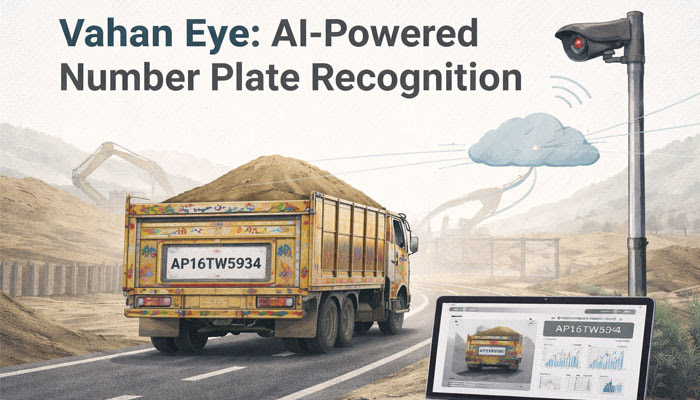
‘Truck art’ or the hand-painted ‘Horn Ok Please’, ‘Use Dipper at Night’ and the ‘Buri nazar waale tera mooh kala’ are an integral part of Indian highways. These artistic expressions, which lighten up many a road journey, also find an extension in hand-painted registration plates. However, such unstandardised lettering can prove to be a challenge for automatic number plate recognition (ANPR) systems. Most commercial ANPR systems are designed for standardised license plates. ANPR systems play a crucial role in modern governance, helping authorities monitor traffic, enforce regulations, prevent illegal transport, and improve public safety. From toll booths to traffic violations, ANPR enables real-time vehicle tracking without manual checks.
A Unique Number Plate Problem
Hence, when the Telangana IT Department approached IIIT-H, seeking an ANPR solution for the Telangana Mineral Development Corporation (TGMDC), their requirement was very different from typical commercial use cases.TGMDC was on the lookout for a cost-effective, robust solution tailored to monitor sand mining trucks, primarily to curb illegal mining and transport. “Typical license plates are actually easy to detect,” explains Dr. Veera Ganesh Yalla, CEO of iHub-Data and Adjunct Faculty at IIIT-H. But in India, especially with trucks, plates are often hand-painted, inconsistent, and highly variable. “They might follow black lettering on a yellow background, but from vehicle to vehicle, their design, the style, everything is unique,” he says, making off-the-shelf solutions for their detection both ineffective and expensive.





Building Smart, Not From Scratch
Commercial systems are typically very expensive, with per-camera costs of licensing and maintenance running into tens of lakhs. Leveraging prior research from Prof. Ravikiran Sarvadevabhatla’s team at the Centre for Visual Information Technology, IIIT-H, where a prototype license plate recognition system had been developed, the iHub-Data team took the research forward into real-world deployment. “The lab tech was more like a research prototype, not really for scaling or translation. So we decided to take it and see what we could do,” Dr. Yalla recalls. The team studied the workflow, rebuilt and strengthened the handwritten character recognition component. What’s unique is that they integrated the analytics as a plug-in into an open-source platform. ”If anybody wants to plug in our license plate technology into their platform, they can do it without having to rewrite their entire platform from scratch,” he notes.
Real-life Deployment
Their solution, named Vahan Eye, was piloted at Chityal on the Vijayawada–Hyderabad highway, where the team installed cameras, laid cables, and deployed the system end-to-end. The deployment tracks trucks entering Telangana and cross-checks them against a whitelist of nearly 40,000 approved vehicles. Tweaked specially to suit the needs of TGMDC, the solution offers customised dashboards. Since September, the system has been running continuously. Despite challenges such as low lighting at night and festival-related obstructions such as garlands covering the number plates, the algorithm has proven robust and continues to improve with live data.

From PoC to Public Impact
Built by a lean team of fewer than five engineers and powered by modern deep learning models, Vahan Eye demonstrates how lab research can be translated into an affordable, field-ready public solution. “Our IP is that we really figured out how to solve this whole handwritten license plate character problem,” says Dr. Yalla. Currently, the team is working on customising the solution for the Police Department for automatic detection of traffic violations by 2-wheelers.
Dr. Yalla, who began his career in the video surveillance industry with classical machine learning solutions that used support vector machines, explains that with advances in deep learning, more powerful algorithms such as YOLO and RF-Detr are now being applied, leading to significantly improved performance and accuracy. As he puts it, the goal is clear: prove the technology works, make it accessible at a fraction of commercial costs, and enable scalable adoption across government departments.

