

While traditional Electronic Design Automation tools have been faithfully executing commands for decades, today’s agentic AI systems are rewriting the rulebook by thinking, iterating, and problem-solving autonomously across entire design workflows. Picture this: specialised AI agents functioning like a virtual design team—complete with their own CEO, CTO, and engineering specialists—orchestrating everything from RTL generation to physical design verification in feedback-driven loops that don’t just respond to errors, they anticipate and resolve them. This isn’t your standard chatbot-writes-some-code scenario; we’re talking about multi-agent architectures powered by Large Language Models that refuse to call it a day until every simulation passes. As the semiconductor industry grapples with a workforce crisis that threatens to bottleneck innovation, these AI systems are emerging as more than assistants; they’re becoming co-designers capable of exponentially multiplying engineering productivity. To understand how industry leaders are navigating this transformation from AI-assisted to AI-orchestrated design, we reached out to companies at the forefront of this revolution.
Architecture to Autonomy: Building Multi-Agent AI Systems for Chip Design




The semiconductor design floor is witnessing an unprecedented transformation where intelligent agents collaborate, critique, and refine work autonomously, like a seasoned design team operating at machine speed.
The Multi-Agent Architecture
Industry implementations structure these systems around specialised agent roles: RTL generation specialists handle code synthesis, verification agents scrutinise design correctness, and physical design agents optimise layouts. The orchestration framework manages task routing and dependencies, ensuring coherent workflow progression. Critically, these agents don’t replace existing EDA platforms; instead, they orchestrate them, invoking synthesis runs and analysing timing reports with minimal human intervention.
LLM Selection and Domain Adaptation
Behind these agents run Large Language Models serving as inference engines. The industry has split between proprietary models like GPT-4 and Claude, which offer robust reasoning capabilities, and open-source alternatives such as DeepSeek-Coder and Llama variants, providing customisation flexibility for high-volume workloads.
Raw LLMs produce generic code, but semiconductor design demands precision. Organisations implement two adaptation strategies: Retrieval-Augmented Generation (RAG) connects LLMs to design rule manuals, timing libraries, and verified IP repositories, grounding outputs in proven patterns. Domain-specific fine-tuning retrains models on millions of lines of verified RTL, enabling them to recognise design intent from terse specifications and suggest synthesis-aligned optimisations.
Talking about choosing the “right” LLM, 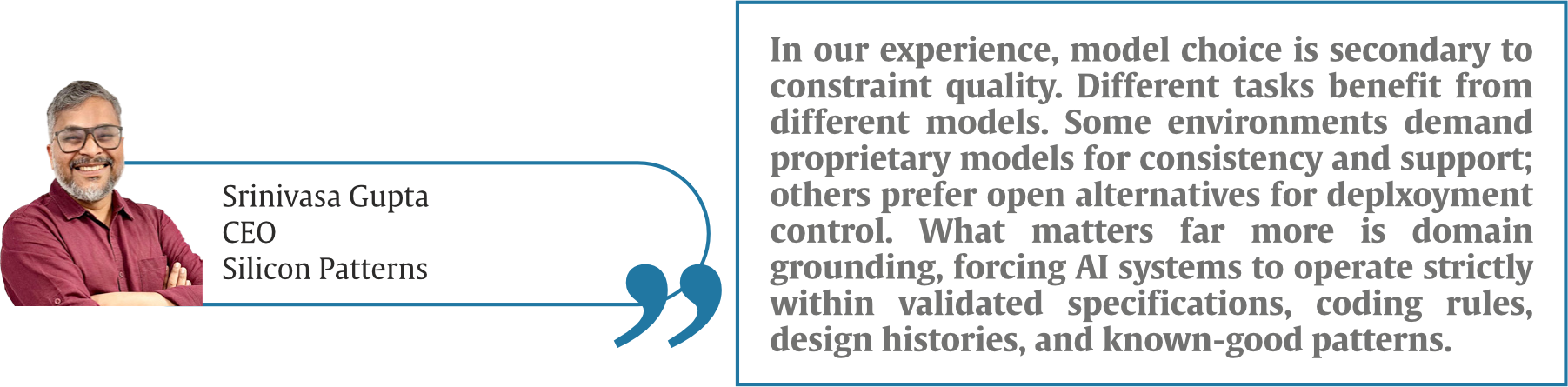
Addressing Code Hallucination
The critical challenge remains code hallucination, plausible but incorrect outputs. Industry leaders deploy multi-layered validation: formal verification integration, simulation-in-the-loop refinement cycles, constraint-guided generation, and mandatory human review checkpoints for critical path logic. As one verification lead noted, AI-generated RTL receives the same scrutiny as junior engineer code, but iterates at 100x speed before human review.
“Hallucination is not a mysterious AI problem. It is the result of under-specified intent. We deal with it the same way we deal with junior engineers: through validation gates. Every AI-generated output passes through linting, simulation, coverage analysis, and equivalence checks. Nothing bypasses human review for critical design decisions. Trustworthy output comes from engineering discipline applied to AI, not from believing AI will magically become trustworthy,” added Gupta.
The technical architecture is maturing rapidly, but the true test ahead is scaling from engineer assistance to autonomous subsystem design, determining whether agentic AI becomes indispensable infrastructure or remains an expensive experiment.
AgentEngineer Revolution: Transforming Roles and Multiplying Productivity
The automation wave reshaping semiconductor design isn’t just changing workflows—it’s fundamentally redefining what it means to be a design engineer in 2026.
Quantifiable Productivity Gains
Early adopters report transformative productivity metrics. RTL generation rates have surged from approximately 50-100 lines per engineer-day in manual workflows to 500-1,000+ lines with AI assistance—a 10x improvement when measured by functional complexity rather than raw line count. Time-to-tapeout reductions range from 20-40% for complex SoC projects, with verification cycles seeing the most dramatic compression.
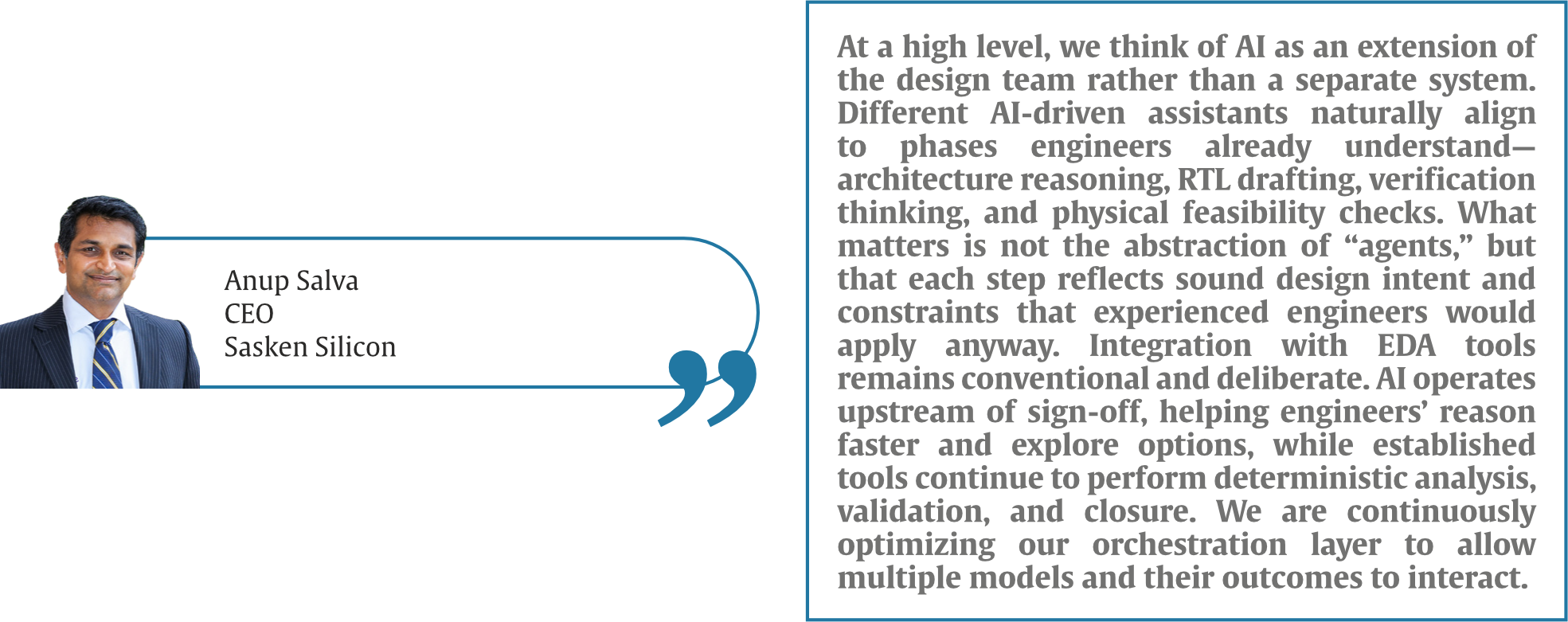
“The biggest gains have come from reducing friction, not replacing engineers. Tasks that previously required multiple iteration initial RTL structure, verification scaffolding, and early debug hypotheses now converge faster. We typically see meaningful schedule compression in early and mid-design phases, allowing teams to spend more time on optimisation, corner cases, and RF-digital interactions. This has increased our capacity to take on more complex mixed-signal and SoC programs without sacrificing rigour,” explains Anup Salva, CEO, Sasken Silicon.
Verification coverage metrics tell an equally compelling story. AI-driven testbench generation achieves 85-95% functional coverage in initial passes compared to 60-70% with manual approaches, while bug detection rates during pre-silicon validation have improved by 30-50%. One design team reported identifying critical corner-case failures that traditional directed tests missed entirely, caught by AI agents exploring unconventional stimulus patterns.
Perhaps most significant: engineering teams report handling 2-3x more concurrent design projects without proportional headcount increases, effectively multiplying organisational capacity during an industry-wide talent shortage.
The Evolving Engineer Role
The shift from manual RTL coding to AI-orchestrated design is forcing a fundamental role transformation. Traditional design engineers spent 60-70% of their time writing and debugging code. Today’s “AgentEngineers” allocate that time differently: 40% on high-level architectural specification and constraint definition, 30% on AI output validation and refinement, 20% on system integration and optimisation, and just 10% on direct coding for critical path logic AI cannot yet handle reliably.
Talking on the evolving role of Engineers in the AI era, Srinivas Gupta, CEO, Silicon Patterns, emphasises that, “AI is not eliminating engineering roles, it is exposing who is adding real value. The role of the engineer is shifting from manual construction to intent definition, supervision, and judgment. Writing RTL is no longer the bottleneck; understanding what should be written and why is. Effective training is not about teaching “prompt engineering.” It is about teaching engineers how to reason clearly, review outputs critically, and understand failure modes. The best learning happens when AI is embedded directly into real project workflows, spec reviews, verification bring-up, debug, not in isolation.”
New competencies are emerging as essential: prompt engineering skills to communicate design intent effectively to LLM agents, AI system supervision capabilities to recognize when autonomous agents are diverging from design goals, and elevated architectural thinking to work at higher abstraction layers. The most successful engineers are those who transition from implementation experts to design orchestrators—defining what to build while delegating how to build it.
Training for Transformation
Organisations are implementing structured transition programs. Technical training covers AI model capabilities and limitations, effective prompt crafting for design specifications, and verification strategies for AI-generated code. Just as importantly, cultural training addresses the psychological shift from individual contributor to AI collaborator, teaching engineers when to trust autonomous outputs and when human judgment remains irreplaceable.
The semiconductor workforce crisis that threatened industry growth is being addressed not through massive hiring campaigns, but through radical productivity multiplication—a smaller cohort of AgentEngineers accomplishing what previously required entire design teams.
Trust, Validation, and the Road to 2026: Overcoming Deployment Challenges
Agentic AI’s technical promise confronts harsh deployment realities. The path from laboratory demonstration to production tapeout demands solving trust, integration, and scalability challenges that determine whether this technology revolutionises the industry or remains confined to pilot projects.
The Three Critical Deployment Challenges
Integration Complexity tops the challenge list. Legacy EDA environments weren’t architected for AI orchestration—tool licenses limit concurrent sessions, APIs lack programmatic access depth, and design databases struggle with AI agents’ iterative read/write intensity. Organisations report 6-12 month integration timelines just to achieve basic agent-tool interoperability.
Trust and Validation Frameworks represent the existential challenge. For tape-out critical stages—final timing closure, DFT insertion, physical verification—engineers demand confidence levels AI systems cannot yet guarantee. One design director noted, “We can’t ship silicon that passes simulation but fails in production because an AI agent hallucinated a clock domain crossing fix.”
Organisational Resistance manifests subtly but persistently. Experienced engineers trained over decades resist delegating design authority to probabilistic systems. Version control becomes contentious when distinguishing human versus AI contributions. Accountability questions arise when AI-generated blocks cause post-silicon failures.
Building Trust Through Validation
Successful deployments implement rigorous validation hierarchies. AI-generated RTL undergoes formal equivalence checking against specifications, simulation coverage thresholds exceed 95% before human review, and critical paths receive mandatory expert sign-off regardless of AI confidence scores. Human-in-the-loop checkpoints gate progression, with engineers retaining veto authority at every stage.
Observability tools provide transparency into AI decision-making—logging which training examples influenced specific design choices, tracking confidence metrics for generated code segments, and flagging low-confidence outputs for immediate human review.
The 2026 Automation Roadmap
Industry consensus positions current systems at Level 2 on the five-level autonomy scale: capable assistants requiring continuous supervision. Reaching Level 4—autonomous subsystem design with minimal oversight—demands breakthroughs across multiple fronts.
Enhanced LLM reasoning must progress beyond pattern matching to genuine architectural trade-off analysis, understanding power-performance-area implications of micro-architectural choices. Memory systems need expansion to manage entire SoC contexts rather than isolated module designs. Formal methods integration must advance from post-generation validation to constraint-guided generation, preventing invalid designs rather than detecting them.
On the India front, Anup Salva, CEO, Sasken Silicon, notes that, “India’s advantage lies in its depth of engineering intuition, especially in areas like RF, analogue, and system-level integration. These are domains where AI works best as a multiplier, not a replacement. Over the next few years, we expect higher automation in well-understood design spaces, but always guided by engineers who understand the underlying physics and architecture. Progress will be driven more by better problem formulation and design discipline than by radical new tools.”
The competitive landscape trajectory appears clear: by late 2026, agentic AI will likely transition from a competitive differentiator to table stakes. Organisations not deploying these systems risk falling behind on time-to-market metrics. Yet the dominant paradigm will remain hybrid human-AI workflows rather than full autonomy—engineers orchestrating AI agents rather than being replaced by them, at least through this decade.
by: Shreya Bansal, Sub-Editor

