

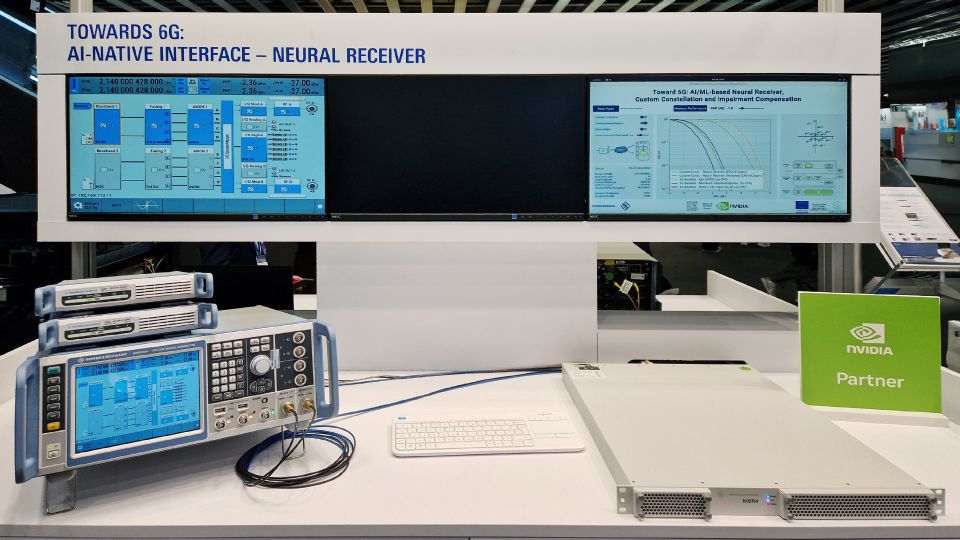
Rohde & Schwarz will showcase a new milestone in AI-driven wireless system testing at MWC Barcelona. The testbed, developed in collaboration with NVIDIA, integrates hardware-in-the-loop site-specific channel emulation using the NVIDIA Sionna Research Kit, enabling testing of AI-RAN applications under realistic channel conditions. The demonstration highlights the long-term collaboration of Rohde & Schwarz and NVIDIA, focusing on prototyping and validation of AI-RAN innovation with cutting-edge test and measurement solutions.
Evolving from prior proofs-of-concept in advanced neural receiver design – including custom constellations for pilotless communication – the new testbed advances from link-level validation to system-level verification using the full 5G NR protocol stack.



Powered by a single NVIDIA DGX Spark, the NVIDIA Sionna Research Kit runs a software-defined 5G RAN based on OpenAirInterface, while supporting AI inference workloads that comply with the strict real-time constraints of wireless systems. To showcase the flexibility of the research platform, a novel AI/ML-enhanced link adaptation algorithm has been integrated into the end-to-end system. It dynamically adjusts the downlink modulation and coding scheme (MCS) to optimise spectral efficiency and link reliability. The AI-driven link adaptation can learn not only site-specific propagation characteristics but also user equipment-specific behaviour on the fly, emphasising the need for end-to-end testbeds that capture these effects.
The testbed integrates the R&S SMW200A vector signal generator featuring dynamic channel emulation capabilities and the FSW signal and spectrum analyser. Jointly, these instruments enable the emulation of complex site-specific radio channels, seamlessly interfacing with the NVIDIA Sionna RT differentiable ray-tracing software. This closed-loop setup enables researchers and developers to evaluate the performance of novel AI-driven RAN features under dynamic, site-specific RF conditions – all without leaving the lab.
Gerald Tietscher, Vice President Signal Generators, Power Supplies and Meters at Rohde & Schwarz, said: “We’re excited to continue our ongoing collaboration with NVIDIA with this latest proof-of-concept for testing AI-enhanced base stations for both 5G-Advanced and 6G under realistic propagation conditions. Leveraging digital twin technology and ray tracing, this approach aims to bridge the gap between AI-driven wireless simulations and real-world deployment, facilitating more efficient and accurate testing of next-generation receiver architectures.”
Soma Velayutham, global industry business development lead for telecommunications at NVIDIA, said: “Synthetic data generation is transforming the way we train and validate AI-RAN systems by ensuring accuracy, scalability, and privacy, especially in settings of sparse data. Rohde & Schwarz, leveraging the NVIDIA Sionna Research Kit, exemplifies how industry-leading expertise and innovative technology can come together to accelerate progress in this critical field.”

