

By Meryem Berrada, Product Marketing Engineer, Keysight Technologies




Modern 5G network testing depends on real-time spectrum analysis to detect transient RF interference that traditional swept spectrum analysers often miss. As RF environments become denser with 5G, IoT, radar systems, and autonomous infrastructure, engineers increasingly rely on handheld spectrum analysers and spectrum management software to identify, localise, and mitigate interference in real time.
The wireless world is not just getting faster. It is getting denser. As global infrastructure shifts toward 5G, massive IoT, and autonomous systems, the RF spectrum is becoming an increasingly crowded and contested space. What once appeared as occasional interference is now evolving into something far more consequential: an invisible gridlock forming across the airwaves. This shift fundamentally changes the nature of the problem.
Interference is no longer a minor inconvenience behind a dropped call. It is a systemic risk capable of disrupting critical operations. Maintaining network integrity now requires more than simply detecting signals. It demands real-time, intelligent awareness of spectrum behaviour as it unfolds. Several key shifts show just how much the RF landscape has changed.
Why Is RF Interference Detection Critical for Safe 5G Network Testing?
The transition to 5G does not just improve performance. It raises the stakes. Networks are moving from human-driven communication toward machine-to-machine ecosystems, where reliability is directly tied to physical outcomes. In this environment, RF interference detection affects far more than connectivity. It can directly impact systems such as autonomous vehicle navigation, public safety communications, and radar and defence infrastructure.
In these contexts, failure is not measured in inconvenience. It is measured in consequence. A momentary disruption can cascade into a critical system failure, leaving little to no margin for error. Interference is no longer something networks can simply tolerate. It is something they must actively anticipate and mitigate during 5G network testing and deployment.
Why Do Traditional Spectrum Analysers Miss Modern RF Interference?
Conventional swept-tuned spectrum analysers were designed for a very different RF environment, one where signals were relatively stable, predictable, and easier to isolate. Today’s signals behave differently. They are often transient, lasting only milliseconds. They can be intermittent in nature and increasingly dense, overlapping within the same spectral space. Traditional swept spectrum analysers measure frequencies sequentially.
That sweep-based approach can provide useful snapshots of RF activity, but it can also miss short-duration events that occur between sweeps. Real-time spectrum analysis changes that perspective. Instead of sampling the spectrum in slices, it continuously captures and processes RF activity across a defined bandwidth without gaps in observation. This makes it better suited to detecting transient, burst, and intermittent signals that are common in modern 5G and dense RF environments.
With modern tools, engineers can visualise RF behaviour using spectrograms and waterfall displays. These views reveal short-duration transients, overlapping emitters, and time-varying interference patterns that would otherwise remain invisible. Capturing this kind of wideband, time-sensitive activity is no longer a specialised capability. It is becoming a baseline requirement for modern RF interference detection.
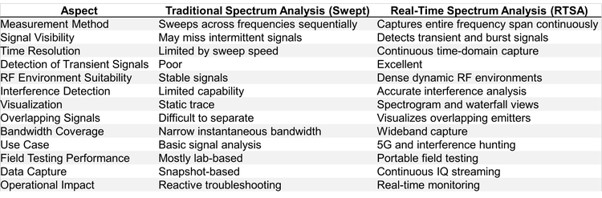
Traditional vs. Real-Time Spectrum Analysis: Key Differences for 5G and RF Interference Detection
Understanding the difference between traditional and real-time spectrum analysis is critical for engineers performing RF interference detection and 5G network testing in modern environments.
How Are Real-Time Spectrum Analysis Workflows Changing Field Testing?
The traditional model of RF troubleshooting, dispatching teams to investigate issues on-site, is rapidly becoming unsustainable. Historically, diagnosing problems in the “last mile” required manual drive testing, consuming significant time, labour, and operational resources. That model is now shifting toward centralised, software-driven workflows.
By combining ruggedised handheld spectrum analysers with centralised analysis platforms, engineers can remotely control distributed test assets, monitor multiple sites simultaneously, and stream live measurement data back to centralised teams. This creates a fundamentally different workflow: capture, stream, analyse, and act. Engineers no longer need to be physically present at every field location. Instead, units can remain deployed at the edge while analysis happens centrally, powered by high-fidelity, wideband IQ data delivered in real time.
How Does Real-Time RF Interference Detection Use TDoA Localisation?
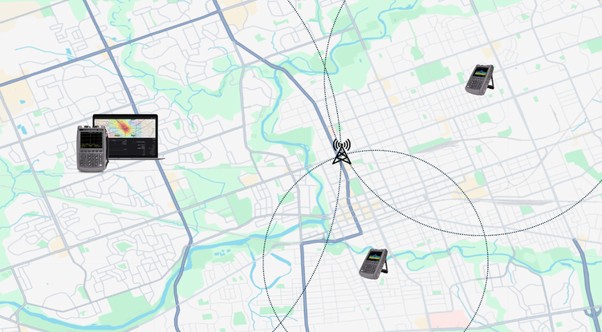
The classic “fox hunt,” tracking interference sources with directional antennas, was built for a slower and simpler RF environment. In today’s dense 5G deployments, where interference sources can appear and disappear in milliseconds, manual methods struggle to keep pace. The modern approach shifts the problem from physical pursuit to mathematical computation. Time Difference of Arrival, or TDoA, techniques use multiple GPS-synchronised receivers to measure the precise arrival time of a signal across different locations.
Because RF propagation speed is constant, software can calculate the emitter’s position based on the difference in arrival times. This approach reduces reliance on slow, manual triangulation and enables rapid, wide-area localisation that scales with the complexity of modern networks. RF interference detection is no longer only a field exercise. It is increasingly a data-driven problem solved through coordinated measurement and computation.
How Are Handheld Spectrum Analysers Closing the Gap Between Field and Lab Testing?
For years, RF engineers had to choose between portability and performance. Handheld spectrum analysers offered convenience in the field but often lacked the depth required for advanced analysis. Benchtop instruments delivered precision, but at the cost of mobility. That trade-off is now changing.
Modern handheld analysers can enable wideband real-time IQ streaming, representing a significant leap from previous limitations and changing what can be achieved outside the lab. This capability is especially important for 5G New Radio, where channel bandwidths can reach up to 100 MHz in sub-6 GHz bands. Without wideband capture, engineers may be forced to stitch together narrower measurements, losing critical time-domain behaviour in the process. With wideband streaming, entire 5G channels can be captured in a single acquisition, preserving signal behaviour and enabling integration into centralised analysis workflows. In practical terms, the boundary between field and lab is becoming less rigid. More advanced analysis can now be brought closer to where the RF problem actually occurs.
Why Real-Time Spectrum Analysis Is Becoming Essential for 5G Network Testing
Spectrum management is undergoing a fundamental transformation. Detecting signals is no longer sufficient. Engineers must now be able to capture transient, wideband RF activity in real time, stream and classify that data within centralised systems, precisely locate interference sources, and act before disruptions escalate into failures.
The wideband reality is already here. With 5G NR channel bandwidths reaching up to 100 MHz in sub-6 GHz bands, real-time wideband capture is not just a forward-looking requirement. It is an immediate need for modern 5G network testing. The question is no longer whether interference will occur. The question is whether your tools can see it in time.

