

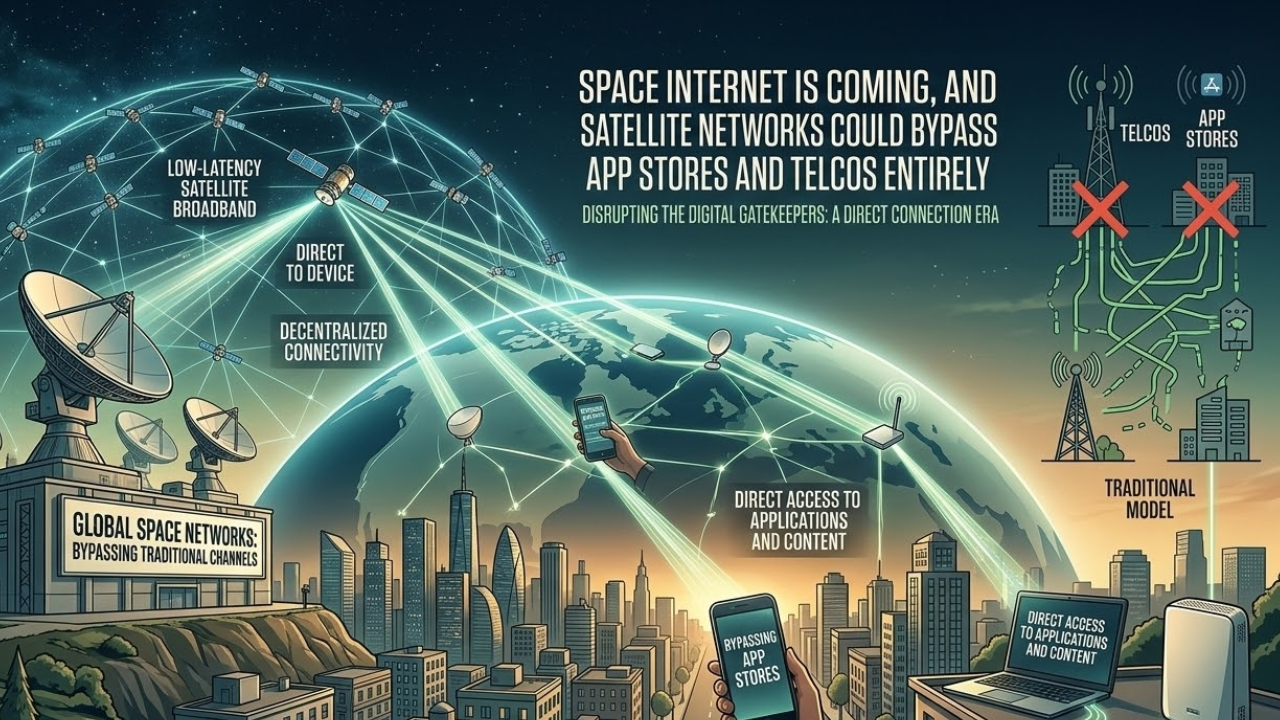
Low Earth Orbit (LEO) satellite constellations are entering a new phase of telecom relevance. What began as fixed satellite broadband for remote homes has evolved into direct-to-device connectivity integrated within 3GPP Non-Terrestrial Network standards. Modern satellites are no longer simple bent-pipe relays. They incorporate regenerative payloads, digital beamforming arrays, onboard processing, and inter-satellite optical links that allow orbital mesh routing. The engineering sophistication is undeniable.
However, for telecom professionals and network architects, the key discussion is not about technological capability. It is about architectural positioning: can satellite networks scale to rival terrestrial radio access networks (RAN)? Can they bypass traditional telecom operators? And do they meaningfully challenge app-store ecosystems? The answers require a grounded understanding of spectrum physics, link budgets, and capacity density.



Spectrum Architecture: IMT and Non-IMT Realities
Direct-to-device satellite systems operate either in traditional satellite allocations (non-IMT bands such as L-band or S-band) or within IMT spectrum harmonised under 3GPP NTN specifications.
In non-IMT bands, scalability faces structural limits. Propagation at these frequencies is highly dependent on near line-of-sight conditions. Building penetration loss, urban canyon multipath fading, and foliage attenuation reduce reliability. Unlike terrestrial networks that can densify through small cells and sectorization, satellites illuminate wide geographic footprints. They cannot dynamically increase cell density in obstructed urban terrain.
This makes non-IMT direct-to-handset connectivity better suited for open environments such as rural regions, highways, maritime routes, and disaster zones rather than dense urban centres. IMT integration under NTN introduces greater harmonisation. Release 17 and beyond specify extended timing advance calibration, Doppler shift compensation, modified Hybrid Automatic Repeat Request (HARQ) timing, and satellite-aware mobility management. Devices can theoretically switch between terrestrial LTE/5G and orbital access with protocol continuity.
Yet the operational model remains conditional. Satellite access is typically triggered when terrestrial RSRP or SINR drops below defined thresholds. The modem evaluates signal quality and only activates NTN mode when necessary. This ensures satellite resources are preserved, and terrestrial networks handle high-density traffic loads.
Elon Musk, CEO of SpaceX, captured the strategic goal succinctly:
“There should be no dead zones anywhere in the world for your cell phone.” The emphasis is on coverage ubiquity, not urban capacity replacement.
Capacity Density: The Defining Constraint
The most decisive technical limitation is spectral density. Terrestrial operators achieve massive throughput through:
- Massive MIMO spatial multiplexing
- Dense macro-cell grids
- Small-cell layering in high-traffic zones
- Fibre-backed backhaul
- Millimeter-wave overlays
- Aggressive frequency reuse patterns
Satellite beams, even with advanced spot-beam architectures and frequency reuse, cover substantially larger areas. The spectral efficiency per square kilometre cannot match dense terrestrial deployments. Additionally, handheld devices operate under strict uplink power constraints, limiting achievable modulation and coding schemes for satellite links.
From a Shannon capacity standpoint, satellite systems are optimised for wide-area coverage, not high-density concurrency. In densely populated markets, even a mid-sized terrestrial operator can deliver greater aggregate throughput than an orbital beam serving the same footprint. This reality defines satellite’s optimal roles:
- Extending connectivity to underserved geographies
- Providing redundancy during disasters
- Supporting maritime and aviation mobility
- Enabling IoT in sparse environments
- Enhancing national connectivity resilience
Gwynne Shotwell, President of SpaceX, has consistently emphasised connectivity as foundational infrastructure. Reliable global access enables economic participation in regions where terrestrial networks are economically infeasible. The engineering model aligns with that vision.
Inter-Satellite Routing and Cloud-Native Architecture
Modern LEO constellations differentiate themselves through inter-satellite optical links (ISLs). Instead of routing traffic exclusively through ground gateways, data can hop between satellites before downlinking closer to its destination. This reduces dependence on terrestrial fibre choke points and can optimise long-haul routing paths.
Software-defined payloads further allow dynamic beam shaping, adaptive spectrum allocation, and load balancing. Combined with cloud-native packet cores and virtualised network functions, satellite systems increasingly resemble distributed edge clouds in orbit.
However, engineering challenges persist:
- Beam handover must be predictive to prevent session drops.
- Doppler shift compensation requires continuous frequency correction.
- Latency variability introduces jitter that must be absorbed at the transport layer.
- Congestion control algorithms, often QUIC-based, must adapt dynamically.
These are solvable challenges, but they reinforce the reality that satellite networks are engineered for resilience and reach rather than metro throughput supremacy.
Application Distribution and App-Store Dynamics
The notion that satellite networks could bypass app stores often conflates connectivity with runtime control. Satellite networks can facilitate cloud-streamed applications, Progressive Web Apps leveraging Web Assembly, multicast firmware updates, and enterprise-managed OTA deployments. However, runtime enforcement remains device-governed. Operating systems from Apple and Google maintain secure boot chains, code-signing validation, and hardware root-of-trust mechanisms independent of the access network.
Thus, while connectivity may be decentralised, execution control remains centralised within device ecosystems. App-store displacement at mass consumer scale remains unlikely in the near term. Satellite-enabled distribution is most viable in enterprise, industrial, defence, and controlled-device environments where policy governance is internally managed.
Global Regulatory Architecture
Satellite beams inherently traverse national borders. This introduces complex regulatory questions regarding lawful intercept, spectrum harmonisation, emergency service prioritisation, and data sovereignty. Unlike terrestrial towers confined within licensed areas, orbital coverage footprints overlap multiple jurisdictions simultaneously.
Regulators worldwide are converging toward coexistence frameworks where satellite operators must comply with local licensing, security audits, and traffic monitoring obligations. Encryption policies, gateway localisation requirements, and national security clearances are increasingly embedded within approval processes.
Indian Regulatory Perspective
In India, satellite internet operates within a structured licensing regime under the Department of Telecommunications. Operators must obtain a Global Mobile Personal Communication by Satellite (GMPCS) license to provide satellite communication services. Spectrum allocation is subject to administrative assignment or auction-based frameworks, depending on policy direction. Gateway earth stations require approval from national authorities, and security compliance is mandatory. Traffic monitoring capabilities must be provisioned in accordance with lawful intercept regulations. Data localisation considerations, especially under emerging digital governance frameworks, may require traffic breakout within Indian jurisdiction rather than pure inter-satellite routing for domestic data flows.
Additionally, satellite services must align with spectrum coordination under the Wireless Planning & Coordination (WPC) Wing. Coexistence with terrestrial IMT networks requires careful interference management and harmonisation. Regulatory approvals also involve security vetting of network elements and equipment supply chains.
India’s regulatory approach emphasises sovereign oversight while encouraging innovation through hybrid terrestrial-satellite integration models. Partnerships between satellite operators and domestic telecom providers are often preferred to ensure compliance with national security and licensing frameworks.
Industry Alignment: Complement, Not Replace
Sunil Bharti Mittal, Chairman of Bharti Airtel, has emphasised cooperation between satellite and terrestrial operators. In dense markets, terrestrial RAN grids remain unmatched in spectral reuse efficiency and urban throughput.
The long-term architecture, therefore, becomes hybrid:
- Terrestrial networks manage dense capacity loads.
- Satellite networks eliminate coverage gaps.
- Multi-RAT device logic dynamically orchestrates between both.
This convergence is not theoretical. It is already embedded within modem firmware design, NTN standardisation, and regulatory frameworks.
Engineering Takeaways
Telecom engineers and policymakers should focus on:
- Intelligent multi-RAT orchestration between terrestrial and NTN layers
- Adaptive transport protocols for variable-latency satellite links
- Robust cryptographic identity frameworks for secure OTA distribution
- Spectrum coexistence planning in IMT-integrated NTN deployments
- Regulatory compliance mechanisms for cross-border satellite beams
Conclusion
Space internet is a meaningful technological evolution. Advanced beamforming, regenerative payloads, inter-satellite optical routing, and NTN standardisation represent major engineering progress. But spectrum reuse laws and capacity density constraints remain decisive. Satellite networks excel in reach, resilience, and redundancy. Terrestrial networks dominate high-density throughput and urban spectral efficiency. The future of connectivity is not orbital disruption of telecom operators or wholesale bypass of app ecosystems. It is a structured convergence of a layered architecture where Earth and orbit operate in coordinated harmony.
Engineers who design seamless integration across these layers will define the next decade of global communications.

