
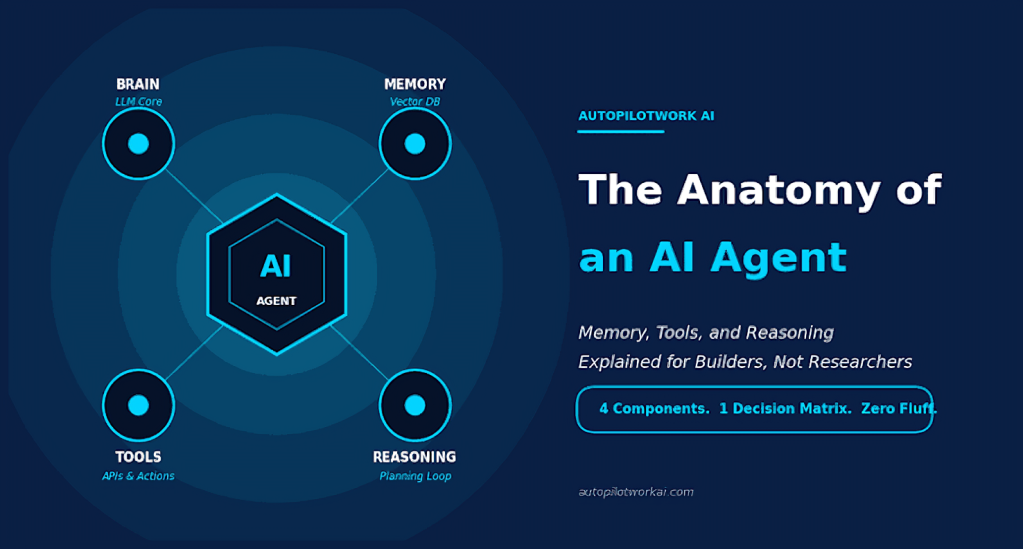
AI is transitioning from answer-providing computer programs to the software we refer to as AI agents, which can choose a goal, reason, come up with a plan, access external resources, and act semi-autonomously. Whereas a chatbot is only activated when a user submits a question, an AI agent can autonomously choose a next step, collect data, communicate with software, and update its plan.
Google Cloud says that these AI agents use reasoning, planning, and memory to accomplish the specific goal on behalf of the user. Companies that leverage AI agents in various fields such as software development, cybersecurity, customer support, research, finance, IT operations, enterprise automation, and many others will be more efficient and innovative.




What Is an AI Agent?
An AI agent is an AI-powered system capable of perceiving, reasoning about the goal, planning, and executing the task that needs to be done by sensing the environment. Usually, an agent would use a large language model (LLM) as the reasoning brain. The LLM, however, isn’t enough on its own, and a real-world agent needs a model, plan orchestration, knowledge sources, tools, permissions, and monitoring.
For instance, rather than merely responding to a customer inquiry about an order, an agent can extract the order number, access the latest information from an enterprise system, verify the shipment, and relay the information back to the customer. If there’s additional work to do, such as generating a support ticket, the agent can employ the right business tool. Agentic AI has the capability to go from “answering” to “acting.”
How AI Agents Work
Most AI agents work in a loop of reasoning, planning, acting, and observing. The agent starts off with a goal and some context and reasons about the current state and what actions may be taken. The planning layer can decompose the goal into subgoals and plan a sequence of actions to achieve those subgoals.
It thinks about what tool/step/action to take, takes the action, watches the outcomes, interprets the data, then takes the next step. This cycle continues until either the goal is reached, the agent hits a terminal state, or makes the last step before human input. This paradigm is similar to the ReAct (reason + act) pattern, which interleaves reasoning and acting to allow external information to inform later inference. Google Cloud and AWS both detail agent architectures based on this iterative process.
Planning: Breaking Complex Goals into Steps
This enables an AI agent to pursue a multi-step goal rather than addressing every prompt as a singular question. Imagine a business requests an agent to research a network issue. The agent might want to review system logs, recognize abnormal activity, analyse recent configuration updates, review security alerts, and draft a recommendation.
Rather than doing it all at once, a planning layer can break the goal into sub-goals, or re-plan if a tool reveals something unforeseen. The latest generation of agent platforms are starting to include support for these kinds of workflows. For instance, Microsoft’s modern Agent Framework has notions of tools, sessions, persistent memory, multi-step workflows, and agents that plan, execute, and follow up on tasks, so planning becomes the task management layer of the agent.
Memory: Giving Agents Context and Continuity
Memory is the other significant aspect in which a simple AI app differs from more advanced agents. An agent usually requires some short-term working memory, which keeps the overall context of the current task, the conversational context, intermediate results, the tools’ results, and the current state of the workflow.
Long-term memory has another function. It can store relevant information for several sessions, like preferences, previous conversations, history of tasks performed, or important lessons. Google Cloud’s existing agent architecture also distinguishes between short-term memory and long-term knowledge and memory. Its Agent Platform includes a Memory Bank that can remember information on a personal level for several sessions.
OpenAI’s agent tooling already enables persistent memory between runs, so agents can hold on to reusable data from their previous work rather than just re-running an entire conversation. That said, memory introduced new engineering trade-offs. Companies have to think through issues of data correctness, privacy, storage, access, and the risk of using stale data.
Tools: How AI Agents Act
An AI model can produce text, but an agent requires tools to act in the real world. The set of tools an agent can use might consist of APIs, databases, search, enterprise applications, code execution environments, browsers, file systems, and business apps. With tool calling, an agent can access current information or perform actions that are beyond the capabilities of a model. For instance, a software-development agent could examine a code repository, run tests, analyse an error, and generate a recommended code update.
An accounts agent could access approved financial data and generate a report. Forthcoming enterprise IT architectures are also converging on standards for interoperability, including the Model Context Protocol (MCP), which AWS says enables discovery and interoperability with other tools. A similar architecture exists for accessing tools through the MAC. But since the range of tools that agents could use would be vast, access to tools must be carefully regulated; AWS suggests, for example, authorisation, input/output validation, access to a trusted tool registry, monitoring and human review for high-risk tasks.
Reasoning: The Decision-Making Engine
Reasoning relates to what an agent will do, given the information to hand. By knowing how reasoning-enabled models make decisions, we can compare alternatives, evaluate potential courses of action, consider constraints, and understand how tools may be of value.
But reasoning alone does not make an agent right. An agent may not be aligned to a goal, rely on false information, adopt the wrong tool, get caught in an inefficient loop, and much more. That’s why production-safe agent systems are combining model reasoning with grounding and evaluation, observability, policy controls, human oversight, and more. 2026 Agentic AI guidance at AWS is for dependable, secure, observable, cost-conscious, bounded autonomy in production.
AI Agents vs Traditional Automation
The most basic type of automation is the X then Y type. This is the beauty of AI. It can go further than that. It can understand what it’s targeting, determine how it needs to behave, and make alterations to the sequence in light of incoming data.
For instance: A traditional automated can order system would send an email informing of the delayed can order. A smarter AI agent would explore the cause of the delayed can order, investigate the system, find out that it is a customer who needs to be informed, write the message, and escalate the matter if it is outside the domain approved by the system. But this level of sophistication introduced even greater complexity and risks. Greater autonomy demands greater ownership over permission, diagnostics, and failover.
Where AI Agents Are Being Used
AI agents are being applied in nearly every enterprise application. In the customer-service domain, they can research queries, fetch account details, and carry out sanctioned actions. In the software engineering space, coding agents can explore repositories, author or update code, test, and debug programs. Cybersecurity agents can research alarms, relate data, and trigger incident-response workflows.
IT-operations agents can research fault domains and suggest or carry out resolution actions. Other areas include research, supply-chain management, financial analysis, healthcare management, and business-process automation. As an example, Google Cloud currently has an agent platform that offers agents tailored to enterprise workflows, discovery of information, and content creation.
The Security Challenge
These same properties that make AI agents helpful could also make them risky. An agent that has access to databases, APIs, or company software can perform harmful things if it’s not tightly controlled. Today’s agent security design therefore involves least-privilege access, identity and role management, use authorisation, input sanity checks, audit trails, speed restrictions, and human approval for high-impact tasks. AWS’s newest guidance advocates limited freedom and clear controls of agents’ activities, while its guidance on secure use of tools advocates policy-based authorisation and verification of tools before they’re used.
The Future of AI Agents
AI agents aren’t simply going to be standalone assistance, but multi-agent systems that can perform more and more complex workflows. A multi-agent architecture is naturally distributed across specialised agents, with some having separate roles (for research, analysis, and execution, for example). The architecture therefore isn’t simply LLM + chatbot. It’s a wider stack of models, reasoning, planning, memory, tools, orchestration, identity, security, and observability.
The real opportunity isn’t to give AI the ultimate in autonomy, but rather the right amount of autonomy for the task at hand. As enterprises consider how to bring agents from experiment to production, reliability, governance, and measurable business impact will be as critical as model intelligence.
Conclusion
AI agents are a new type of software agent that uses one or more types of artificial intelligence. An AI agent is made up of a mixture of reasoning, planning, memory, and tools, which makes the agent capable of reaching goals, responding to change, and completing long-term tasks.
The technology is still evolving, but the trend is clear: Future AI-beyond the ones and zeros of a cloud model will manifest as digital workers that will be able to understand objectives, coordinate activities, and operate within applications. Their success will rely on more than the intelligence of the model behind them; it will depend on the design of systems for safety and reliability.

